For most of the twentieth century, the single-lens reflex (SLR) camera was the default tool of serious photography, and at its heart sat a surprisingly simple mechanism: a hinged mirror that bounced light from the lens up into an optical viewfinder. When you pressed the shutter, the mirror flipped out of the way, the shutter opened, and the exposure was made. That design served photographers for decades — but it carried real costs in size, weight, vibration, and mechanical complexity. Removing the mirror turned out to be one of the most consequential engineering decisions in the history of the camera.
What the reflex mirror actually did
In a DSLR, the mirror sits at a 45-degree angle between the lens and the sensor. Most of the light is reflected up through a focusing screen and pentaprism to the optical viewfinder, giving a direct, real-time view through the lens. A small portion passes through a semi-transparent area of the mirror down to a separate autofocus sensor at the base of the body.
The trade-offs are physical. The mirror box adds depth to the body, the pentaprism adds height, and flipping the mirror up and down at high speed limits burst shooting and introduces the familiar vibration photographers call “mirror slap.”
The first mirrorless camera
The category began in earnest in September 2008, when Panasonic unveiled the Lumix DMC-G1 at the photokina trade show in Cologne. Developed with Olympus around the new Micro Four Thirds standard, the G1 is widely credited as the world’s first mirrorless interchangeable-lens camera. By deleting the mirror box and pentaprism, Panasonic cut the flange focal distance — the space between the lens mount and the sensor — nearly in half, which in turn allowed for much smaller bodies and lenses. In place of an optical viewfinder, the G1 used an electronic viewfinder (EVF) that showed the image full-time, a capability that became a defining feature of the entire mirrorless approach.
How removing the mirror changed the design
Deleting the mirror box is not a small tweak — it rewrites the geometry of the whole camera. Without the mirror, the lens can sit much closer to the sensor, so bodies become thinner and lenses can be designed shorter and lighter, especially at wide angles. The optical viewfinder and pentaprism disappear, replaced by an EVF and a rear screen that are always live, showing exposure, white balance, and depth of field before you shoot — a true “what you see is what you get” preview.
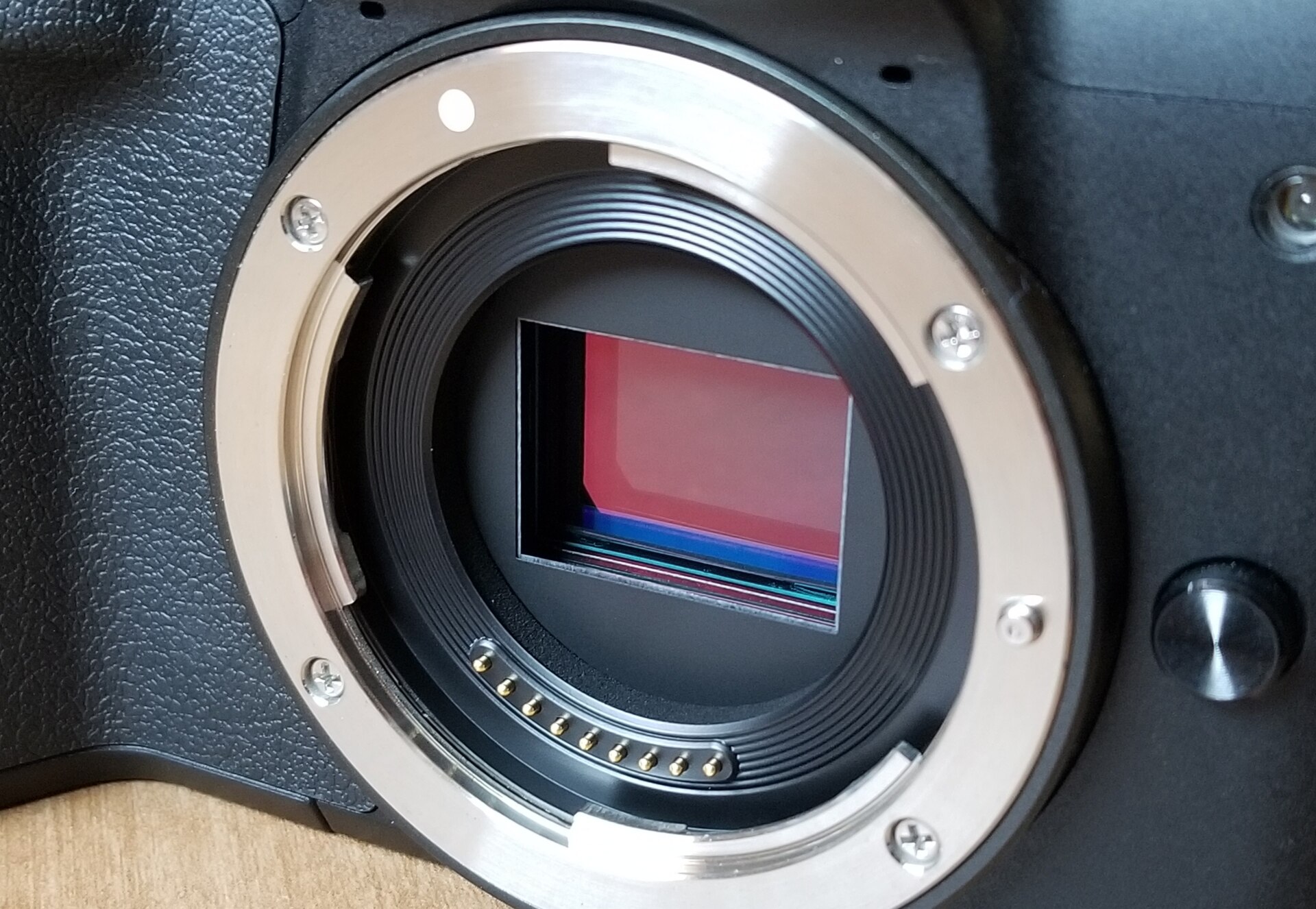
It also removed a major source of noise and vibration. With no mirror to flip, mirrorless cameras can shoot silently and sustain faster burst rates, and the electronic shutter can reach speeds that a mechanical focal-plane shutter cannot. Because the image sensor itself is now always active, it can do the autofocus work: phase-detection pixels embedded directly on the chip spread focus points across nearly the whole frame, and the sensor can be physically shifted for in-body image stabilization that steadies any lens you attach.
Full-frame mirrorless and the mount wars
Mirrorless design matured quickly. Sony introduced its NEX series on the E-mount in 2010, and in October 2013 the Sony a7 and a7R became the world’s first full-frame mirrorless interchangeable-lens cameras — a 24.3-megapixel a7 with on-chip phase detection, priced at $1,699 body-only. Canon and Nikon, whose DSLRs had defined the market, followed in 2018: Nikon announced the Z 7 and Z 6 with the new Z mount in August, and Canon answered days later with the EOS R and its RF mount in September.
Those new mounts were deliberate. With a short flange distance and wide throat diameters — Canon kept the RF mount at 54mm — the systems freed lens designers to build faster, sharper optics, including exotic glass such as Nikon’s f/0.95 Nikkor. The short flange distance also made mirrorless bodies ideal for adapting legacy lenses, which is why an entire ecosystem of mount adapters now connects vintage SLR glass to modern bodies.
What photographers gained
The payoff is visible across every style of shooting. Smaller, lighter kits make mirrorless cameras easier to carry for travel and street work. Silent electronic shutters suit weddings, wildlife, and documentary work. Full-frame autofocus coverage and real-time subject tracking — driven by the always-on sensor — make action and eye-tracking dramatically more reliable. And because the sensor is always live, video became a first-class feature rather than an afterthought, turning the same body into a capable stills and cinema tool.
Conclusion
The mirror was never the point of the camera — it was a workaround that let photographers preview a scene before digital sensors existed. Once sensors could feed a live image to a viewfinder, the mirror’s job was done, and its removal unblocked a wave of innovation that is still playing out. From the Panasonic G1’s 2008 debut to today’s full-frame flagships, mirrorless design shows what happens when an entire product category is rethought around its digital core rather than its mechanical past.
Frequently Asked Questions
What was the first mirrorless camera?
The Panasonic Lumix DMC-G1, unveiled at photokina in September 2008, is widely recognized as the world’s first mirrorless interchangeable-lens camera. It launched the Micro Four Thirds standard developed with Olympus.
Why are mirrorless cameras smaller than DSLRs?
Removing the reflex mirror and pentaprism shortens the flange focal distance and eliminates the mirror box, so the body can be thinner and lenses can be shorter and lighter.
Can I use DSLR lenses on a mirrorless camera?
Yes. Because mirrorless bodies have a short flange distance, mount adapters let you attach many legacy DSLR lenses — often with full autofocus and image stabilization preserved, depending on the adapter.
Related Posts

Camera Burst Speed and Buffer Explained: What Those FPS Numbers Really Mean
A cattle egret landing sequence, captured as a burst of…
Pixel Binning Explained: How Your Phone Camera Captures Brighter Low-Light Photos
If you've ever wondered why a 108-megapixel phone still saves…
Weather Sealing in Cameras Explained: IP Ratings, Seals & Limits
"Weather sealing" is one of the most heavily marketed —…