Fujifilm has just done something it has never attempted in the history of its GFX medium-format system. On March 20, 2025, the company announced the GFX100RF — the first fixed-lens camera ever to carry a 102-megapixel medium-format sensor. It is a compact, all-in-one body that promises the resolving power and tonal depth of medium format in a package you can actually carry every day.
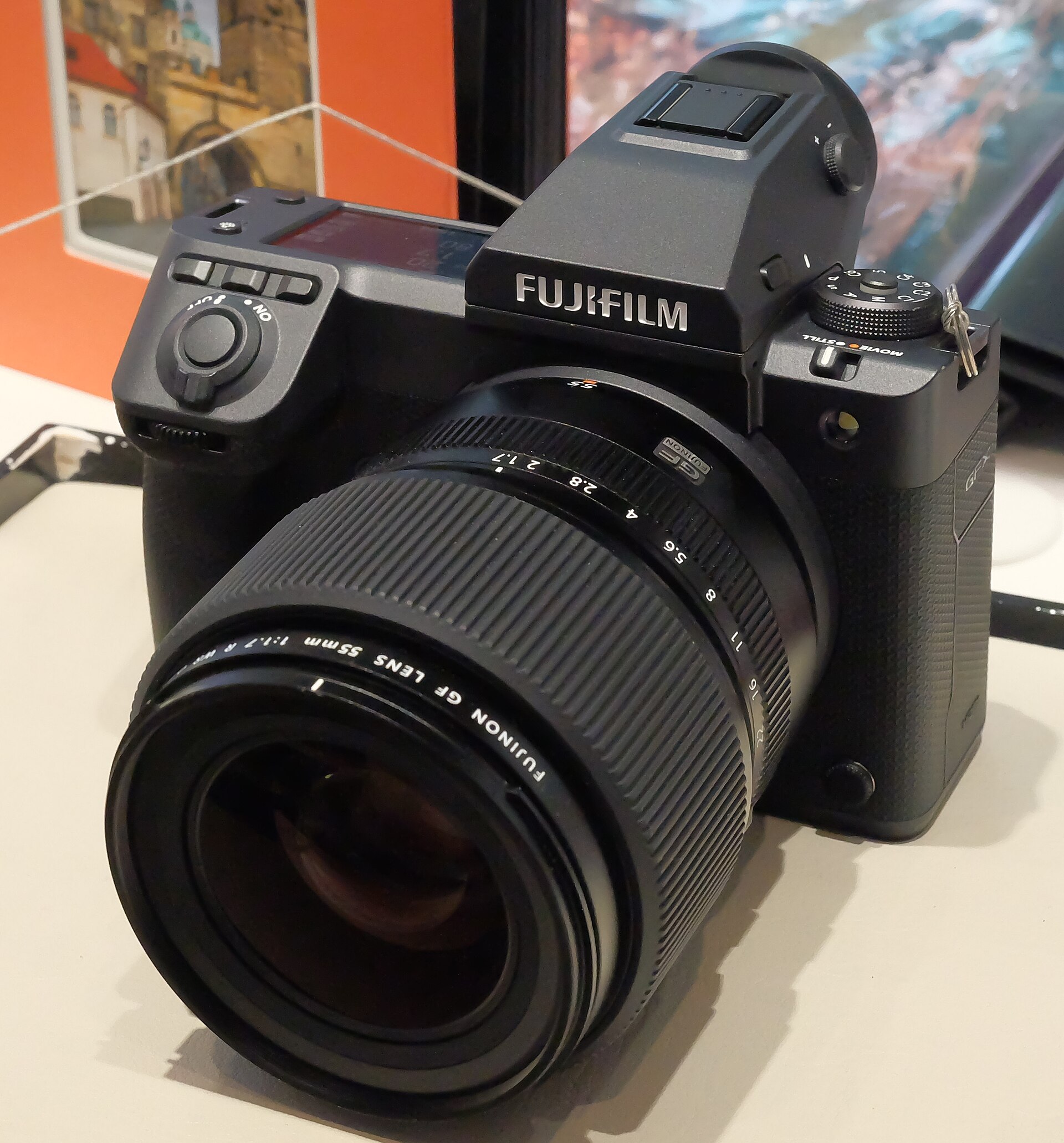
The significance is hard to overstate. Until now, shooting on Fujifilm’s GFX line has always meant buying a large camera body and at least one large, expensive lens. The GFX100RF collapses all of that into a single 735-gram body with a built-in lens, priced at $4,899.95 — the most affordable new route into Fujifilm’s 102MP sensor.
What Makes the GFX100RF Different
The GFX100RF is several “firsts” rolled into one. It is the first fixed-lens model in GFX System history, the lightest GFX camera ever made, and the first to feature a built-in neutral-density filter. At 735g (1.62 lb) with battery and card included, it weighs less than any previous GFX body without a lens attached — a striking figure for a camera whose sensor is roughly 1.7 times larger than a full-frame chip.
The built-in lens is a FUJINON GF 35mm f/4, which gives a 28mm-equivalent field of view on the medium-format sensor. It is the same everyday-carry focal length that made Fujifilm’s X100 series a cult favorite, now paired with a sensor far larger than the APS-C chip in those models. Fujifilm ships the camera in two finishes: an all-black version and one with a silver top plate.
Sensor, Lens, and Image Quality
At the heart of the GFX100RF is the GFX 102MP CMOS II HS sensor, a 43.8 x 32.9mm chip paired with the X-Processor 5 image engine — the same combination found in the flagship GFX100 II. It records 16-bit raw files and 10-bit HEIFs, with a base ISO of 80 that expands to 102,400. That native low ISO, combined with the oversized sensor, translates to clean shadows, enormous dynamic range, and detail that holds up to aggressive cropping.
A signature control on the top plate is a dedicated aspect-ratio dial offering nine framing ratios, plus a digital teleconverter that crops into the sensor for 35mm, 50mm, and 63mm-equivalent fields of view. Even after a heavy crop you are left with a large number of working megapixels. The trade-off is the f/4 maximum aperture and the lack of in-body image stabilization — a deliberate choice Fujifilm made to keep the body compact.
Build, Handling, and Controls
The GFX100RF borrows its handling language from the X100 series. It features a 5.76-million-dot OLED electronic viewfinder and a 3.2-inch, 2.1-million-dot three-way tilting touchscreen, along with the full set of 20 Film Simulation modes and a Q Menu for fast adjustments. A built-in four-stop ND filter and a leaf shutter are included, the latter enabling quiet shooting and flash sync at any shutter speed.
Battery life is rated at 820 shots on the CIPA standard — genuinely strong for a 100-megapixel camera — and the body measures a relatively compact 133.5 x 90.4 x 76.5mm. Subject-detection autofocus covers humans, animals, and vehicles, representing Fujifilm’s most capable AF to date in a GFX camera.
Video and Performance
For stills, the GFX100RF shoots continuously at up to 6fps with autofocus, sustaining bursts of around 296 JPEGs or 40 raw files. Video tops out at 4K 30p in 4:2:2 10-bit All-Intra with bitrates up to 720Mbps, and ProRes recording is available to an external SSD at up to 60fps. There is no sensor-shift stabilization, but a digital stabilization mode is available for video to smooth handheld footage.
Price, Availability, and Who It’s For
The GFX100RF carries a Manufacturer’s Suggested Retail Price of $4,899.95 (about £4,699 / AU$8,799 / CA$6,999), with availability beginning in late April 2025. That is cheaper than the full-frame Leica Q3 and less than the GFX100S II body alone, which shares the same sensor but ships without a lens. The camera was later recognized with the Photographic Society of Japan’s 2026 Technical Award.
It is not a camera for everyone. The fixed 28mm-equivalent lens, f/4 aperture, and absence of stabilization keep it firmly in specialist territory — street, documentary, travel, and portrait photographers who prize resolution and dynamic range above all else, and who are happy to work within a single focal length’s discipline.
Conclusion
The GFX100RF is a statement of intent from Fujifilm. It takes the two ideas the company has spent years refining — the everyday-carry ethos of the X100 and the uncompromising sensor of the GFX100 II — and fuses them into one camera. For the right photographer, it is the most compelling argument yet that medium format no longer has to mean heavy.
Frequently Asked Questions
Does the GFX100RF have interchangeable lenses?
No. The GFX100RF uses a fixed FUJINON GF 35mm f/4 lens, equivalent to 28mm on full frame, and is the first fixed-lens camera in the GFX System.
How much does the Fujifilm GFX100RF cost?
The GFX100RF is priced at $4,899.95 in the United States, roughly £4,699 in the UK and AU$8,799 in Australia, with availability starting in late April 2025.
Does the GFX100RF have image stabilization?
It has no in-body or optical stabilization. A digital stabilization mode is available for video recording only, so handheld stills at slower shutter speeds require steady technique.
Related Posts

Smartphone Camera Trends for 2026: Bigger Sensors, Variable Aperture, and AI
For years, the smartphone camera race was defined by a…
Sony LYT-901: The First 200MP Smartphone Sensor with Built-in AI
Sony has officially entered the 200-megapixel race. On November 27,…