Disclosure: This article contains affiliate links. If you buy through them, we may earn a commission at no extra cost to you.
The Fujifilm X-M5 is the smallest and most affordable camera in Fujifilm’s current X Series — and one of the most surprising. Announced in October 2024 at just $799.95 (body only), it pairs Fujifilm’s proven 26.1MP X-Trans CMOS 4 sensor with the latest X-Processor 5 image engine. The result is a tiny, screen-only mirrorless body that inherits the AI-powered autofocus, 20 Film Simulations, and 10-bit 6.2K video found in far pricier Fuji cameras like the X100VI and X-H2S. There’s no viewfinder and no in-body stabilization, so it isn’t for everyone — but for vloggers and content creators who shoot from a flip-out screen, the X-M5 delivers flagship-grade color and video for a fraction of the cost.
What Makes the X-M5 Special
- 26.1MP APS-C X-Trans CMOS 4 sensor — the same back-illuminated imaging core found in the X-T4 and X-S20
- X-Processor 5 with AI subject-detection autofocus, borrowed from the X100VI and X-T50
- 6.2K open-gate 10-bit video and 4K/60p in a body that costs less than $800
- 20 Film Simulation modes, including the newer Reala ACE
- A 355 g body just 38 mm deep, with a fully articulating selfie-friendly touchscreen
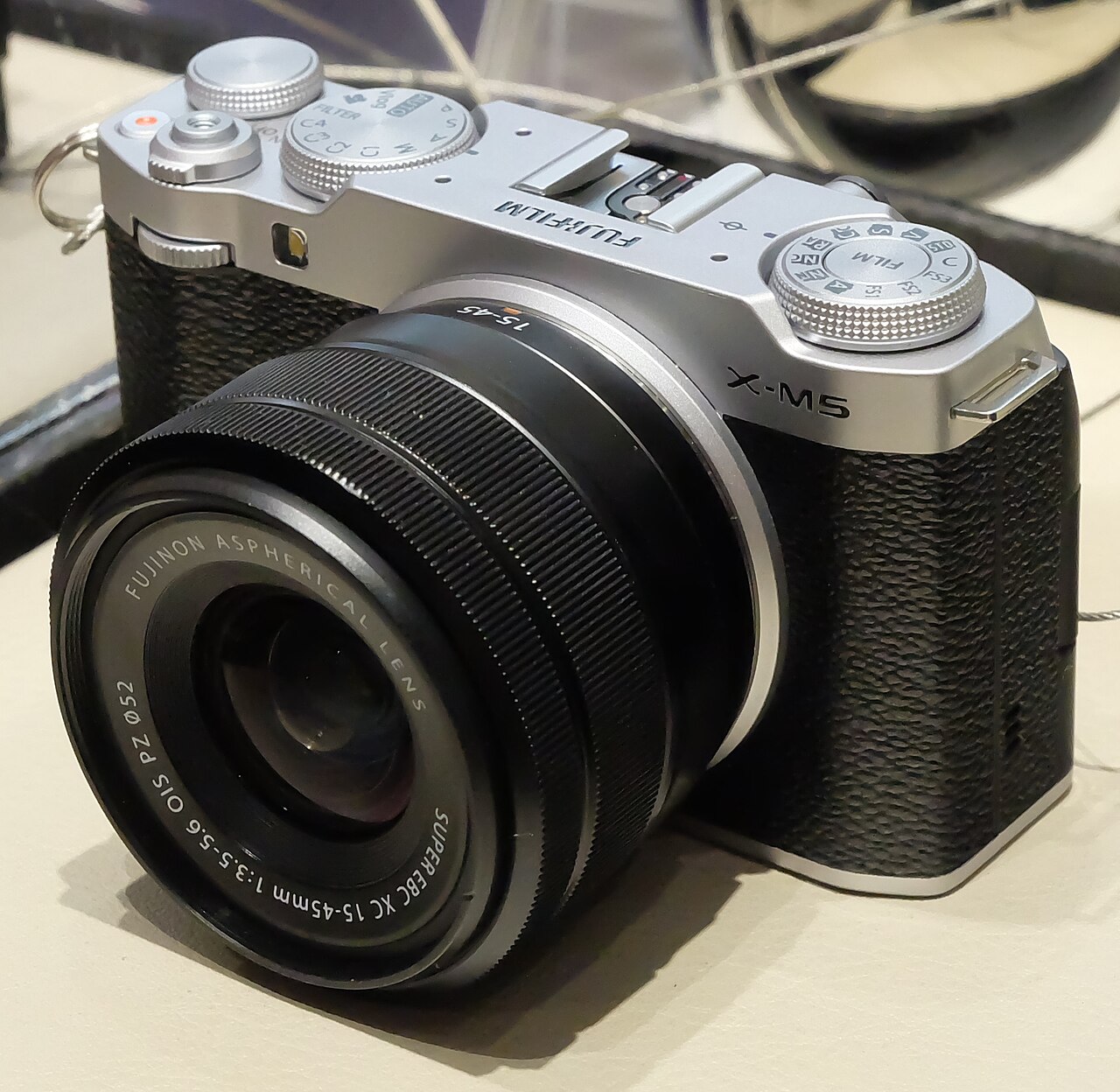
Image Quality
At the heart of the X-M5 is the 26.1MP back-illuminated X-Trans CMOS 4 sensor — the same chip that powered the X-T4. It isn’t Fujifilm’s newer 40MP X-Trans CMOS 5 HR sensor, so you don’t get the enormous cropping headroom of the X-T5 or X100VI, but 26 megapixels is more than enough for social media, prints up to around A2, and 4K/6K video. The sensor has no optical low-pass filter, so fine detail stays crisp, and Fujifilm’s signature color science is on full display. The 20 Film Simulations — from Classic Chrome and Classic Neg to the newer Reala ACE — let you bake a finished look straight into the JPEG, which is exactly what casual shooters and creators want. The main caveat is the absence of in-body image stabilization: in low light you’ll lean on lens OIS (like the XC 15-45mm’s) or a steady hand.
Autofocus & Speed
This is where the X-M5 punches far above its price. The X-Processor 5 gives it the same AI subject-detection autofocus as the X100VI and X-T50, spread across 425 phase-detect points. It reliably locks onto faces and eyes, and can also detect animals, birds, cars, motorcycles, bicycles, airplanes, trains, insects, and drones. For a camera aimed at vloggers who film themselves, the face/eye tracking is the star of the show — it holds focus even as you move around the frame. Burst shooting tops out at 8 fps with the mechanical shutter, 20 fps with the electronic shutter at full width, and 30 fps with a 1.25x crop — genuinely quick for an entry-level body.
Video
For video, the X-M5 is seriously over-equipped for its price. It records 6.2K 3:2 open-gate footage up to 30p, oversampled 4K up to 60p (with a crop), and Full HD up to 240p for slow motion — all in 4:2:2 10-bit internally with F-Log and F-Log2 for grading. A 3.5mm mic input and a 3.5mm headphone jack (rare at this price) make it a legitimate video tool, not just a toy. The open-gate 6.2K mode is especially nice for creators who want to punch out both vertical and horizontal cuts from a single take. The one thing missing is in-body stabilization: you get digital IS only, so handheld walking shots are shakier than on an IBIS-equipped body like the X-S20.
Design & Handling
The X-M5 is tiny — 111.9 × 66.6 × 38 mm and 355 g with battery and card, making it the lightest camera in the current X Series. It’s genuinely pocketable in a jacket when paired with a pancake lens. The 3.0-inch, 1.04-million-dot touchscreen is fully articulating, so it flips around for selfie shooting and vlogging; it’s bright and responsive, though its resolution is lower than the 1.84M-dot panels on pricier Fuji bodies. There’s no EVF, so you compose entirely on the screen — fine for video, more of a compromise for bright-sunlight stills. You get a single UHS-I SD slot, USB-C, micro-HDMI, and mic/headphone jacks. The NP-W126S battery is rated for about 330 shots (440 in Eco mode), so budget for a spare on a long day. It ships in silver (November 2024) and black (April 2025).
Full Specifications
| Specification | Detail |
|---|---|
| Sensor | 26.1MP APS-C X-Trans CMOS 4 (BSI), 23.5 × 15.6 mm |
| Processor | X-Processor 5 |
| Lens mount | Fujifilm X |
| Image stabilization | None (digital only) |
| Autofocus | 425-point phase-detect + AI subject detection |
| Continuous shooting | 8 fps mechanical; 20 fps electronic; 30 fps (1.25x crop) |
| ISO range | 125–12,800 standard (expandable to 51,200) |
| Shutter | 30s–1/4000s mechanical; up to 1/32,000s electronic |
| Video | 6.2K 3:2 up to 30p; 4K up to 60p; FHD up to 240p; 4:2:2 10-bit; F-Log/F-Log2 |
| Screen | 3.0″ fully articulating touchscreen, 1.04M-dot |
| Viewfinder | None |
| Film Simulations | 20 (incl. Reala ACE) |
| Storage | Single SD UHS-I slot |
| Ports | USB-C, micro-HDMI, 3.5mm mic, 3.5mm headphone |
| Battery | NP-W126S; ~330 shots CIPA (440 Eco) |
| Dimensions | 111.9 × 66.6 × 38 mm |
| Weight | 355 g (with battery & card) |
| Price | $799.95 body only; $899.95 with XC 15-45mm |
X-M5 vs. the Competition
| Fujifilm X-M5 | Sony ZV-E10 II | Nikon Z30 | |
|---|---|---|---|
| Price (body) | $799.95 | $999 | $706.95 |
| Sensor | 26.1MP APS-C X-Trans 4 | 26MP APS-C BSI CMOS | 20.9MP APS-C CMOS |
| Max video | 6.2K/30p, 4K/60p | 4K/60p (oversampled) | 4K/30p |
| Video bit-depth | 10-bit 4:2:2 | 10-bit | 8-bit |
| Burst | 8 fps mech / 20–30 fps elec | 11 fps (no mech shutter) | 11 fps |
| Viewfinder | None | None | None |
| Screen | 3.0″ 1.04M-dot vari-angle | 3.0″ 1.04M-dot vari-angle | 3.0″ 1.04M-dot vari-angle |
| IBIS | None | None | None |
| Weight | 355 g | 377 g | 405 g |
| Battery (CIPA) | ~330 (440 Eco) | ~610 | ~330 |
The X-M5’s closest rivals are the Sony ZV-E10 II and the Nikon Z30 — both screen-only APS-C bodies aimed at creators. The Sony counters with a bigger battery, polished vlogging touches like Product Showcase AF and S-Cinetone, and oversampled 4K/60p, but it costs about $200 more. The Nikon Z30 undercuts both on price yet is the oldest of the three: 20.9MP, 8-bit video, and 4K/30p only. In the middle, the X-M5 offers the densest video spec (6.2K open gate, 10-bit), Fujifilm’s color, and the fastest subject-detection autofocus of the group.
Verdict
The Fujifilm X-M5 is the best-value compact APS-C camera for creators right now. It gives you Fujifilm’s colors, genuinely capable AI autofocus, and 10-bit 6.2K/4K video in a 355 g body for under $800. The trade-offs — no EVF, no IBIS, a single UHS-I slot, and a lower-res screen — are exactly the compromises you’d expect at this price, and none of them will bother a vlogger shooting from a flip-out screen. If you need a viewfinder or stabilization, step up to the X-S20; if you want the smallest, cheapest route into Fujifilm’s X-mount ecosystem with flagship-grade video, the X-M5 is the easy pick.
What Amazon Buyers Say
The X-M5 holds a 4.7 out of 5 stars average from 19 global ratings on Amazon (silver body listing) — a small sample, but strongly positive. Here’s how the ratings break down:
| Star rating | Share of reviews |
|---|---|
| 5 stars | 75% |
| 4 stars | 17% |
| 3 stars | 8% |
| 2 stars | 0% |
| 1 star | 0% |
Amazon’s “Customers say” summary finds buyers “find the camera’s build quality highly impressive and appreciate its compact design,” while noting “the image quality receives mixed feedback.” Here are a few verbatim excerpts from verified reviews:
“Compact and pro”
“The build quality is solid and feels great in hand…”
“…Cons: No EVF (a big shortcoming), too tiny screen text (very hard to read for elders, especially under direct sunlight), very limited image…”
Read all customer reviews on Amazon
FAQ
Does the X-M5 have in-body image stabilization (IBIS)?
No. The X-M5 relies on digital stabilization for video and lens-based OIS for stills. If you need IBIS, consider the Fujifilm X-S20 or X-T50 instead.
Does the X-M5 have a viewfinder?
No — the X-M5 is a screen-only body, so you frame everything on its 3.0-inch vari-angle touchscreen. If an EVF is essential, look at the X-E5 or X-T50.
Is the X-M5 good for vlogging?
Yes. Its flip-out screen, reliable face/eye tracking, 6.2K 10-bit video, and dedicated mic and headphone jacks make it one of the best-value vlogging bodies around — though the lack of IBIS means you’ll want a gimbal or steady hand for walking shots.
Related Posts
Canon RF 70-200mm f/2.8 L IS USM Z Review (2026): The Hybrid Telephoto Rebuilt for Video
Disclosure: This article contains affiliate links. If you buy through…
Fujifilm X-H2S Review (2026): The APS-C Speed King with 40fps and 6.2K ProRes
Disclosure: This article contains affiliate links. If you buy through…
Panasonic Lumix S5 II Review: The Full-Frame Hybrid That Finally Nailed Autofocus
Disclosure: This article contains affiliate links. If you buy through…