If you have ever shopped for a speedlight, you have seen spec lines like “Guide Number: 60 (m, ISO 100)” or “GN 28m @ 50mm” and probably wondered what they actually tell you. A guide number is the closest thing flash makers give us to a power rating — but it is not a brightness figure like lumens, and it is not a power figure like watt-seconds. It is a tool for working out correct manual flash exposure, and it is far simpler than it looks.
What Is a Guide Number?
A guide number (GN) is simply the product of two values that together produce a correct exposure: the f-number and the distance from the flash to the subject. In other words, GN = f-number × distance. A flash with a guide number of 40 (in meters) will correctly expose a subject 5 meters away at f/8 (because 5 × 8 = 40), or a subject 10 meters away at f/4 (10 × 4 = 40). Same flash, same ISO, same beam position — just a different pairing of aperture and distance that multiplies to the same constant.
Three things always matter when you read a guide number: the unit (meters or feet), the ISO (almost always 100), and the zoom position of the flash head. Because all three change the number, a bare “GN 60” is meaningless without them.
The Formula in Practice
Once you know a flash’s guide number for your ISO and zoom setting, exposure math becomes a single division:
- Aperture = GN ÷ distance
- Distance = GN ÷ f-number
Suppose your flash has a GN of 36 (meters, ISO 100). With the subject 4 meters away, 36 ÷ 4 = 9, so f/9 is your starting aperture. Move the subject to 6 meters and you need 36 ÷ 6 = f/6.3. Want to shoot wide open at f/4? Your maximum working distance is 36 ÷ 4 = 9 meters.
This works because of a convenient coincidence in physics. Light falls off with the inverse square law — double the distance and you get one quarter of the light (a two-stop drop). Aperture numbers, meanwhile, step by a factor of √2 per stop. Those two square-root relationships cancel each other out, leaving the simple product of aperture × distance as a constant. The guide number just encodes that constant for one flash, one ISO, and one beam spread.
Why the Zoom Head Position Changes Everything
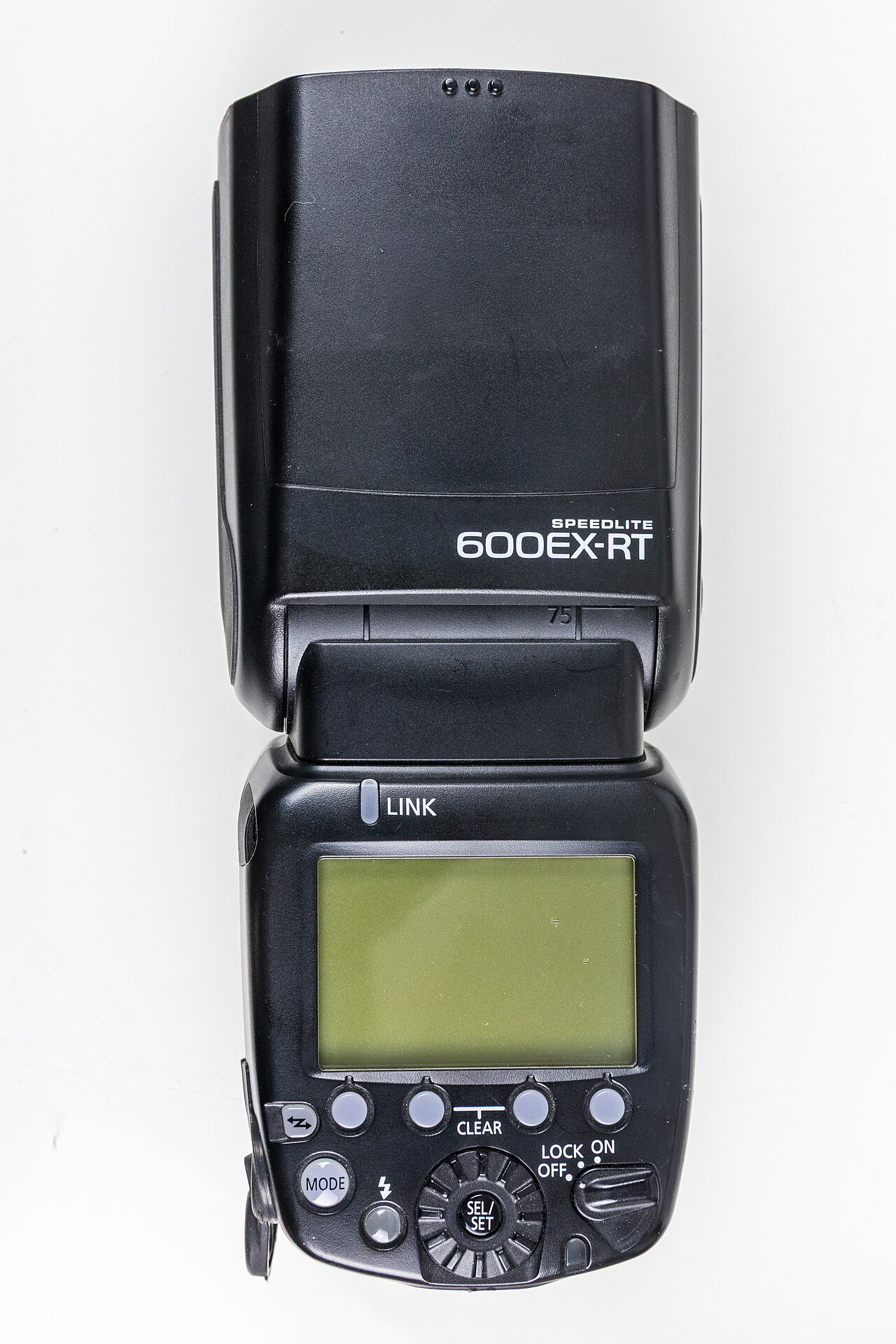
Speedlights concentrate their beam as you zoom the head to match longer focal lengths. A tightly focused beam throws light farther, so the same physical output reads as a higher guide number. That is why the Canon Speedlite 600EX-RT is rated at GN 60 (m, ISO 100) at its 200 mm zoom setting, while Nikon’s SB-5000 lists GN 34.5 m at 35 mm — neither number is wrong, they were simply measured at different zoom positions. Two flashes can have nearly identical real output yet wildly different published guide numbers purely because of where the beam was aimed when measured.
The round-head Godox V1 is the classic example: it carries a modest-looking GN 28 m (ISO 100, 50 mm) despite being a very capable flash. Its round head spreads light broadly instead of focusing it into a hot spot, so it reads lower than a fresnel-head speedlight of similar energy.
Guide Number vs. Watt-Seconds
Do not confuse a guide number with watt-seconds (Ws), the energy rating used on studio strobes and on Godox’s AD-series lights. Watt-seconds measure stored electrical energy; the guide number measures the resulting light reaching a subject at a distance, which depends on the reflector, the zoom, and any modifier. A 200 Ws Godox AD200 with a fixed 35 mm head has a GN of roughly 52 (m, ISO 100), while a 76 Ws Godox V1 rates GN 28 at 50 mm — nearly three times the energy, but less than twice the guide number. Neither figure tells the whole story on its own: GN is more useful for on-camera distance math, while Ws is better for comparing raw output between strobes.
Adjusting GN for ISO
Published guide numbers assume ISO 100. Change the ISO and the effective GN scales with the square root of the ISO ratio:
new GN = GN × √(new ISO ÷ old ISO)
Double the ISO from 100 to 200 and the effective guide number grows by about 1.4×; jump to ISO 400 and it doubles. That is why raising ISO is the fastest way to extend a flash’s reach. Bounce the flash off a ceiling or fit a diffuser, and the effective GN drops sharply — diffusion costs stops of light, so either recalculate or switch to TTL and let the camera meter through the modifier.
Using GN in the Real World
Manual flash with a guide number shines when the flash-to-subject distance stays fixed — portraits, product shots, and still life. Measure the distance, divide the GN by it, dial the aperture, and you get a consistent exposure shot after shot. For a moving subject or a constantly changing distance, TTL metering is almost always more practical — but knowing the guide number still tells you whether your flash has the reach for the job, and it is the spec to compare when you are buying.
Conclusion
The guide number is not a mysterious spec — it is a one-line exposure formula dressed up as a number. Remember “GN = aperture × distance,” check the unit, ISO, and zoom, and you can work out correct flash exposure with nothing but division. The next time you see “GN 60” on a flash box, you will know exactly what it is really telling you.
FAQ
What does a guide number actually measure?
It is the product of f-number and distance that gives a correct exposure at a given ISO and zoom setting. A higher GN means more light reaches the subject — either more reach at the same aperture, or a smaller aperture at the same distance.
Why does the same flash list different guide numbers in different places?
Because GN depends on the beam/zoom position, the ISO, and the unit (meters vs. feet). Always compare guide numbers at the same ISO, zoom, and unit.
How do I convert a guide number from meters to feet?
Multiply by 3.28. A GN 40 in meters is roughly GN 131 in feet.
Is a higher guide number always better?
Not necessarily. It means more power or reach, but for close-up work a high-GN flash may simply need to be turned down. For bounce and diffused lighting, however, extra power headroom is genuinely useful.
Related Posts
Megapixels Explained: How Many Do You Actually Need in 2026?
Ask almost any beginner what makes a camera good and…

Macro Photography: A Complete Guide to Close-Up Shooting
Macro photography opens up a world the naked eye barely…
Metering Modes Explained: How Your Camera Measures Light
Before your camera can set a correct exposure, it has…