Blurry photos and shaky video share one root cause: camera movement. Your hands tremble and walking turns every step into a bounce. Image stabilization exists to cancel that motion before it ruins the shot — but it comes in three very different flavors: Optical Image Stabilization (OIS), In-Body Image Stabilization (IBIS), and Electronic Image Stabilization (EIS). They sound interchangeable, yet each moves different parts and fixes different kinds of shake. Here’s what each does and how to choose.
What Image Stabilization Actually Fights
Camera shake isn’t one thing. It’s a spectrum of motion: high-frequency tremor from your hands and breathing, medium-frequency rolling as you tilt or pan, and low-frequency bobbing from walking. A stabilization system can only correct motion within its physical or digital range — which is why no single system fixes everything.
OIS — Optical Image Stabilization (in the Lens)
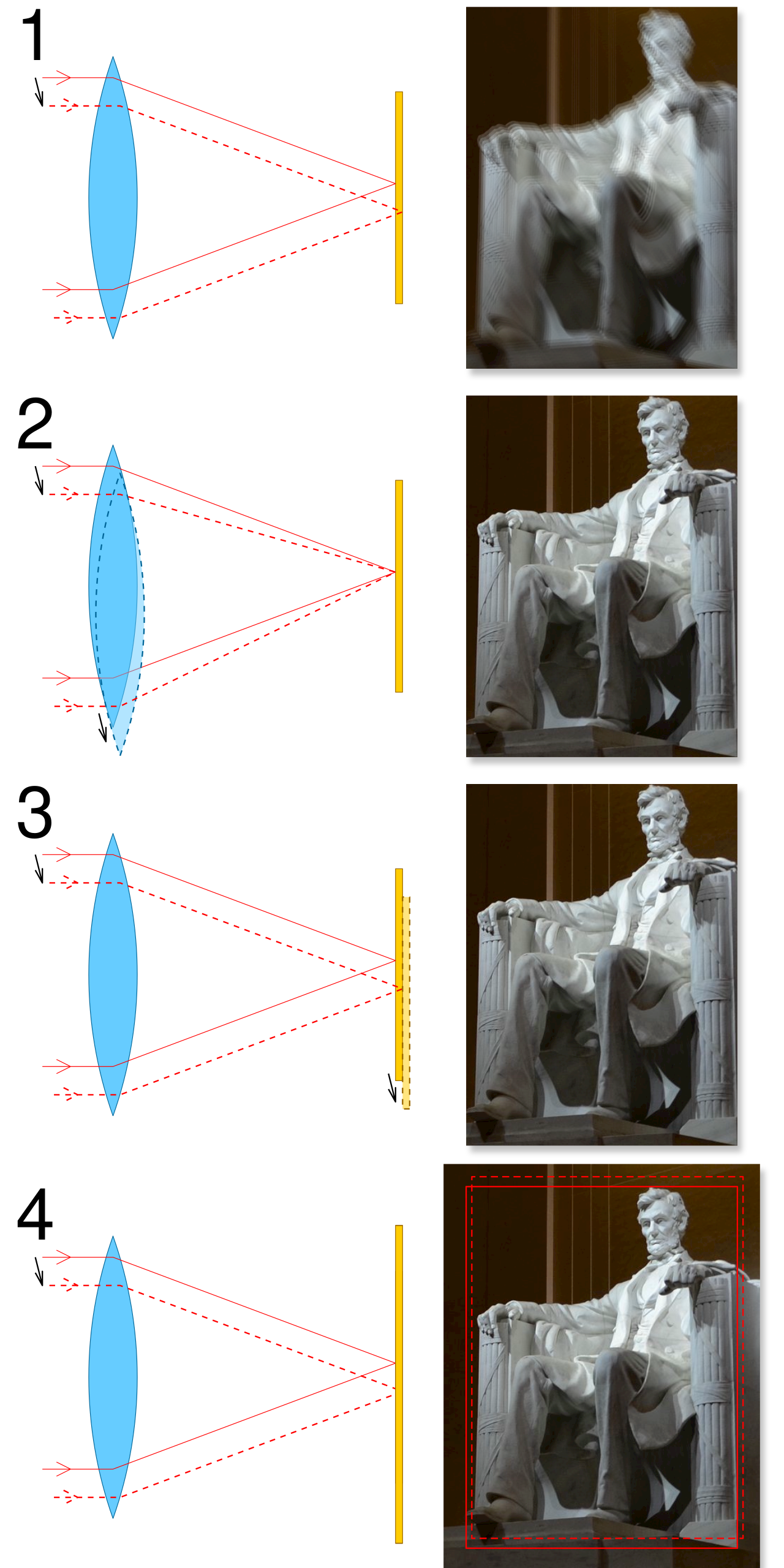
Optical Image Stabilization moves a group of lens elements, not the camera. Tiny gyroscopes detect pitch and yaw, and a motor shifts a “compensation group” sideways to keep the image steady on the sensor. Because the correction happens before light reaches the sensor, OIS also steadies your viewfinder, which helps you frame the shot. It works especially well at long focal lengths, where a small angular wobble becomes a big shift in the image — which is why telephoto lenses lean on it so heavily. It also helps still photos in low light by allowing slower shutter speeds. Typical OIS lenses carry a CIPA rating of three to five stops. The catch: it’s built into specific lenses, so you pay for it again with every lens you buy.
IBIS — In-Body Image Stabilization (in the Sensor)
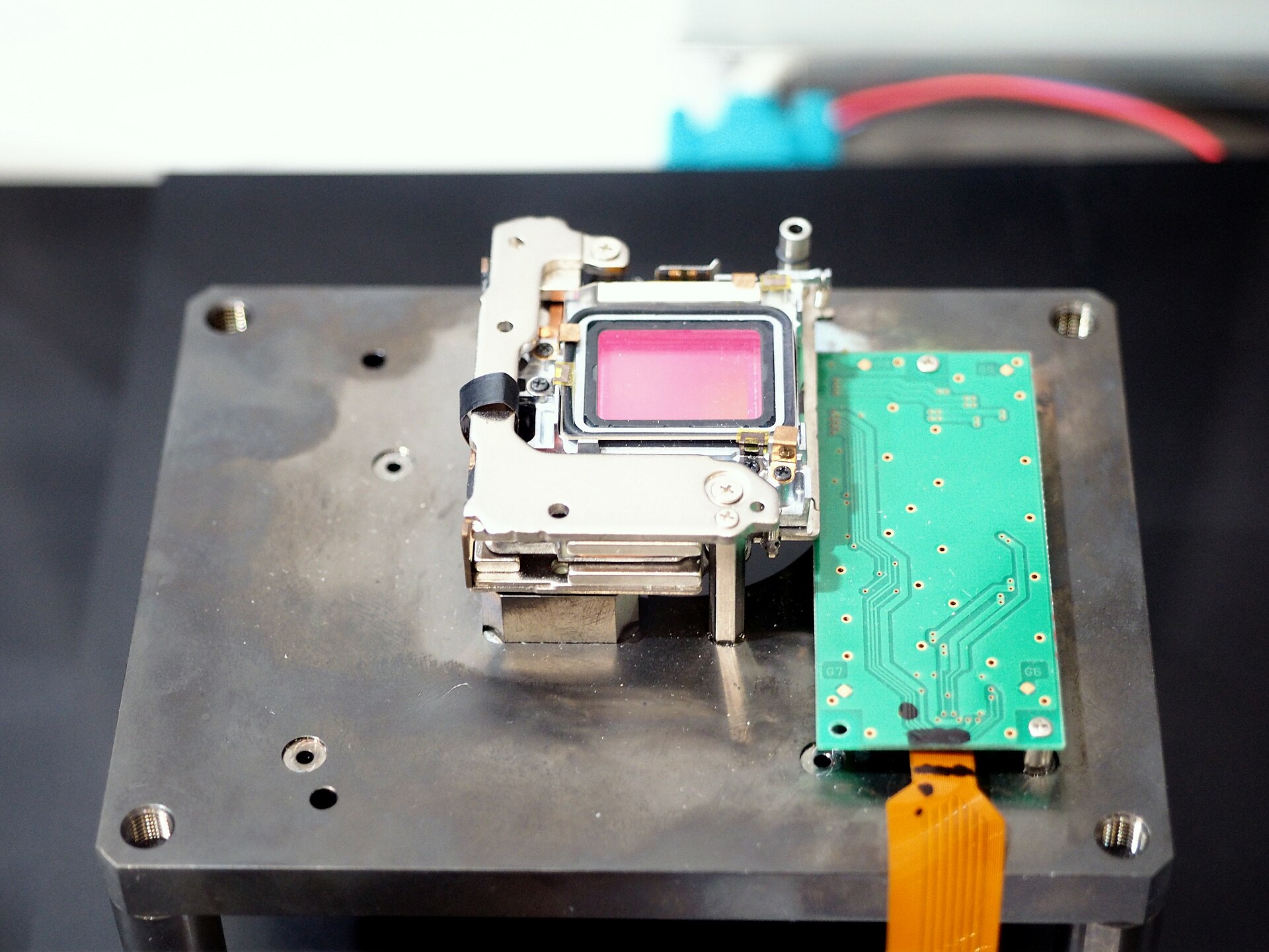
In-body stabilization moves the sensor itself. The sensor floats on a magnetic platform and shifts across five axes — pitch, yaw, roll, plus horizontal and vertical translation — to chase the scene. Olympus popularized 5-axis IBIS with its OM-D line in 2012, and today Sony, Canon, Nikon, Panasonic, and Fujifilm all ship it in mirrorless bodies. The killer advantage is universality: one stabilized body steadies every lens you mount, including old manual primes with no electronics at all. IBIS also corrects roll — rotation around the lens axis — which lens-based OIS handles poorly, and it enables pixel-shift high-resolution modes on some cameras. Ratings commonly land between five and seven stops. Its limit: at very long focal lengths the sensor physically can’t travel far enough, so lens-based OIS still wins there.
EIS — Electronic Image Stabilization (in Software)
Electronic stabilization moves nothing physical. The camera captures a slightly wider frame than it shows, then software uses gyro data and frame-to-frame analysis to shift and crop the output so the scene looks steady. It’s cheap, needs no dedicated hardware, and it’s the dominant technology in smartphones and action cameras — GoPro’s HyperSmooth, DJI’s RockSteady, and Insta360’s FlowState are all EIS under the hood. Because EIS can crop and warp aggressively, it’s the best in-camera tool for big walking motion. The trade-offs are real: you lose roughly 5–20% of your field of view, edge warping or a “jelly” wobble can appear with rolling-shutter sensors, and EIS does nothing for still photos because it needs multiple frames to work.
When the Systems Team Up
The smoothest footage comes from combining systems. Dual or Sync IS pairs a stabilized lens with an IBIS body — Canon’s Coordinated IS, Panasonic’s Dual I.S., and Nikon’s Synchro VR all coordinate lens and sensor, reaching up to 8.5 stops. Meanwhile, video modes labeled “Active,” “Boost,” or “Super Steady” stack EIS on top of IBIS to tame the walking motion that mechanical systems can’t follow — at the cost of a tighter crop. One practical note: on a tripod, switch stabilization off entirely, since an IS system can fight its own micro-vibrations and introduce blur.
Which One Should You Choose?
Match the system to the job. Shooting stills in low light or at long telephoto? Prioritize OIS or IBIS. Shooting handheld video while walking? Use IBIS plus an Active/EIS mode — and compensate for the crop with a wider lens. Adapting old or unstabilized glass? A body with IBIS stabilizes all of them. And if none of it is enough for fast-moving action, a mechanical gimbal is the only thing that fully replaces steady hands. As a rule of thumb: IBIS buys the most flexibility per dollar, OIS wins at telephoto, and EIS wins for walking video.
Conclusion
Image stabilization is really three answers to the same question. OIS moves the lens, IBIS moves the sensor, and EIS moves the frame in software — and each one owns a different part of the shake spectrum. Once you know what motion you’re fighting, the right tool becomes obvious: OIS for telephoto and low light, IBIS for lens flexibility, EIS for walking video, and two or three of them together for the smoothest handheld footage a camera can produce.
FAQ
Is IBIS better than OIS?
Not universally. IBIS works with every lens and adds roll correction, while OIS reaches further at long focal lengths and steadies the viewfinder. Many cameras use both together.
Does image stabilization help still photos, or only video?
Both OIS and IBIS help still photos by letting you use slower shutter speeds in low light without blur — that’s what a “stop” of stabilization measures. EIS, however, is video-only: it needs multiple frames, so it can’t sharpen a single still.
Can EIS replace a gimbal?
For casual walking shots, often yes. But aggressive EIS crops the frame, can introduce warping, and can’t match a gimbal for fast pans or running. If your work depends on smooth footage, a gimbal still has no in-camera equal.
Related Posts
Backside-Illuminated (BSI) vs Frontside-Illuminated Sensors: What’s the Difference?
Scroll through the spec sheet of any modern camera or…
Pixel Binning Explained: How Your Phone Camera Captures Brighter Low-Light Photos
If you've ever wondered why a 108-megapixel phone still saves…

Camera Dynamic Range Explained: What Stops Really Mean (and Why They Matter)
Every photographer has hit the same wall: a scene the…