Every digital camera is built around one component that shapes more of the final image than any other: the image sensor. Three formats dominate the market today — full-frame, APS-C, and Micro Four Thirds — and the differences between them explain most of what you pay for when you buy a camera. Here’s a practical comparison of their dimensions, crop factors, and the trade-offs that actually show up in your photographs.
The three formats at a glance
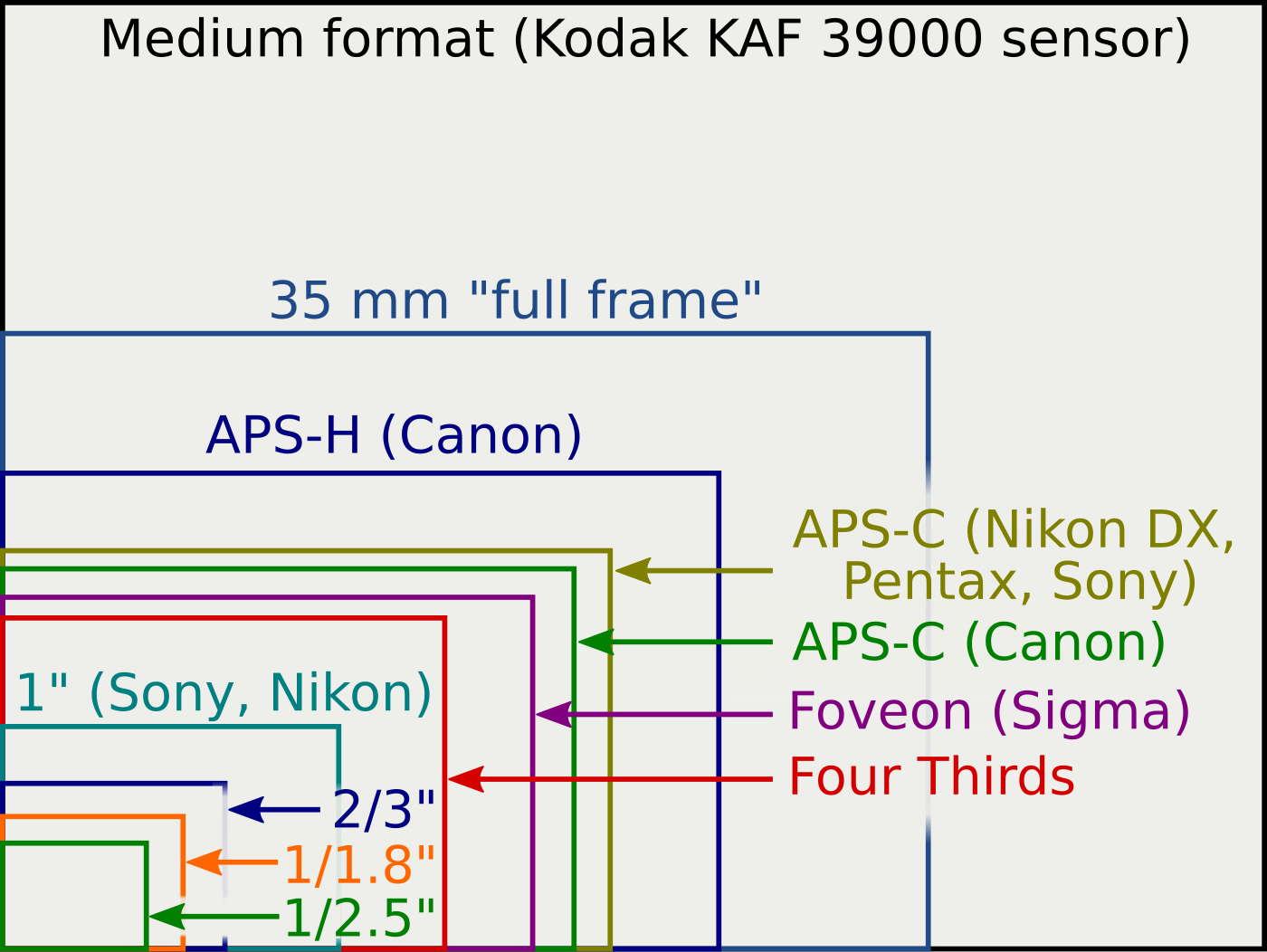
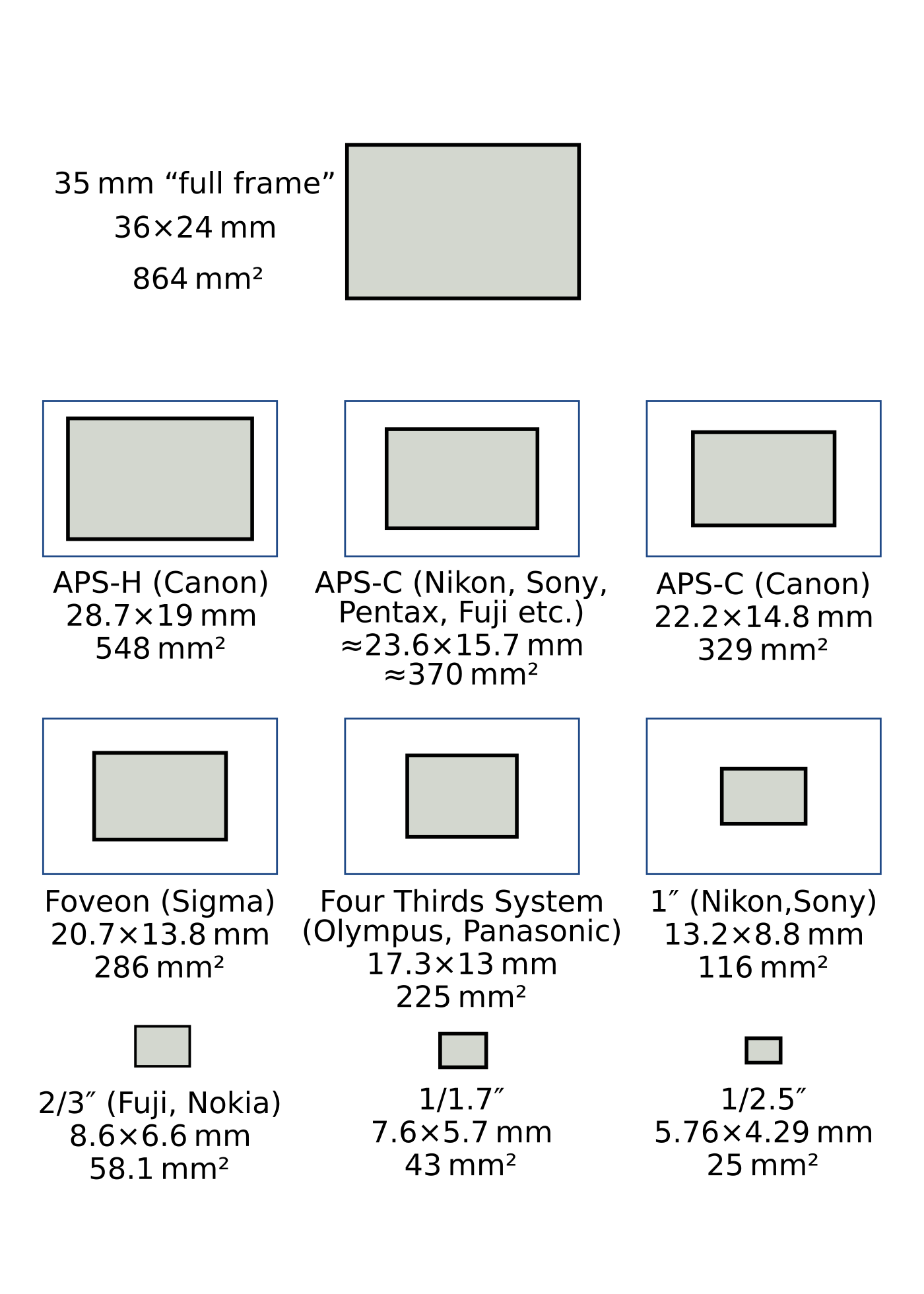
- Full frame — 36 × 24 mm. Matches the classic 35 mm film frame, with a diagonal of about 43.3 mm and a crop factor of 1.0×. It’s the “reference” format found in cameras like the Canon EOS R5 II, Sony a7 IV, Nikon Z8, and Panasonic Lumix S5 II.
- APS-C — roughly 23.5 × 15.6 mm. Sony, Nikon, and Fujifilm use this size with a 1.5× crop factor; Canon’s version is slightly smaller at 22.3 × 14.9 mm with a 1.6× crop. It covers about 42% of the full-frame area (around 39% on Canon). You’ll find it in the Sony a6700, Fujifilm X-T5, Nikon Z50 II, and Canon EOS R7.
- Micro Four Thirds — 17.3 × 13 mm. A 2.0× crop factor and a squarer 4:3 aspect ratio, at roughly 26% of the full-frame area. The standard was created in 2008 by Panasonic and Olympus (now OM System) and powers cameras such as the Panasonic Lumix G9 II and GH7, and the OM System OM-1 II.
What crop factor actually means
A lens’s focal length never changes — what changes is how much of its image circle the sensor captures. The crop factor converts any focal length to its 35 mm equivalent so you can compare framing across formats. A 24 mm lens on a 1.5× APS-C body frames like a 36 mm lens on full frame, while a 25 mm lens on Micro Four Thirds (2×) frames like a 50 mm. Remember that equivalent framing is not the same as an equivalent look: depth of field and total light also scale, which is why the next section matters.
Depth of field and low-light performance
At the same framing and f-number, a larger sensor produces shallower depth of field, giving you more background blur and subject separation. It also gathers more total light, which typically means less noise and better dynamic range in dim conditions. A Micro Four Thirds lens at f/1.8 gives roughly the depth of field of a full-frame lens at f/3.6 — just multiply the f-number by the crop factor. That separation is exactly why full frame remains the favourite for portraits and weddings, while smaller sensors need faster, longer lenses to match the look.
Size, weight, and price
Bigger sensors demand bigger bodies — and, more importantly, bigger and heavier lenses. Micro Four Thirds kits are dramatically lighter and more compact; APS-C sits in the middle and is usually the best value for money; full frame carries the largest cost and bulk. When you compare systems, judge the whole kit you’ll actually carry, not just the camera body.
Telephoto reach and other practical differences
The crop factor works in your favour for long lenses. A 400 mm lens on Micro Four Thirds frames like an 800 mm on full frame, which is why wildlife and bird photographers often prefer APS-C or Micro Four Thirds — they get far more reach per gram and per dollar. Video shooters also value the compact, highly stabilised Micro Four Thirds bodies such as the GH7 for run-and-gun work.
Which sensor size should you choose?
- Full frame — maximum image quality, the shallowest depth of field, and the strongest low-light performance. Ideal for professional portraits, weddings, and landscape work.
- APS-C — the sweet spot for most enthusiasts: excellent quality, lower cost and bulk, plus useful extra telephoto reach.
- Micro Four Thirds — the winner for travel, video, wildlife, and maximum portability, with the smallest and most affordable lenses.
Conclusion
There’s no single “best” sensor size — only the best one for your priorities. Full frame leads on pure image quality, APS-C balances quality with value and reach, and Micro Four Thirds wins on size, weight, and portability. Match the format to how you actually shoot, and any of the three can deliver outstanding results.
FAQ
Is full frame always better than APS-C?
No. Full frame wins on depth-of-field control and low-light noise, but APS-C is smaller, cheaper, and gives more telephoto reach from the same lens.
What does crop factor mean for my lenses?
It converts a lens’s focal length to a 35 mm equivalent. Multiply by 1.5× (most APS-C) or 2× (Micro Four Thirds) to estimate how it will frame on full frame.
Can I use full-frame lenses on APS-C or Micro Four Thirds cameras?
Yes — full-frame lenses work on APS-C bodies (with the crop applied) and often on Micro Four Thirds via adapters, though native lenses are usually smaller and sharper.
Related Posts
Camera Dynamic Range Explained: What Stops Really Mean (and Why They Matter)
Every photographer has hit the same wall: a scene the…
Camera Burst Speed and Buffer Explained: What Those FPS Numbers Really Mean
A cattle egret landing sequence, captured as a burst of…
Electronic vs Mechanical Shutter: Which Should You Use?
Every photograph depends on one small but critical decision: how…