Aperture is one of the three pillars of the exposure triangle, alongside shutter speed and ISO — but it does far more than control brightness. It is also the main creative dial for depth of field: how much of your scene, from the foreground to the horizon, appears sharply in focus. Whether you want a creamy, blurred background behind a portrait or tack-sharp detail from corner to corner in a landscape, aperture is the control that makes it happen. This guide explains what aperture is, how f-stops work, and how to use depth of field to shape your photographs.
What Is Aperture?
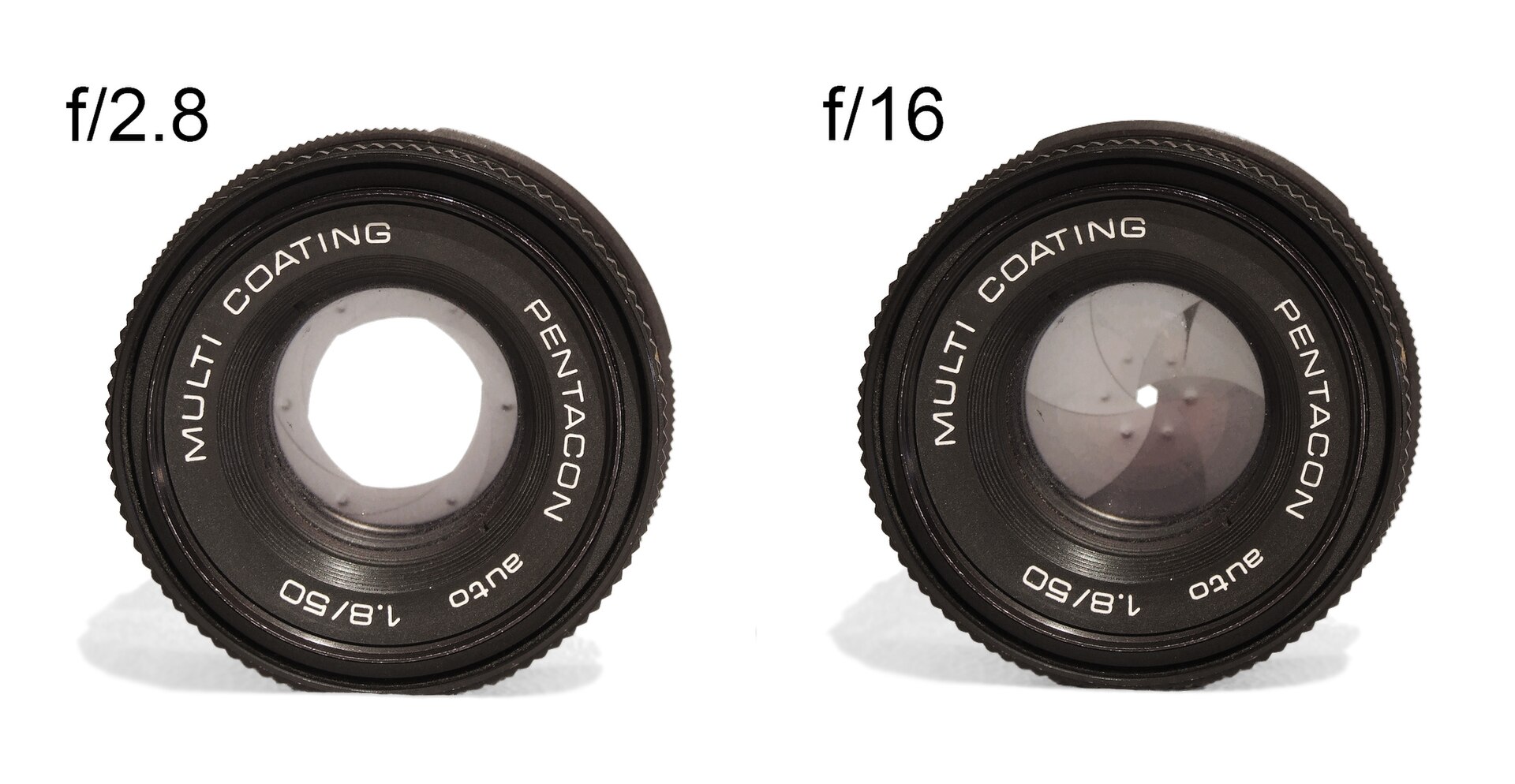
Aperture is the adjustable opening inside a camera lens that lets light through to the sensor. It works like the pupil of an eye: it widens in dim light to let in more illumination and narrows in bright light to let in less. Physically, it is a set of overlapping blades — called the diaphragm — that form a roughly circular hole. The size of that hole is expressed as an f-number, or f-stop. The counterintuitive part for beginners is that a small f-number means a large opening, and a large f-number means a small opening. So f/1.8 is a wide aperture, while f/16 is a narrow one.
F-Stops: Decoding the Numbers
The f-stop scale looks odd at first glance: f/1.4, f/2, f/2.8, f/4, f/5.6, f/8, f/11, f/16, f/22. Each step in this sequence is a “full stop,” and moving from one to the next either halves or doubles the amount of light reaching the sensor. Going from f/4 to f/5.6 cuts the light in half; going from f/5.6 to f/4 doubles it. The reason the numbers look like fractions is that f-stop is a ratio: the focal length of the lens divided by the diameter of the aperture opening. A 50mm lens set to f/2 has an opening 25mm across (50 ÷ 2). That is why a wider opening produces a smaller number.
How Aperture Controls Depth of Field
Depth of field is the distance between the nearest and farthest objects in a scene that appear acceptably sharp. When you focus on a subject, there is a zone of sharpness in front of it and behind it — and aperture is the single biggest control over how deep that zone runs. A wide aperture such as f/1.8 or f/2.8 produces a shallow depth of field: only a thin slice of the scene is sharp, while everything in front of and behind the subject melts into soft blur. A narrow aperture such as f/11 or f/16 produces a deep depth of field: far more of the scene, from close foreground to distant background, appears in focus. Aperture is not the only factor — focal length, focus distance, and sensor size also play a role — but it is the one photographers reach for first.
Shallow vs. Deep Depth of Field: When to Use Each
Shallow depth of field is the classic tool for portraits, wildlife, and food photography. A wide aperture isolates the subject from a busy or distracting background and directs the viewer’s eye exactly where you want it. Deep depth of field is the go-to for landscapes, architecture, and group photos, where you want everything — the rocks in the foreground and the mountains behind them — rendered sharply. It is also essential in real-estate and interior photography, where detail matters throughout the frame. The choice is not just technical; it is a storytelling decision about what to emphasize and what to let fall away.
Aperture and Exposure
Because aperture changes how much light enters the lens, it is also one-third of the exposure triangle. Opening the aperture lets in more light, which lets you shoot with a faster shutter speed or a lower ISO in dim conditions — that is why fast lenses such as an f/1.8 prime are prized for low-light work. Closing it down reduces light, which you compensate for with a slower shutter speed or a higher ISO. One caveat: at very small apertures such as f/16 or f/22, a phenomenon called diffraction softens fine detail. Most lenses are sharpest a few stops down from wide open, often around f/8.
Practical Tips for Controlling Depth of Field
- For a blurred background, get close to your subject, use the widest aperture your lens allows, and keep some distance between the subject and the background.
- For deep sharpness, stop down to f/8–f/11 and, on most cameras, focus about a third of the way into the scene.
- Depth of field shrinks dramatically when you are close to the subject, so macro shots often need very narrow apertures.
- Use aperture-priority mode (A or Av) to let the camera handle shutter speed while you stay in creative control.
Conclusion
Aperture is the photographer’s most expressive exposure control. Master it, and you stop merely recording light and start shaping how a viewer reads your image. Start by shooting the same scene at f/1.8 and f/16 and comparing the results — the difference in depth of field is the fastest lesson in photography you will ever get.
Frequently Asked Questions
What does a “fast” lens mean?
A fast lens has a large maximum aperture — a small f-number such as f/1.4 or f/1.8 — letting in more light and allowing faster shutter speeds in low light.
What is bokeh?
Bokeh is the aesthetic quality of the out-of-focus areas in a photo, most visible when shooting wide open. Smooth, round highlights produce “good” bokeh.
Which aperture is best for landscapes?
Between f/8 and f/11 is a common sweet spot: deep depth of field with minimal diffraction, keeping both foreground and background sharp.
Related Posts
Golden Hour and Natural Light Photography: A Complete Guide
Ask almost any landscape or portrait photographer to name their…
Exposure Bracketing Explained: How to Capture Perfect Exposures Every Time
Have you ever photographed a sunset where the sky glows…
HDR Photography Explained: Capturing the Full Range of Light
Point your camera at a sunset, a church interior, or…