Tamron has announced the 16-50mm F2.8 A (Model B091), a constant-aperture f/2.8 standard zoom built specifically for APS-C mirrorless cameras. Unveiled on October 14, 2026, the lens pairs a bright f/2.8 aperture with a compact, lightweight body and Tamron’s fast VXD autofocus motor. Perhaps most notably, it is coming to four lens mounts — Sony E, Canon RF, Nikon Z, and Fujifilm X — putting a fast, affordable standard zoom within reach of crop-sensor shooters across nearly every major mirrorless system.
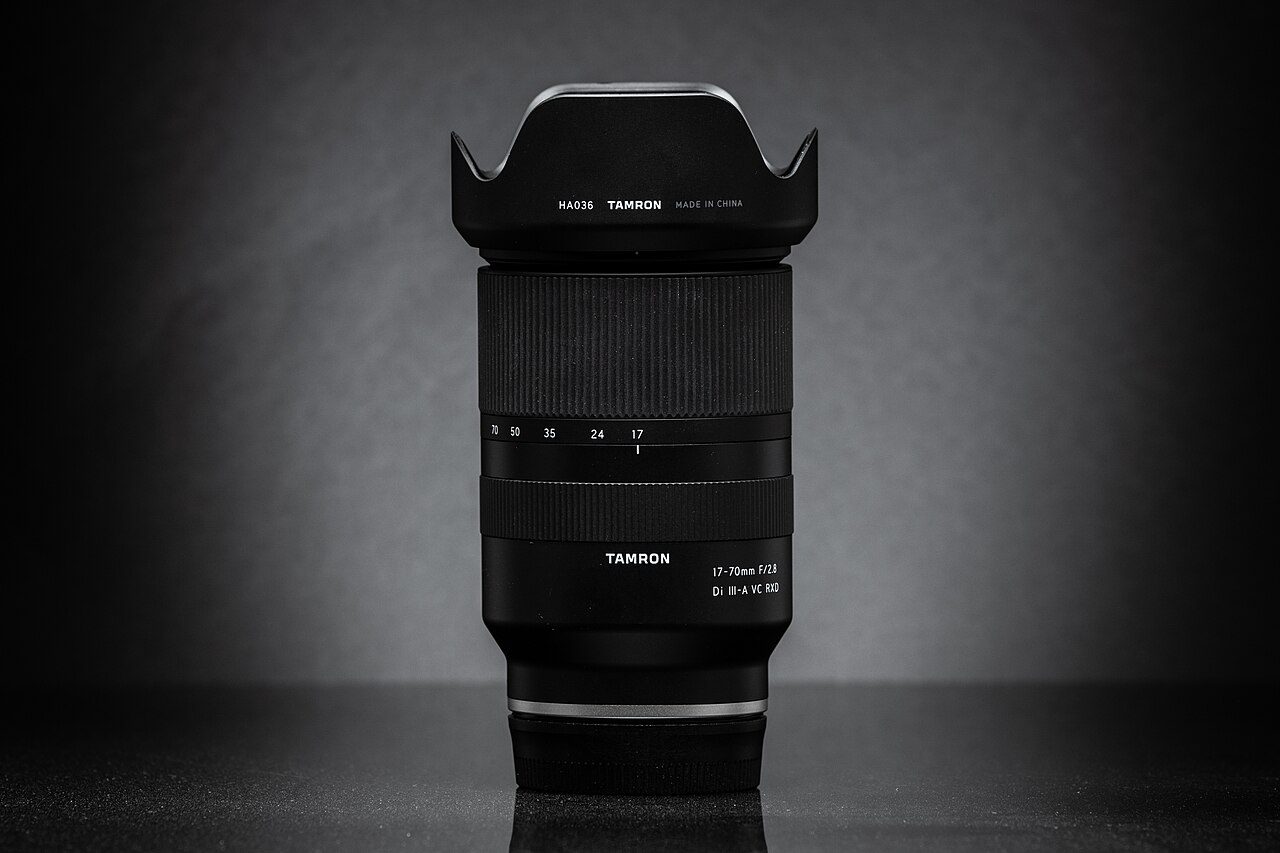
Tamron’s 17-70mm f/2.8 Di III-A VC RXD, a related APS-C standard zoom. The new 16-50mm F2.8 A follows the same compact, fast-aperture philosophy. Photo: Henry Söderlund / CC BY 2.0.
Key Specifications
At its core, the 16-50mm F2.8 A is about balancing speed with portability. The lens covers a 16–50mm focal range, which works out to a full-frame equivalent of roughly 24–75mm on Sony E, Nikon Z, and Fujifilm X mounts, and 25.6–80mm on Canon RF (where the sensor’s 1.6x crop factor applies). That range spans wide-angle through short telephoto — the classic everyday “do everything” spread.
Despite the constant f/2.8 aperture, the lens stays remarkably compact. On Sony E-mount it measures just 3.2 inches (79.6 mm) long and weighs 10.8 oz (305 g), with a modest Ø55mm filter thread. The optical design uses 14 elements in 10 groups, and a 7-blade circular diaphragm keeps out-of-focus highlights smooth up to two stops from wide open.
Autofocus is handled by Tamron’s VXD (Voice-coil eXtreme-torque Drive) linear motor, the same high-speed, near-silent system used in the company’s premium zooms. Minimum focus is a useful 6 inches (0.15 m) at the wide end, dropping to 11.5 inches (0.29 m) at the tele end, for a maximum magnification ratio of around 1:4.5. The lens also features moisture-resistant construction and a fluorine-coated front element for easier cleaning.
Four Mounts, Staggered Release
Availability rolls out over the next two months:
- Sony E-mount — $529 USD, from October 29, 2026
- Canon RF-mount — $549 USD, from October 29, 2026
- Nikon Z-mount — $549 USD, from November 19, 2026
- Fujifilm X-mount — $529 USD, from December 17, 2026
Where It Sits in the Market
The APS-C fast-standard-zoom category has been heating up, and the 16-50mm F2.8 A enters it at an aggressive price point. Sony’s own E 16-55mm f/2.8 G — the natural comparison for E-mount shooters — sells for around $1,400, making Tamron’s $529 asking price less than half of that. Sigma’s popular 18-50mm f/2.8 DC DN Contemporary is smaller and lighter still, but it starts at 18mm rather than 16mm (a meaningful difference for landscapes and tight interiors) and is not available for all four mounts covered here.
Tamron’s own 17-70mm f/2.8 Di III-A VC RXD remains the stabilized, longer-reach option in the lineup, but it is heavier and pricier. The 16-50mm F2.8 A strips back to the essentials for shooters who value size and cost above all else.
One detail worth noting: the lens does not carry Tamron’s VC (Vibration Compensation) designation, meaning it has no built-in optical stabilization. On bodies with in-body image stabilization (IBIS) — such as many recent Sony, Nikon, and Fujifilm models — that is less of a concern, but buyers on non-stabilized bodies should factor it in.
Who It’s For
The 16-50mm F2.8 A is aimed squarely at everyday and travel photographers who want brighter, sharper images than a kit lens without the bulk or cost of a flagship f/2.8 zoom. The 16mm wide end makes it especially friendly for landscapes, architecture, and group shots in tight spaces, while the f/2.8 aperture delivers softer background blur and stronger low-light performance. The quiet VXD motor also makes it a solid choice for video, where focus transitions need to be fast and silent.
Conclusion
With a fast constant aperture, a genuinely compact body, and four-mount availability, the Tamron 16-50mm F2.8 A is one of the most compelling new lenses of late 2026 for APS-C mirrorless shooters. If the optics live up to Tamron’s recent track record, it could quickly become the default “go-to zoom” it is designed to be.
FAQ
Which mounts does the Tamron 16-50mm F2.8 A come in?
Sony E, Canon RF, Nikon Z, and Fujifilm X.
Is it a full-frame lens?
No — it is designed for APS-C sensors, giving a full-frame equivalent of about 24–75mm (25.6–80mm on Canon RF).
Does it have image stabilization?
No built-in optical stabilization (VC). It relies on in-body stabilization (IBIS) from the camera body.
How much does it cost and when can I buy it?
$529 for Sony E and Fujifilm X, and $549 for Canon RF and Nikon Z. Sony E and Canon RF ship October 29, 2026; Nikon Z on November 19; and Fujifilm X on December 17.
Related Posts
Medium Format Goes Mainstream in 2026
For more than a decade, digital medium format was the…
2026 Mirrorless Camera Market Trends: What CIPA Data Reveals
The mirrorless camera market has entered a new phase in…
Canon EOS R1 AI Autofocus Firmware Update: Action Priority AF Adds American Football
Canon has pushed a free firmware update to its flagship…