A wide-angle lens shows you more of the world. A fisheye lens shows you the world differently. Instead of keeping straight lines straight, a fisheye bends them into sweeping curves — and at its most extreme, it can squeeze an entire 180° hemisphere into a single circular frame. Once a niche tool for scientific imaging, the fisheye has become a favorite of action-sports shooters, experimental photographers, and anyone chasing a look no other lens can produce.
What Is a Fisheye Lens?
A fisheye is an ultra-wide lens with a field of view typically between roughly 100° and 180° — far beyond the roughly 100–110° that rectilinear ultra-wides reach before edge stretching becomes unusable. The defining trait is its projection. A rectilinear lens maps the scene so that straight lines stay straight on the sensor; a fisheye uses an equidistant (or equisolid-angle) mapping instead, so straight lines that don’t pass through the center of the frame are rendered as curves. The farther a line sits from center, the more it bends.
The trade-off is deliberate. Because the distance from the image center scales directly with the angle of the incoming light, a fisheye packs a huge field of view onto the sensor without stretching edge objects the way a rectilinear ultra-wide does. The result is that famous bulging look — but subjects near the edge keep their shape.
Circular vs Full-Frame Fisheyes
Fisheyes come in two flavors. A circular fisheye projects the entire 180° hemisphere into a circle that sits in the middle of the frame, surrounded by black — a round “globe” of the scene. These are the classic, most extreme fisheyes, historically used for all-sky meteorological cameras and planetariums.
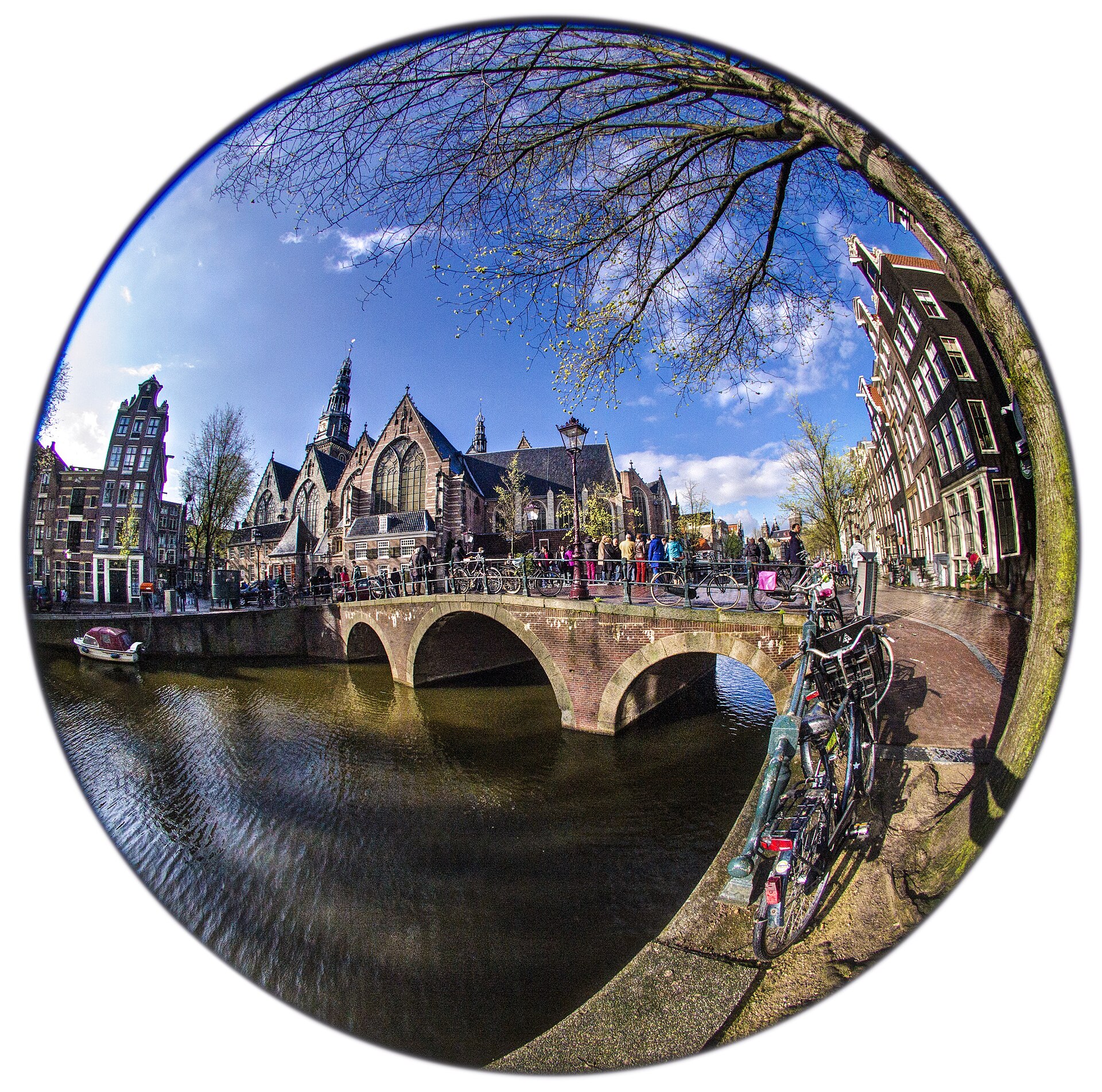
A full-frame fisheye (also called a diagonal fisheye) covers 180° across the diagonal of the sensor, so the image fills the entire frame with no black surround. Lines still curve, but the effect is tamer and often more practical for everyday creative work.
Some zoom fisheyes give you both in one lens. The Canon EF 8-15mm f/4L Fisheye USM is circular at 8mm and full-frame at 15mm on a full-frame body; the Nikon AF-S Fisheye NIKKOR 8-15mm f/3.5-4.5E ED behaves the same way, delivering a full 180° circle at 8mm and a roughly 175° diagonal view at 15mm.
How the Fisheye Projection Works
The core idea is the equidistant projection: radial distance from the image center is proportional to the angle of the incoming light — double the angle and you double the distance from center. A rectilinear lens instead maps distance proportionally to the tangent of the angle, which is what keeps straight lines straight but also stretches edge objects and, mathematically, can never reach 180°.
That is the real reason fisheyes exist: 180° — and beyond, in some extreme designs — is only possible with a non-rectilinear projection. The cost is curved lines; the payoff is an enormous field of view that fits on one sensor. It is also why most fisheyes have a bulging front element that cannot accept standard screw-on filters, something worth knowing before you buy.
What Are Fisheye Lenses Used For?
- Action sports: skateboarding, snowboarding, and BMX shooters love the exaggerated, immersive perspective.
- Creative and experimental photography: curving lines turn buildings, interiors, and landscapes into abstract shapes.
- Architecture and interiors: a full-frame fisheye can capture an entire room in a single shot.
- Astronomy and planetariums: circular fisheyes map the whole sky onto one frame (all-sky cameras).
- 360° and VR: a fisheye (or two) is the starting point for stitching full-sphere panoramas.
- Underwater photography: paired with a dome port, a fisheye lets you shoot very close to a subject while keeping the whole scene in frame.
Popular Fisheye Lenses in 2026
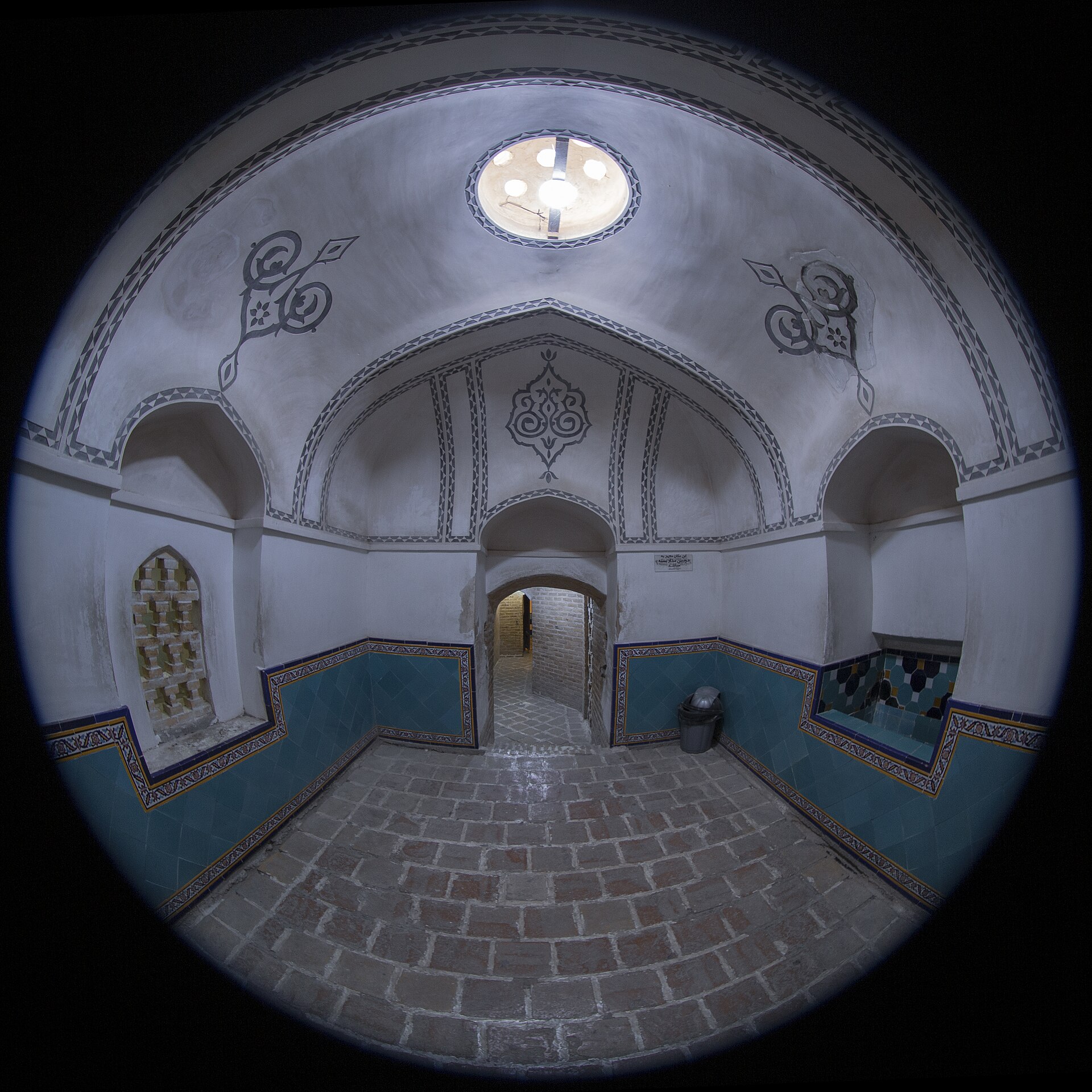
The flagship zooms are the Canon EF 8-15mm f/4L Fisheye USM and the Nikon AF-S Fisheye NIKKOR 8-15mm f/3.5-4.5E ED. Both are weather-sealed professional lenses that switch between circular and full-frame fisheye simply by zooming, and both work on mirrorless bodies through the first-party adapters.
On a tighter budget, Sigma’s 8mm f/3.5 EX DG circular fisheye offers autofocus for full-frame DSLRs, while Samyang/Rokinon’s manual-focus fisheyes — the 8mm f/3.5 for APS-C and the 12mm f/2.8 for full-frame — deliver the same look at a fraction of the price. Samyang/Rokinon lenses are also sold in native mirrorless mounts, which makes them the most common entry point for mirrorless shooters.
Defishing: Turning a Fisheye Image Straight
If the curve ever gets too much, you don’t have to return the lens. Defishing remaps an equidistant image back to a rectilinear projection in software — Lightroom, Capture One, DxO PhotoLab, and several free tools all do it. The catch is that the extreme edges lose resolution as they are stretched out, so a defished image is usually cropped. Many shooters treat defishing as a bonus: buy a fisheye for the creative look, and defish when you need a clean ultra-wide shot.
Conclusion
A fisheye lens is one of the most distinctive tools you can put on a camera. It trades straight lines for an impossible field of view, and whether you shoot a full 180° circle or a full-frame diagonal, the result is a perspective no rectilinear lens can imitate. If you want images that look like nothing else in your library, a fisheye — especially an affordable manual-focus model — is one of the cheapest ways to get there.
FAQ
What’s the difference between a fisheye and a wide-angle lens?
A wide-angle (rectilinear) lens keeps straight lines straight; a fisheye curves them. Fisheyes also reach far wider fields of view — up to 180° or more — that rectilinear lenses mathematically cannot.
Can a fisheye lens take filters?
Generally no. Most fisheyes have a bulbous front element that blocks screw-on filters, though a few models offer small rear or built-in filter options.
Is a fisheye lens worth buying?
If you shoot action sports, architecture, astrophotography, or want a unique creative look, yes — especially an affordable manual-focus model. If you only want something wider than your kit lens, a rectilinear ultra-wide is usually the better choice.
Can I fix fisheye distortion in editing?
Yes. Defishing tools in Lightroom, Capture One, and free software remap the image to a rectilinear view, at the cost of some sharpness at the edges.
Related Posts
High-Speed Sync (HSS) Explained: How Flash Works Above Your Camera’s Sync Speed
If you have ever tried to use a flash in…
Shutter Shock and Electronic First-Curtain Shutter (EFCS) Explained
You set up your camera on a tripod, attach a…
Anamorphic Lenses Explained: Squeeze Factor, Oval Bokeh, and the Cinematic Look
Walk onto a movie set and you'll notice something most…