Every digital camera you’ve ever held — from an early-2000s DSLR to the latest mirrorless flagship — captures light on one of two kinds of sensor: CCD or CMOS. The names get thrown around constantly, but what actually separates them? The difference comes down to a single architectural choice: where each sensor converts light into an electrical signal, and how it moves that signal off the chip. In this guide we break down how both technologies work, where they genuinely differ, and which one matters for the photos you take today.
How a CCD Sensor Works
A CCD (Charge-Coupled Device) is built around one shared readout path. When light hits the silicon, each pixel accumulates a small packet of electrical charge. After the exposure, the sensor doesn’t read pixels in place — instead, clock voltages shift every packet of charge from pixel to pixel, row by row, like a bucket brigade, until it reaches a single output amplifier in the corner of the chip. That one amplifier turns the charge into a voltage and digitizes it.
Because every pixel is read through the exact same amplifier, a CCD produces a very uniform image with almost no pixel-to-pixel variation. That uniformity, plus a near-100 percent fill factor in full-frame designs, is why CCDs ruled early digital photography and still appear in astronomy and scientific instruments. The trade-off is speed and power: shifting millions of charge packets serially takes time and energy, so CCDs read out slowly and draw substantial power.
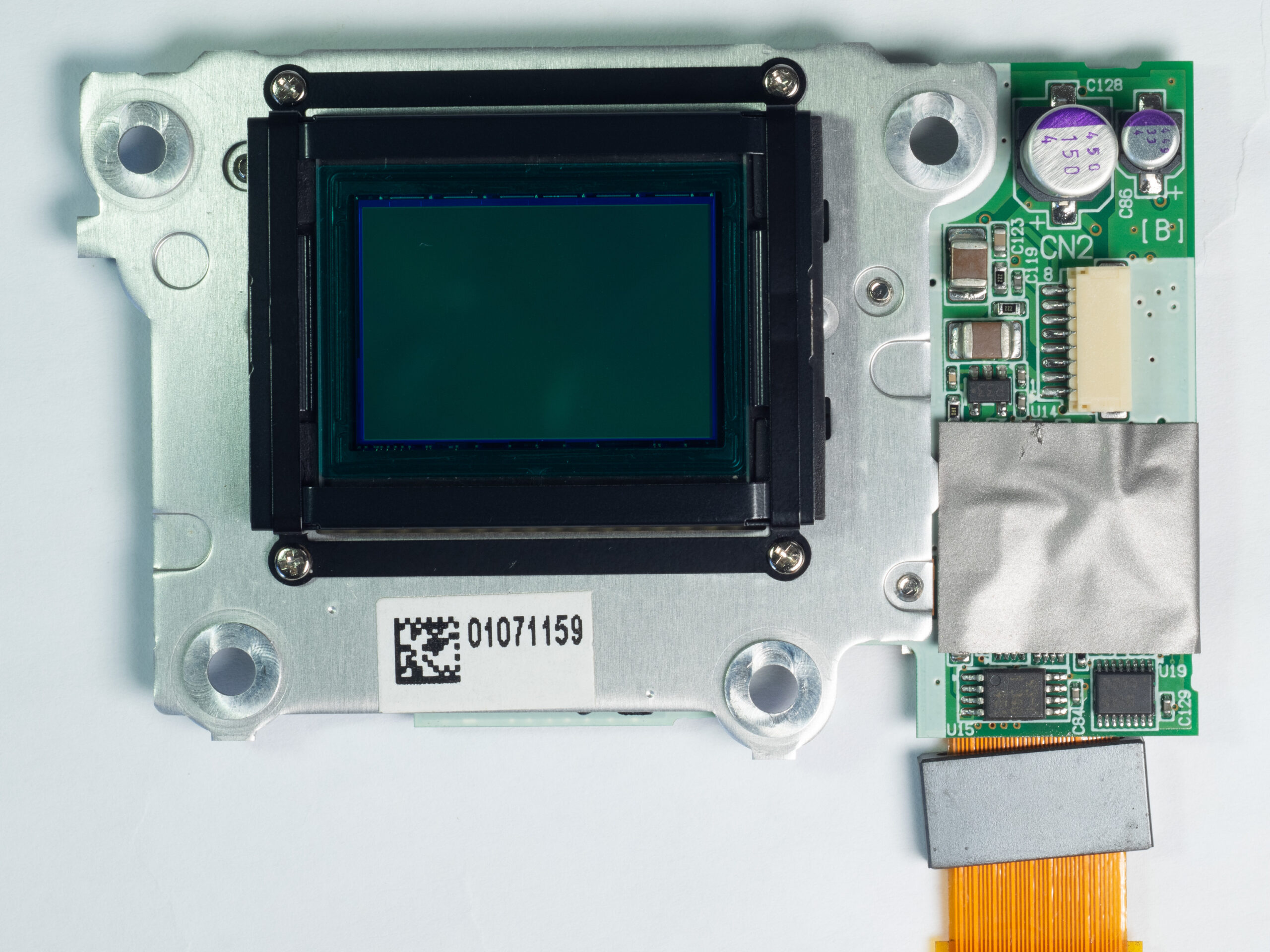
How a CMOS Sensor Works
A CMOS (Complementary Metal-Oxide-Semiconductor) sensor flips the approach. Each pixel carries its own amplifier — and often its own circuitry — that converts charge into voltage right at the photosite. Signals are then read out in parallel: every column has its own analog-to-digital converter (ADC), so an entire row is digitized at once.
Parallel readout is a huge advantage. It makes CMOS sensors dramatically faster and roughly a hundred times more power-efficient than comparable CCDs — exactly what smartphones, video, and high-speed burst shooting demanded. The catch is uniformity: millions of individual amplifiers introduce tiny pixel-to-pixel variations (fixed-pattern noise) that manufacturers must calibrate out. Modern design — especially four-transistor “pinned photodiode” pixels with correlated double sampling — has pushed CMOS read noise down to about one electron or less, closing the quality gap that once favored CCDs.
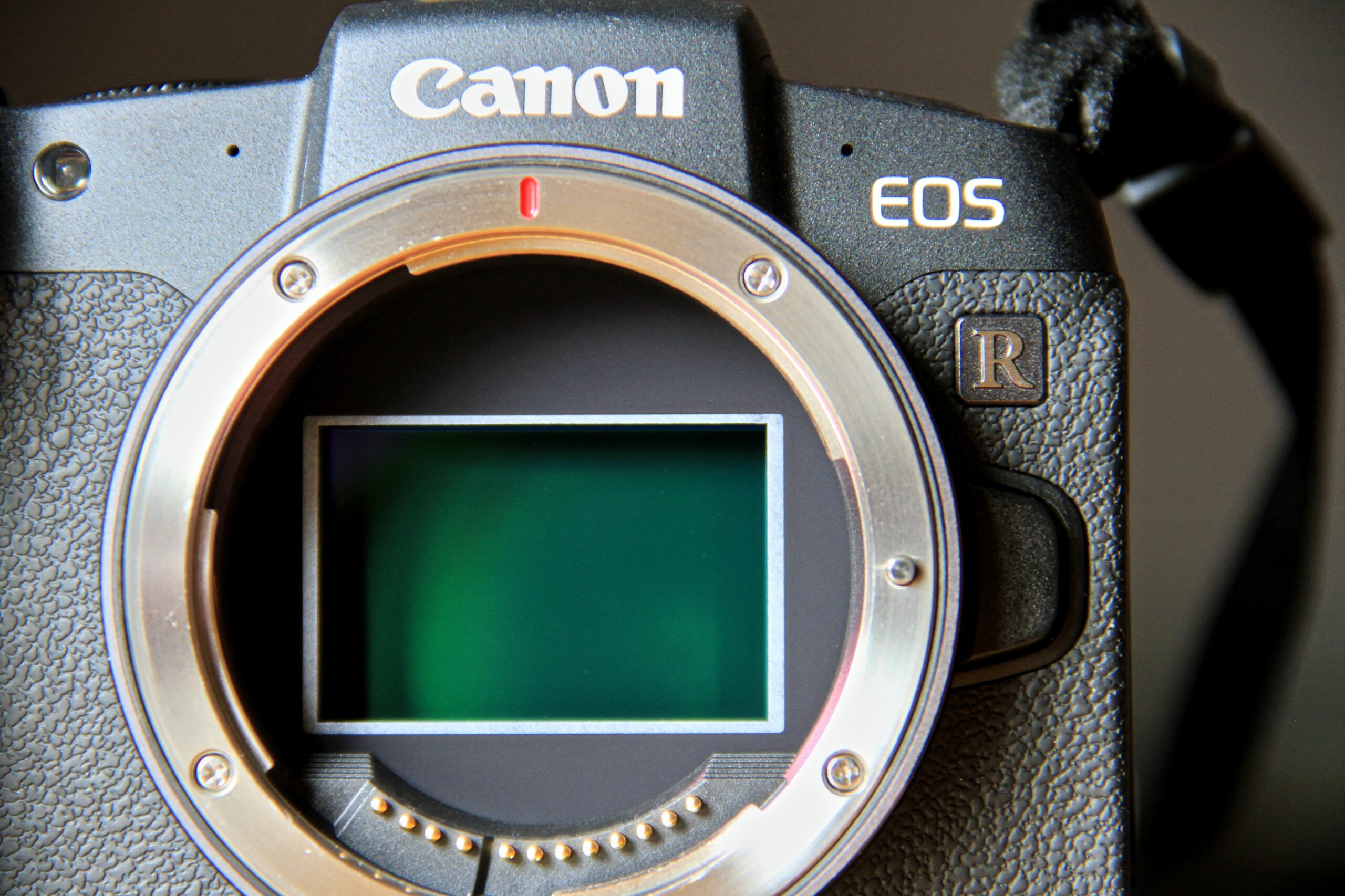
The Key Differences at a Glance
- Speed: CMOS reads in parallel, enabling 30 fps stills, 4K and 8K video, and bursts above 100 fps. CCDs are serial and far slower.
- Power: CMOS is far more efficient, extending battery life; CCDs draw significantly more power for the same job.
- Image quality: CCDs historically had cleaner, more uniform output; modern CMOS matches or beats them in read noise and dynamic range.
- Blooming and smear: CCDs can show vertical streaks when a bright light overflows a pixel well or hits the chip during readout. CMOS doesn’t shift charge across the chip, so smear is essentially eliminated.
- Manufacturing: CMOS is made on standard silicon foundries, so it’s cheaper and easier to integrate with on-chip logic — autofocus, image processing, even memory.
Rolling vs. Global Shutter
One of the most visible differences follows directly from CMOS architecture. Because CMOS reads row by row, most CMOS sensors use a rolling shutter: the top of the frame is exposed and read slightly before the bottom. That’s why fast motion or a panning camera can produce skewed “jelly” distortion, and why electronic shutters sometimes band under artificial light. CCDs, by contrast, expose the whole frame at once, giving a true global shutter with no rolling distortion. CMOS can achieve global shutter too, but it requires extra in-pixel storage that reduces light-gathering area, so it’s reserved for specialized cameras.
Which Sensor Should You Choose?
For almost every photographer today, the answer is already decided for you: virtually every current interchangeable-lens camera uses CMOS. Nikon, Canon, and Sony all migrated from CCD to CMOS in the mid-2000s, and the modern features you rely on — live view, 4K video, on-sensor phase-detect autofocus, silent electronic shutter, strong high-ISO performance — only exist because of CMOS. CCD still matters in niches: astronomy cameras, microscopy, and scientific imaging, where its global shutter and extreme uniformity justify the slower readout and higher power draw. If you’re buying a camera for stills or video, you’re buying CMOS — and that’s a good thing.
Conclusion
CCD and CMOS solve the same problem — turning light into a digital image — with opposite strategies. CCD moves charge off the chip through one shared amplifier for pristine uniformity; CMOS converts and reads each pixel in parallel for speed and efficiency. Time has picked a winner for consumer cameras: CMOS won because it could do more, faster, for less power. CCD survives where precision and a global shutter matter more than speed. Understanding the difference doesn’t change what you buy today, but it explains why your camera works the way it does.
FAQ
Are CCD sensors still used today?
Yes, but mostly in specialized fields. Astronomy, microscopy, and scientific cameras still use CCDs for their global shutter, high fill factor, and uniform response. Consumer cameras and smartphones are now almost entirely CMOS.
Do CCD sensors produce better image quality than CMOS?
Not anymore. CCDs once had an edge in uniformity and low fixed-pattern noise, but modern CMOS sensors match or surpass them in read noise, dynamic range, and high-ISO performance.
Why does CMOS cause rolling shutter, but CCD doesn’t?
CMOS reads rows sequentially, so the top and bottom of the frame are exposed at slightly different times. CCD exposes and transfers the whole frame together, giving a native global shutter.
Related Posts
Image Stabilization Explained: OIS, IBIS, and EIS
Blurry photos and shaky video share one root cause: camera…
Pixel Binning Explained: How Your Phone Camera Captures Brighter Low-Light Photos
If you've ever wondered why a 108-megapixel phone still saves…
Electronic vs Mechanical Shutter: Which Should You Use?
Every photograph depends on one small but critical decision: how…