Turn your ISO up in dim light and every shot comes back speckled with grain. Most photographers call that “high-ISO noise” and blame the sensor — but the biggest culprit is actually light itself. Before you spend money chasing a “cleaner” camera, it helps to understand the two sources that actually create the grain: photon shot noise and read noise. Once you know which one you are fighting, you can make smarter choices about ISO, exposure, and gear.
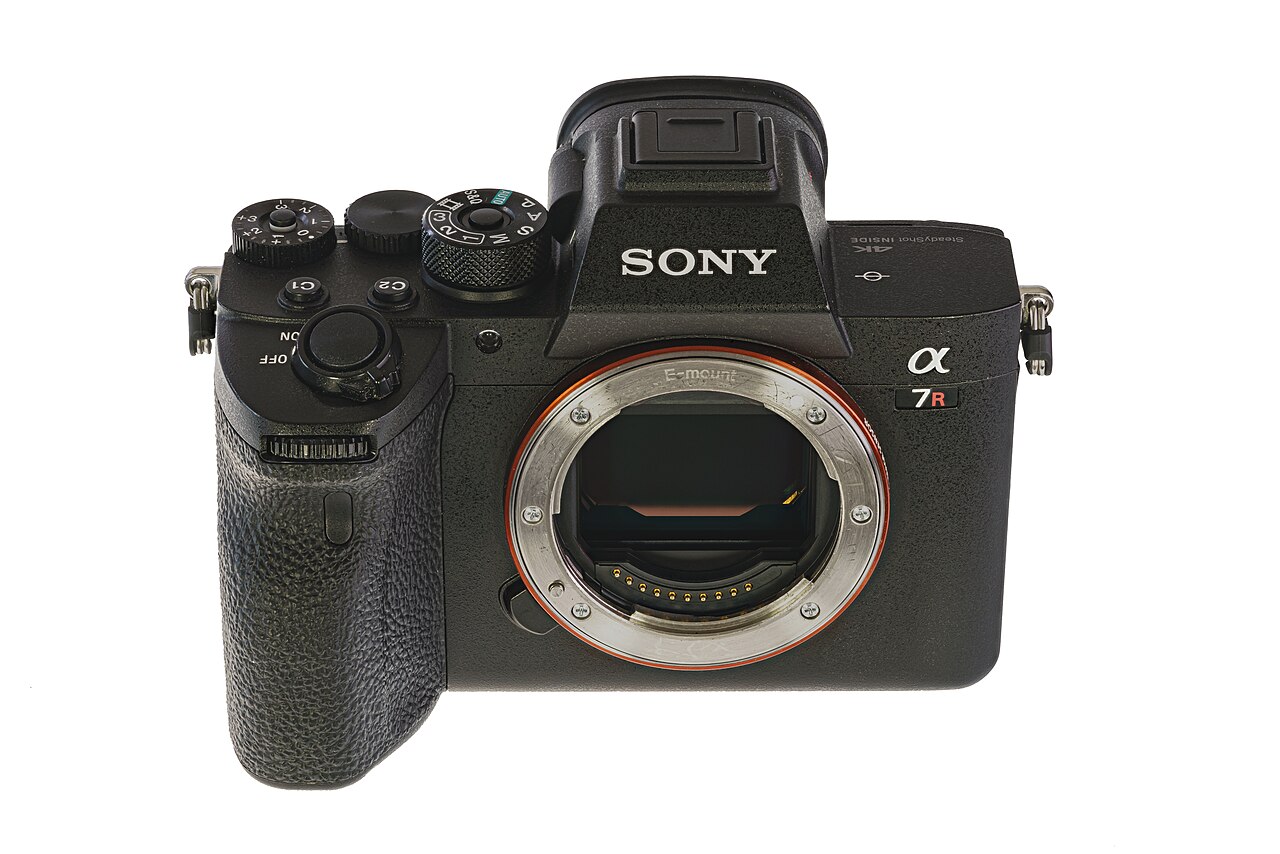
What Is Noise in a Digital Photo?
Every pixel on your sensor does the same job: it counts how much light landed on it during the exposure, then turns that count into a brightness value. Noise is simply when that count is wrong — when two pixels that should record the same brightness instead record slightly different numbers. Those random errors appear as the speckled texture you see in the shadows and at high ISO. The errors come from a few places, but two of them dominate: the light itself, and the electronics that read out the sensor.
Photon Shot Noise — Noise That Comes From Light Itself
Light arrives as discrete particles: photons. Even if you photograph a perfectly even, unchanging surface, the number of photons striking any single pixel from one instant to the next is never exactly the same — it fluctuates randomly. This is photon shot noise, and it is a property of light, not a defect in your camera. A theoretically perfect sensor would still record it.
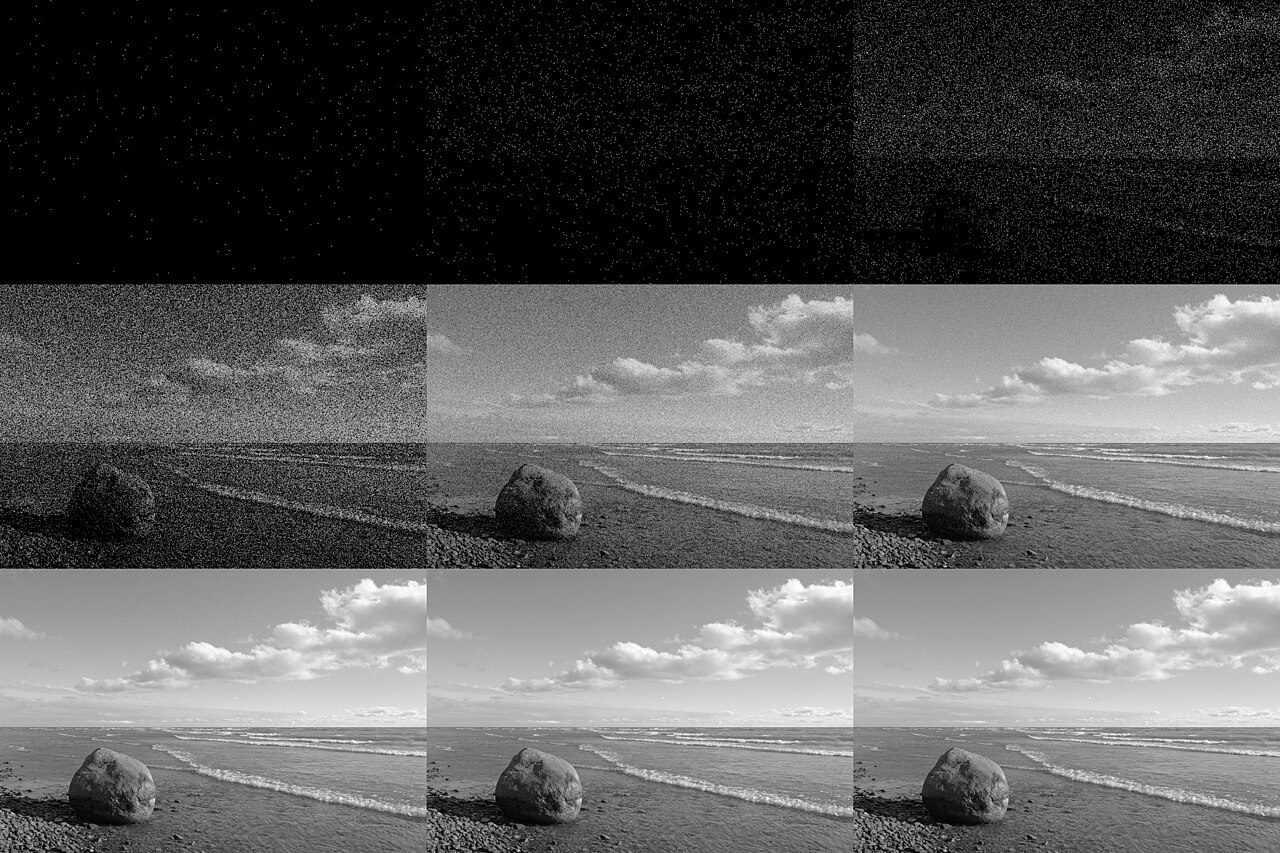
Shot noise follows Poisson statistics, which give a very convenient rule: the amount of noise is the square root of the signal. Collect 10,000 photons and the typical fluctuation is about 100 (the square root of 10,000); collect 100 photons and it is about 10. The noise grows as the signal grows, but more slowly — so the signal-to-noise ratio (SNR) actually improves as you capture more light. In fact, SNR equals the square root of the photon count. Double the light and the image gets about 1.4× cleaner; quadruple it for a 2× improvement. This is the single most important fact about noise: more light, not a better sensor, is the real cure for grain.
Read Noise — The Sensor’s Own Imperfections
After the exposure, the sensor has to read every pixel out: move the accumulated electrons, convert them to a voltage, amplify them, and digitize them. None of those steps is perfectly precise, and each adds a little random error. Together, that error is called read noise, and it is measured in electrons. It is fixed for a given camera mode and ISO — it does not depend on how much light you captured.
Modern consumer sensors typically sit around 1–3 electrons of read noise at base ISO, while older designs could be 5–10 electrons; the best cooled scientific CMOS cameras reach roughly 1 electron. Because read noise is a fixed floor, it matters most in the deep shadows and at high ISO, where the photon count is tiny — there, a few electrons of read noise can be a large fraction of your signal.
Dark Current and the Minor Players
Sensors also generate dark current: heat knocks electrons loose even with no light present. It builds with exposure time and temperature, so it is negligible for a 1/125 s handheld shot but becomes a real factor in multi-second and long exposures — one reason astrophotographers value cooler sensors or in-camera long-exposure noise reduction. There is also fixed pattern noise (consistent per-pixel differences, usually calibrated out) and quantization error from the analog-to-digital converter. For everyday photos, though, shot noise and read noise are the two that decide how clean your image looks.
Why High ISO Looks So Grainy
Here is the insight that surprises most people: turning up ISO does not create most of the noise — it just reveals it. Raising ISO does not make the sensor more sensitive; it amplifies the (already tiny) signal it captured. When you raise ISO you are usually shooting in less light, so each pixel collects far fewer photons. Fewer photons means shot noise becomes a much larger fraction of the signal, and the image turns grainy; the amplifier then boosts that grainy signal to normal brightness, making the noise obvious. This is also why noise lives in the shadows — dark areas have few photons even at low ISO, so their signal-to-noise ratio is worst. Bright highlights are always the cleanest part of the frame.
Dual Conversion Gain — The Modern Trick
Sensor designers found a clever way to cut read noise at high ISO: dual conversion gain. At a certain ISO (often around 400–800), the sensor switches to a higher charge-to-voltage gain, which drops the read noise measured in electrons. There is a trade-off — higher gain lowers the pixel’s full-well capacity — but since you are already working with tiny signals at high ISO, it is a good deal. You can actually see the switch as a step down in read-noise-versus-ISO graphs. It is a big reason modern sensors are so much cleaner in low light than cameras from a decade ago.
How to Shoot Cleaner, Lower-Noise Images
Because shot noise dominates, the practical advice all points the same direction: capture more light.
- Use the widest aperture and slowest shutter speed you can afford for the shot.
- Lower ISO when the light allows — but do not underexpose to “protect” yourself; a correctly exposed ISO 3200 shot beats an underexposed ISO 800 shot pushed in post.
- Add light: a window, a reflector, or a flash improves things far more than a new camera.
- Prefer a larger sensor or larger pixels for low light — bigger “light buckets” collect more photons.
- For long exposures, keep the sensor cooler or use in-camera long-exposure noise reduction.
- Use AI denoising as a final polish, not a substitute for a good exposure.
Conclusion
The grain in your high-ISO photos is not one problem but two: photon shot noise, which is light itself being random, and read noise, the small fixed error from reading the sensor. Shot noise is the bigger of the two, and it explains the most useful rule in photography — the cure for noise is more light. Understand that, and you will stop chasing “cleaner sensors” and start making exposures that are genuinely clean.
FAQ
Is high ISO the cause of noise?
Not directly. High ISO amplifies a signal captured in low light, where shot noise is already large. The noise comes from the lack of light, not the ISO setting itself.
Do bigger sensors really have less noise?
Generally yes. A larger sensor or larger pixels capture more photons for the same exposure, so shot noise is a smaller fraction of the signal.
What makes a camera “clean” at high ISO?
Mostly low read noise plus good light capture. Modern sensors with dual conversion gain keep read noise near 1–3 electrons even at high ISO.
Related Posts
EXIF Metadata Explained: What Your Camera Records and How to Read It
Every photo you take contains more than the image you…
Optical Low-Pass Filter (Anti-Aliasing) Explained: Why Some Cameras Show Moiré and Others Don’t
Point your camera at a finely woven shirt, a distant…
Pixel Binning Explained: Why Your 200MP Phone Takes 12MP Photos
Open the camera app on a modern flagship phone and…