Point your camera at a finely woven shirt, a distant chain-link fence, or a brick wall, and you may see something that isn’t really there: wavy rainbow bands rippling across the surface. That artifact is called moiré, and for decades camera makers fought it with a thin sliver of crystal hidden just above the sensor — the optical low-pass filter (OLPF), also called an anti-aliasing (AA) filter. Yet in recent years many high-resolution cameras have quietly dropped it, and “no AA filter” has become a selling point instead of a warning. Here’s what the filter does, how it works, and why its absence is now often a feature.
What an optical low-pass filter does
A sensor samples the scene with a fixed grid of pixels, and like any digital sampler it has a hard limit: it can faithfully record detail only up to half its sampling rate, a threshold called the Nyquist frequency. Fine detail beyond that limit doesn’t simply vanish — it folds back down into the image as a false, lower-frequency pattern. On repeating structures such as fabric weave, brick, or wire mesh, that false pattern shows up as moiré and rainbow “false color” fringing.
An OLPF is a physical blur filter placed directly in front of the sensor. Its job is to soften the incoming image just enough that spatial frequencies above the Nyquist limit are attenuated before they reach the pixels, so they can’t alias into moiré. It’s deliberately a very gentle blur — enough to block the offending frequencies, not enough to be obvious to the eye.
How a piece of crystal blurs an image
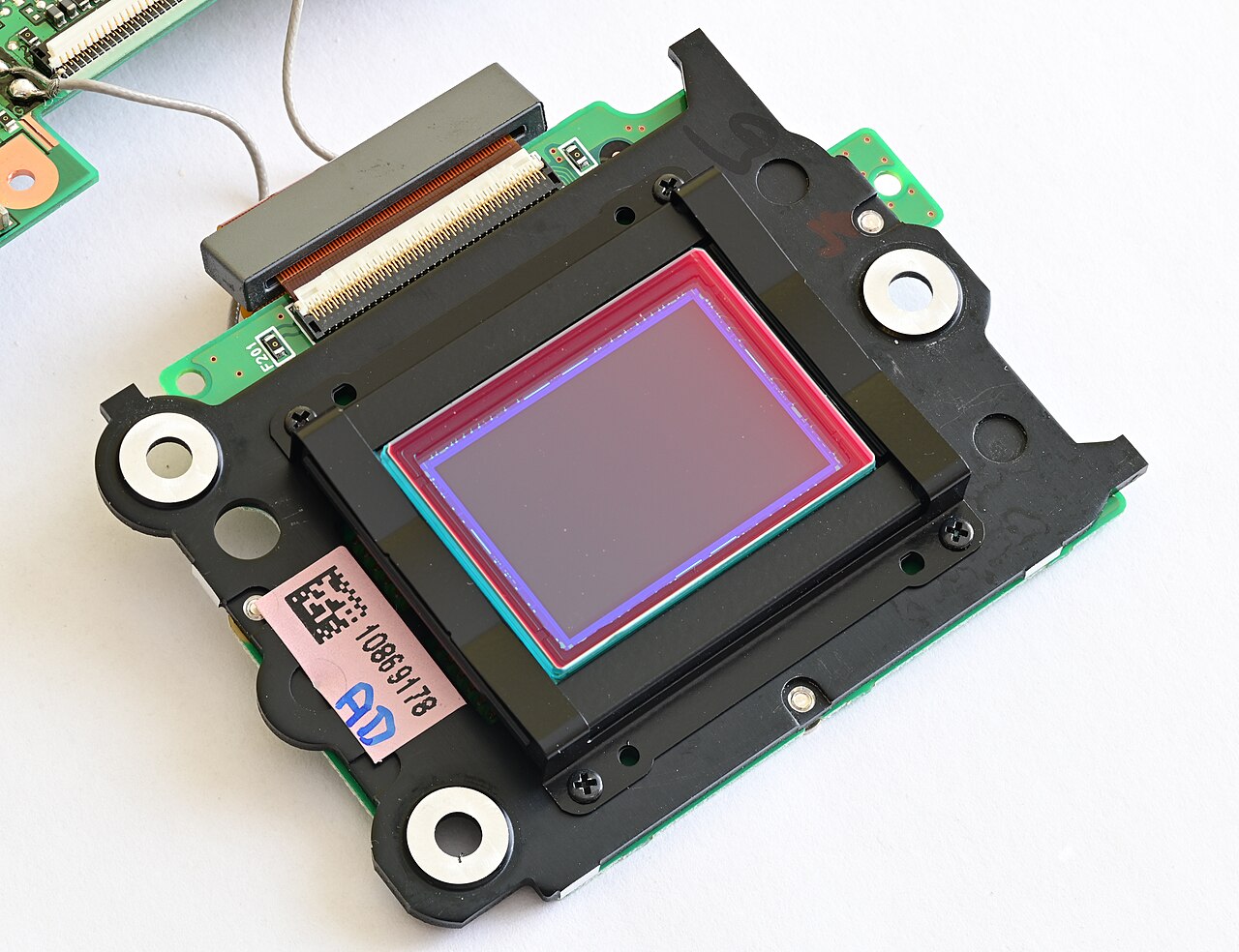
The filter is typically made of a birefringent crystal such as crystalline quartz or lithium niobate. When light passes through such a crystal at the right angle, a single ray splits into two rays — the “ordinary” and “extraordinary” rays — displaced from each other by a tiny, precisely controlled distance. Instead of landing on one pixel, each point of light lands on two or more neighboring pixels, which is exactly what a low-pass blur does.
A single plate blurs in only one direction. Stack two plates rotated 90 degrees relative to each other and each point is split four ways — a “four-dot” beam splitter that softens detail both horizontally and vertically. The displacement distance is tuned to the sensor’s pixel pitch, so the blur is matched to what that specific sensor actually needs.
The sharpness cost — and why cameras dropped it
The catch is that an OLPF can’t perfectly separate “too fine” detail from “just fine” detail. The blur it introduces also shaves contrast from real, sub-Nyquist detail, leaving images very slightly softer than the lens alone would produce. On early low-resolution sensors with big pixels, that trade was worth it. But as pixel counts climbed and pixels shrank, two things changed: the Nyquist limit moved higher, so less real-world detail exceeds it, and the lens’s own blur — its diffraction and optical limits — began to act as a natural low-pass filter.
That’s why many modern high-megapixel cameras simply omit the filter. Bodies like the Nikon Z7, Sony’s a7R series, and Canon’s EOS 5DS R ship without a conventional AA filter, trading a little moiré risk for visibly crisper detail. For landscape and wildlife photographers shooting mostly organic, irregular textures, the trade is almost always worth it.
The “cancelled” filter: Nikon D800E and Canon 5DS R
Removing a filter outright isn’t always simple, because lenses are designed around a specific thickness of glass sitting in front of the sensor. Nikon’s D800E and Canon’s 5DS R found a clever workaround: rather than deleting the OLPF, they used two birefringent plates whose second layer counteracts the blur of the first. The stack stays the same physical thickness, so the optical path is unchanged, but the net effect is no blur — effectively an AA-filterless sensor in an AA-filter body.
Canon pushed the idea further with its “high-res Gaussian Distribution LPF” in the EOS-1D X Mark III, a four-plate design that splits light into sixteen points. It preserves more real sharpness than the classic four-dot filter while still suppressing moiré — a middle ground between “filter on” and “filter off.”

When moiré shows up — and how to reduce it
Moiré and false color appear mainly on fine, regular, repeating patterns shot at the wrong distance or angle: clothing fabric, window screens, fences, roof shingles, and some bird feathers.
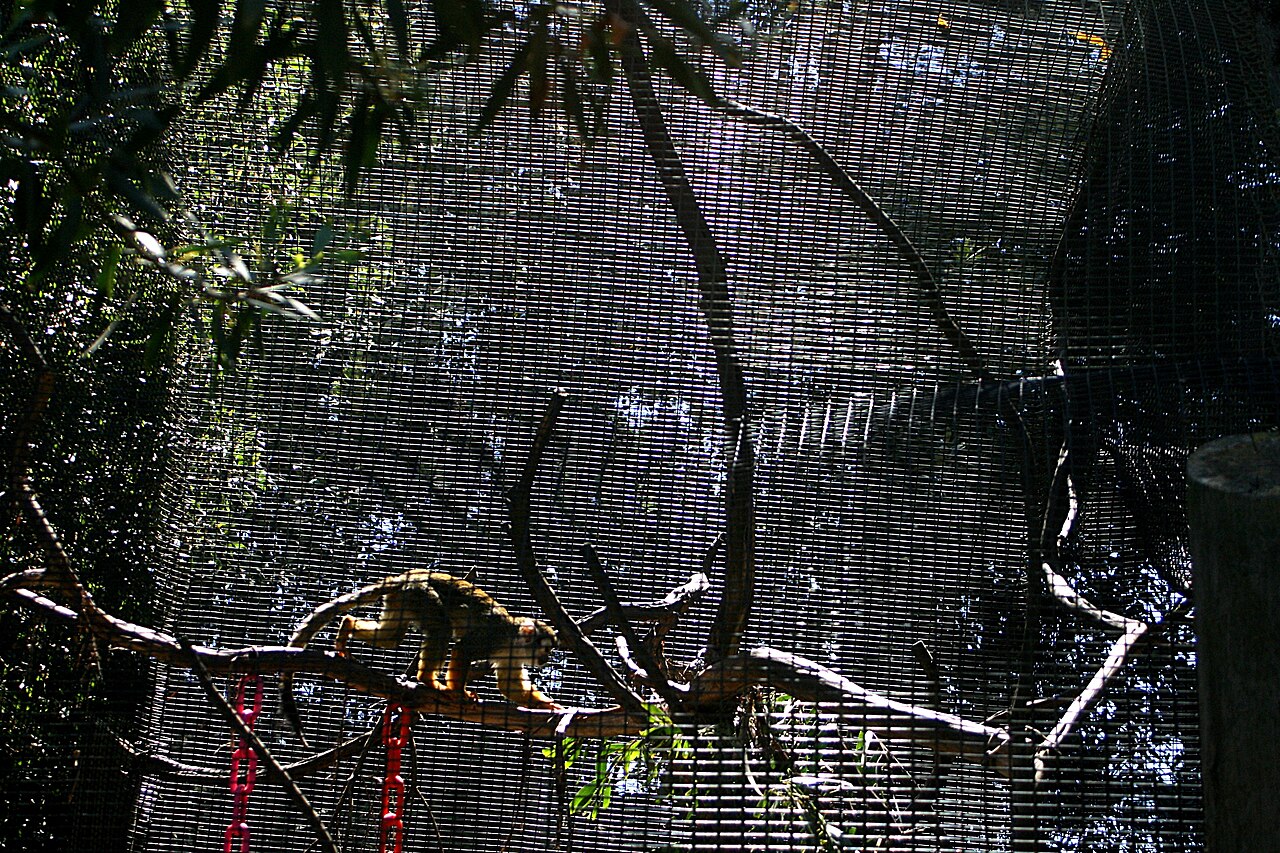

If your camera lacks an AA filter, you can usually dodge moiré in the field: change your distance or angle slightly, or stop the aperture down a few stops so diffraction itself softens the offending detail. A slight manual defocus works too. In post, raw converters and dedicated tools can often suppress color moiré while preserving luminance detail.
Conclusion
The optical low-pass filter is a quiet piece of engineering that captures photography’s central trade: resolution versus artifacts. For years it was essential; today, shrinking pixels and sharper lenses have made it optional. Knowing whether your camera has one — and when it matters — helps you understand why a chain-link fence sometimes shimmers in your viewfinder, and what to do about it.
FAQ
What’s the difference between an OLPF and an anti-aliasing filter? Nothing — they’re the same thing. “Optical low-pass filter” and “anti-aliasing (AA) filter” are two names for the birefringent plate (or plates) mounted in front of the sensor.
Should I buy a camera with or without a low-pass filter? It depends on your subjects. If you shoot a lot of fine repeating patterns — fashion, architecture, textiles — a filter (or Canon’s sixteen-point design) helps. If you shoot landscape or wildlife and want maximum detail, an AA-filterless body is usually fine.
Why does moiré show up as rainbow colors? Color moiré comes from the Bayer color filter array: each color channel samples at a slightly different rate, so fine detail aliases differently in red, green, and blue, producing false colors.
Can I remove moiré in editing? Partially. Raw converters and tools like Lightroom’s moiré brush can reduce color moiré, but heavy luminance moiré is difficult to remove cleanly — prevention in the field is always better.
Related Posts

High-Speed Sync (HSS) Explained: How Flash Works Above Your Camera’s Sync Speed
If you have ever tried to use a flash in…
Image Stabilization Explained: OIS, IBIS, and EIS
Blurry photos and shaky video share one root cause: camera…
Lens Aberrations Explained: Chromatic Aberration, Distortion, and Vignetting
Every lens is a compromise. Glass bends light, but it…