Disclosure: This article contains affiliate links. If you buy through them, we may earn a commission at no extra cost to you.
The Nikon Zf is Nikon’s love letter to its own film-era history. On the outside it looks like a 1980s FM2 — brass top plate, machined dials, and a blocky shoulder you half-expect to feed with 35mm. On the inside it’s a thoroughly modern camera, built around the same 24.5MP full-frame sensor as the Z6 II and the EXPEED 7 processor from the flagship Z8 and Z9. Launched in September 2023 and still a best-seller into 2026, it’s aimed at photographers who want flagship image quality, 8-stop stabilization, and modern subject-detection autofocus in a body that rewards you with physical dials instead of menu diving.
What Makes the Nikon Zf Special
- Flagship processing in a sub-$2,500 body: the EXPEED 7 engine is the same one that drives the Z8 and Z9, giving the Zf the latest generation of autofocus and image processing.
- 24.5MP full-frame BSI sensor — a proven, low-noise chip with excellent dynamic range and clean high-ISO performance.
- 8-stop, 5-axis in-body stabilization with Focus-Point VR, Nikon’s most effective IBIS at this camera’s price point.
- Deep-learning subject detection for people, animals, birds, and vehicles, plus 3D tracking for erratically moving subjects.
- Real retro dials — dedicated ISO, shutter-speed, and exposure-compensation dials, plus a one-touch monochrome switch for instant black-and-white shooting.
- 96MP pixel-shift high-res mode and focus shift for studio, product, and macro work.
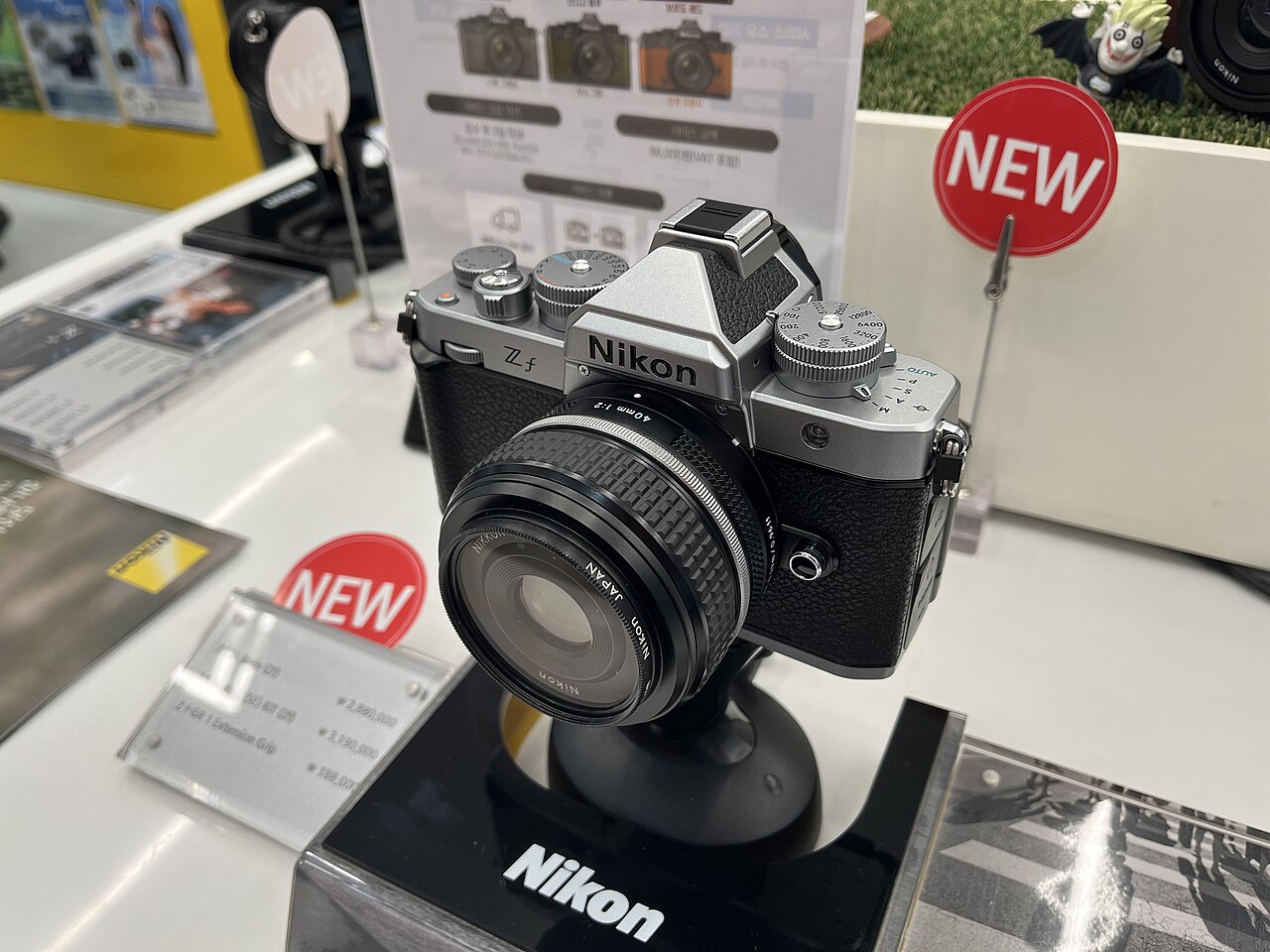
Image Quality
The 24.5MP full-frame sensor may not chase headline megapixel numbers, but it delivers where it counts: excellent dynamic range and low noise that holds up well into the ISO range. Native sensitivity runs from ISO 100 to 64,000 and expands to 50–204,800. For still-life, product, and landscape shooters, the 96MP pixel-shift high-res mode stitches a burst of shifted frames into a single ultra-detailed file, while focus shift automates focus stacking for macro and studio work.
One feature that sets the Zf apart is its dedicated monochrome switch, which drops you straight into black-and-white shooting with realistic film-grain simulation — a direct nod to the street and documentary photographers this camera is clearly aimed at.
Autofocus & Speed
The Zf pairs a 273-point hybrid autofocus system with deep-learning subject detection inherited from Nikon’s flagship bodies. It locks onto eyes, faces, animals, birds, cars, motorcycles, bicycles, trains, and planes, and adds 3D tracking for subjects that move unpredictably. Continuous shooting tops out at 14 fps, which is plenty for street work, events, and most action — though it’s not a dedicated sports machine.
Video
For a camera with “stills-first” styling, the Zf is a surprisingly capable video tool. It records 4K UHD up to 60p — 30p is oversampled from 6K for the sharpest output, while 60p uses a DX crop — plus Full HD up to 120p, all in 10-bit 4:2:2 with N-Log and HLG for flexible grading. A USB-C port handles charging and plug-and-play webcam duty, and there are separate microphone and headphone jacks for on-camera audio.
Design & Handling
At 710 g the Zf feels dense and premium, with a weather-sealed body and a 3.2-inch fully-articulating touchscreen paired with a sharp 3.69M-dot OLED viewfinder. The dials are tactile and clicky, and the whole package is a joy to shoot with for photographers who grew up on film bodies. Two practical caveats recur in owner feedback: the grip is intentionally shallow (many add a third-party grip for larger lenses), and the second card slot is a microSD rather than a full-size SD. It’s a camera you choose for feel and character, not for spec-sheet maximalism.
Full Specifications
| Sensor | 24.5MP full-frame (35.9 × 23.9 mm) BSI CMOS |
| Processor | EXPEED 7 |
| Lens mount | Nikon Z |
| ISO range | 100–64,000 (expandable 50–204,800) |
| Image stabilization | 5-axis sensor-shift, up to 8.0 stops (Focus-Point VR) |
| Autofocus | 273-point hybrid, deep-learning subject detection + 3D tracking |
| Continuous shooting | Up to 14 fps |
| Shutter speed | 1/8000 s to 30 s |
| Viewfinder | 0.5-inch OLED, 3.69M dots |
| Rear screen | 3.2-inch fully-articulating touchscreen, 2.1M dots |
| Video | 4K UHD 30p (full-width) / 60p (DX crop), FHD 120p, 10-bit 4:2:2 N-Log/HLG |
| High-res modes | 96MP pixel shift; focus shift stacking |
| Storage | 1× SD (UHS-II) + 1× microSD |
| Connectivity | USB-C (USB 3.2 Gen 1), micro HDMI, Wi-Fi, Bluetooth, mic + headphone |
| Battery | EN-EL15c, ~380 shots (CIPA) |
| Weather sealing | Yes |
| Weight | 710 g (with battery and card) |
| Dimensions | 144 × 103 × 49 mm |
Nikon Zf vs. Sony a7C II vs. Canon EOS R6 Mark II
| Spec | Nikon Zf | Sony a7C II | Canon EOS R6 Mark II |
|---|---|---|---|
| Sensor | 24.5MP full-frame BSI | 33MP full-frame BSI | 24.2MP full-frame |
| Stabilization | Up to 8 stops | Up to 7 stops | Up to 8 stops |
| Autofocus | 273-point subject detection | 759-point AI recognition | 1,053-zone Dual Pixel AF II |
| Burst | 14 fps | 10 fps | 12 fps mech / 40 fps e-shutter |
| 4K video | 60p (30p full-width) | 60p (1.5× crop) | 60p oversampled, full-width |
| EVF | 3.69M-dot OLED | 2.36M-dot OLED | 3.69M-dot OLED |
| Rear screen | 3.2″ vari-angle, 2.1M dots | 3.0″ vari-angle, 1.03M dots | 3.0″ vari-angle, 1.62M dots |
| Card slots | SD + microSD | 1× SD UHS-II | 2× SD UHS-II |
| Weight | 710 g | 514 g | 670 g |
| Launch MSRP | ≈$2,000 | $2,199 | $2,499 |
Verdict
The Nikon Zf isn’t the most spec-dense full-frame camera you can buy — the Canon R6 Mark II shoots faster and the Sony a7C II is far lighter. What the Zf offers is something those cameras don’t: genuine character. It’s a flagship-grade shooter wrapped in a design that makes you want to pick it up and photograph. If you value tactile dials, film-era aesthetics, and Nikon’s excellent stabilization and autofocus, the Zf is an easy recommendation and one of the most enjoyable cameras in its class.
What Amazon Buyers Say
The Nikon Zf averages 4.7 out of 5 stars from Amazon buyers — a strong score for a full-frame camera at this price. Here’s what verified owners highlight most.
“This camera has been a game changer. The new Nikon autofocus is spectacular. IBIS, is a photographers dream come true. The new Z mount lenses, are incredible. If you’re considering taking the dive into the Nikon world, do it!”
“To be honest, I’m not a huge fan of the retro look, however, I’m absolutely in love with everything inside this body. Upgraded from the D7500 to the ZF and wow! What an incredible camera. The AF system is so incredibly fast.”
“Easy to use even without manual, though some features (like self timer) take a bit of clicking through the menus. I love the manual mode features and external button controls. Image quality is great as should be expected.”
“Super nice camera. no complaints whatsoever. Just a little big & bulky though for what it is, compared to competitors (Sony, Fuji, etc…).”
Owners consistently praise the autofocus, stabilization, and image quality; the most common reservations are the shallow grip and the size relative to lighter rivals. Read all customer reviews on Amazon.
FAQ
Is the Nikon Zf good for beginners?
Yes — the retro dials actually make exposure settings more visible than menu-driven systems, and the guided shooting modes ease the learning curve. The main trade-off is the shallow grip, which some newcomers find less secure with heavier lenses.
Does the Nikon Zf shoot good video?
It’s a strong hybrid. 4K/30p is oversampled from 6K for crisp detail, 4K/60p is available with a DX crop, and 10-bit N-Log/HLG gives real grading headroom — more than enough for most creators, though video-first shooters may prefer the Nikon Z6 III.
What lenses fit the Nikon Zf?
It uses the Nikon Z mount, so any NIKKOR Z lens fits natively. With the FTZ II adapter you can also use nearly all F-mount lenses, including many older AI-S manual lenses — a big draw for shooters who want to keep using vintage glass.
Related Posts
Sigma 24-70mm f/2.8 DG DN II Art Review: The Flagship Zoom That Beats Sony on Value
Disclosure: This article contains affiliate links. If you buy through…

Best Cameras for Landscape Photography (2025 Buying Guide)
Landscape photography is a test of patience and detail. The…
Sony a7 V Review (2026): The Best Full-Frame Camera for Most People
Disclosure: This article contains affiliate links. If you buy through…