Disclosure: This article contains affiliate links. If you buy through them, we may earn a commission at no extra cost to you.
The Nikon Z8 is one of those rare cameras that makes you rethink what a flagship has to look like. Nikon took essentially everything that made the $5,500 Z9 a landmark — the 45.7-megapixel stacked sensor, the EXPEED 7 engine, the deep-learning autofocus, the 8K video — and packed it into a body roughly 30% smaller that you can actually carry on a gimbal or a long hike. The result is a camera that sits at the top of most “best full-frame camera” lists, and one of the most recommended bodies for hybrid shooters in 2026.
What Makes the Nikon Z8 Special
The Z8 is best understood as a Z9 in a smaller shell. Its headline features:
- 45.7MP stacked BSI CMOS sensor — the same chip as the flagship Z9, with readout fast enough that Nikon dropped the mechanical shutter entirely.
- No mechanical shutter — fully electronic capture up to 1/32,000s, completely silent, with virtually no rolling-shutter distortion.
- EXPEED 7 processing — the engine behind subject-detection autofocus, 120fps bursts, and internal RAW video.
- 20fps RAW / 30fps JPEG / 120fps (11MP crop) continuous shooting with a deep buffer.
- 8K/60p N-RAW and 4K/120p internal video recording in a hybrid body.
- 5-axis in-body stabilization rated up to 6 stops with Synchro VR.
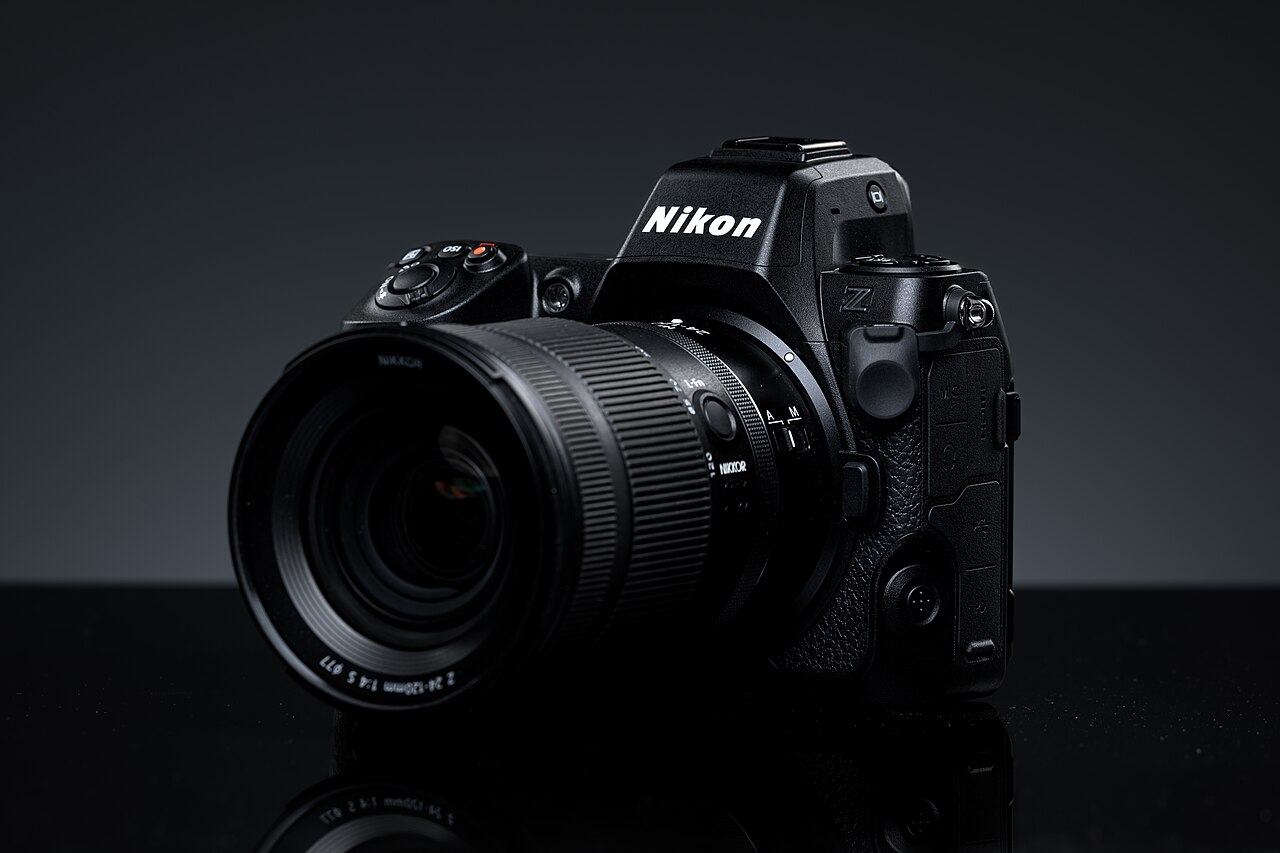
Image Quality
The 45.7-megapixel stacked sensor delivers outstanding detail and dynamic range, with a native ISO range of 64–25,600 (expandable to 32–102,400). Base ISO 64 is a genuine asset for landscape and studio work, preserving clean shadows and giving you room to push files hard in post. High-ISO performance is excellent for the resolution, and the stacked design keeps readout fast enough that even demanding scenes stay clean.
You also get a choice of file formats to match the job: 14-bit RAW, High Efficiency RAW (smaller files with no visible quality penalty), 10-bit HEIF, and standard JPEG. For most shooters, High Efficiency RAW is the sweet spot — full flexibility with far more manageable file sizes.
Autofocus & Speed
Autofocus is where the Z8 earns its flagship badge. It uses a 493-point phase-detection system driven by deep learning that recognizes and tracks nine subject types: people (including the smallest faces in the frame), dogs, cats, birds, cars, motorcycles, bicycles, trains, and airplanes. Combined with 3D Tracking — the mode Nikon shooters have loved since the DSLR era — the Z8 locks onto erratically moving subjects and holds them.
Speed matches the focus: 20fps in RAW, 30fps in full-resolution JPEG, 60fps in DX crop, and up to 120fps at 11MP, plus pre-release capture that buffers shots before you fully press the shutter. For wildlife, sports, and event work, this is as fast as anything on the market.
Video
Video is the Z8’s other half. It records 8K/30p internally (and up to 8.3K/60p in 12-bit N-RAW), 4K up to 120p for slow motion, and supports ProRes RAW HQ and 10-bit ProRes 422 HQ in-camera. N-Log and HLG give you grading headroom, and tools like waveforms, zebras, and focus peaking make it genuinely usable as a production camera, not a stills body with video tacked on.
The heat management is a standout: Nikon quotes up to 90 minutes of 8K/30p and over two hours of 4K/60p continuous recording, which puts it well ahead of many rivals in its class.
Design & Handling
The Z8 is built from magnesium alloy and carbon fiber, fully weather-sealed, and rated to work down to -10°C (14°F). It weighs about 910g with battery and card — noticeably lighter than the Z9’s integrated-grip design, and far easier to balance on a gimbal. The deep grip feels secure in the hand.
The 3.69M-dot electronic viewfinder is bright (3,000 nits) and blackout-free, and the 3.2-inch, 2.1M-dot touchscreen uses a four-axis tilt mechanism that flips for vertical shooting as well as horizontal. Storage is dual-slot: one CFexpress Type B (or XQD) and one SD UHS-II.
Full Specifications
| Specification | Nikon Z8 |
|---|---|
| Sensor | 45.7MP stacked BSI CMOS (full-frame FX, 35.9 × 23.9mm) |
| Processor | EXPEED 7 |
| Lens mount | Nikon Z (F-mount via FTZ adapter) |
| ISO range | 64–25,600 (expandable 32–102,400) |
| Shutter | Electronic only, up to 1/32,000s |
| Continuous shooting | 20fps RAW · 30fps JPEG · 60fps DX · 120fps (11MP) |
| Autofocus | 493-point phase-detect, 9 subject types, 3D Tracking |
| Stabilization | 5-axis IBIS, up to 6 stops (Synchro VR) |
| Video | 8K/30p · 8.3K/60p N-RAW · 4K/120p · ProRes RAW HQ |
| Viewfinder | 0.5″ OLED, 3.69M-dot, blackout-free |
| LCD | 3.2″ 2.1M-dot four-axis tilting touchscreen |
| Storage | 1× CFexpress Type B/XQD + 1× SD UHS-II |
| Battery | EN-EL15c (≈340 shots CIPA) |
| Weather sealing | Yes (down to -10°C / 14°F) |
| Dimensions | 144 × 118.5 × 83mm |
| Weight | 910g (with battery and card) |
Nikon Z8 vs Nikon Z9 vs Canon EOS R5 Mark II
| Feature | Nikon Z8 | Nikon Z9 | Canon EOS R5 Mark II |
|---|---|---|---|
| Sensor | 45.7MP stacked | 45.7MP stacked | 45MP stacked |
| Max burst | 20fps RAW / 120fps | 20fps RAW / 120fps | 30fps electronic |
| Video | 8K/30p, 8K/60p N-RAW | 8K/60p N-RAW | 8K/60p RAW |
| Body | Compact, no grip | Integrated vertical grip | Compact, no grip |
| Weight | 910g | ≈1,340g | ≈746g |
| Launch price | $3,999.95 | $5,499.95 | $4,299 |
The Z8’s pitch is simple: it delivers the Z9’s sensor, autofocus, and video for about $1,500 less, in a smaller body. You give up the integrated grip, the larger battery, and Ethernet — things most shooters rarely miss. Against the Canon EOS R5 Mark II, the Z8 counters with a lower launch price and a proven 45.7MP sensor; the R5 II is lighter and adds Canon’s excellent lens ecosystem and eye-control AF. Both are superb; the Z8 remains the value pick for Nikon users.
Verdict
The Nikon Z8 is one of the most complete cameras Nikon has ever made — flagship speed, resolution, autofocus, and video in a body you’ll actually want to carry. It’s the natural upgrade for D850 and Z7/Z6 owners, and a serious option for anyone shopping the high-end full-frame market. The only real drawbacks are the power draw (carry spare batteries) and a menu system with a learning curve. For hybrid photographers and videographers who want Z9-class capability without the Z9’s size or price, the Z8 is an easy recommendation.
What Amazon Buyers Say
The Z8 holds a strong 4.5 out of 5 stars across roughly 970 Amazon ratings. Here’s how that breaks down:
| Star rating | Share of reviews |
|---|---|
| ★★★★★ (5 stars) | 83% |
| ★★★★ (4 stars) | 6% |
| ★★★ (3 stars) | 2% |
| ★★ (2 stars) | 2% |
| ★ (1 star) | 7% |
“Arguably the best camera in this class on Earth currently. Nikon is back in a big way. This thing really is amazing. It’s a little more expensive than some, but it’s cheaper than the flagships, and has virtually all of the features and abilities!”
“I’ve been a Nikon user for decades and come from the D850. The D850 is a great camera but the weight and clunk the mirror makes make it a problem at times. The Z8 solves those issues. It is also very nice that I can use all my D850 batteries.”
“Does so many things well, tiny crops still look good, video is WOW, Z series lenses are incredibly sharp — just be sure to keep pushing yourself to learn more about the features — there are a ton buried in the menus.”
“Just amazing! Bought for my son before he left for Kenya again, an upgrade from his Nikon D5300… No real photo quality difference from Z 9.”
See all customer reviews on Amazon.
FAQ
Is the Nikon Z8 better than the Nikon Z9?
They share the same sensor, autofocus, and video engine, so image quality and performance are effectively identical. The Z9 adds an integrated vertical grip, a larger battery, and Ethernet, while the Z8 is smaller, lighter, and about $1,500 cheaper. For most shooters, the Z8 is the better buy.
Does the Nikon Z8 have a mechanical shutter?
No. The Z8 uses an all-electronic shutter with a top speed of 1/32,000s. The stacked sensor reads out so quickly that rolling-shutter distortion is minimal, and the camera is completely silent in operation.
Is the Nikon Z8 good for video?
Yes — it’s one of the strongest hybrid bodies available, recording 8K/30p (and 8.3K/60p N-RAW) and 4K/120p internally, with ProRes RAW HQ support and heat management good enough for long continuous takes.
Related Posts

Best Smartphone Cameras in 2026: Top Camera Phones for Every Budget
Smartphone cameras have quietly replaced the dedicated point-and-shoot for most…
Sony a7 V Review (2026): The Best Full-Frame Camera for Most People
Disclosure: This article contains affiliate links. If you buy through…
Best Mirrorless Cameras Under $1000 in 2026: Top Picks for Every Shooter
The sub-$1000 mirrorless market in 2026 is the sweet spot…