Disclosure: This article contains affiliate links. If you buy through them, we may earn a commission at no extra cost to you.
The OM System OM-3 is the retro-styled mirrorless camera many Micro Four Thirds shooters had been waiting for. Announced in February 2025 and styled after the classic 1972 Olympus OM-1 film SLR, it crams the exact same 20.4MP stacked sensor and TruePic X processor found in the flagship OM-1 Mark II into a compact, weather-sealed body that weighs under 500 g. On paper, it is a flagship disguised as a travel camera. Here is our full review.
What Makes the OM-3 Special
At its core, the OM-3 is a miniature OM-1 Mark II. The headline features:
- 20.4MP Stacked BSI Live MOS sensor (Sony IMX472) paired with the TruePic X image processor — the same imaging pipeline as the flagship.
- 5-axis in-body image stabilization rated at 6.5 stops on its own and up to 7.5 stops with Sync IS lenses.
- 1053-point cross-type Quad Pixel phase-detection AF with AI subject detection for people, animals, birds, and vehicles.
- Up to 120 fps sequential shooting (single AF) and 50 fps with continuous AF, plus Pro Capture pre-capture.
- A dedicated Creative Dial offering four film-like color profiles and four monochrome profiles.
- Computational photography tools: 50MP handheld / 80MP tripod High Res Shot, Live ND up to ND128, Live GND, Focus Stacking, and HDR.
- IP53 weather sealing and a retro, dial-driven design inspired by the Olympus OM-1.
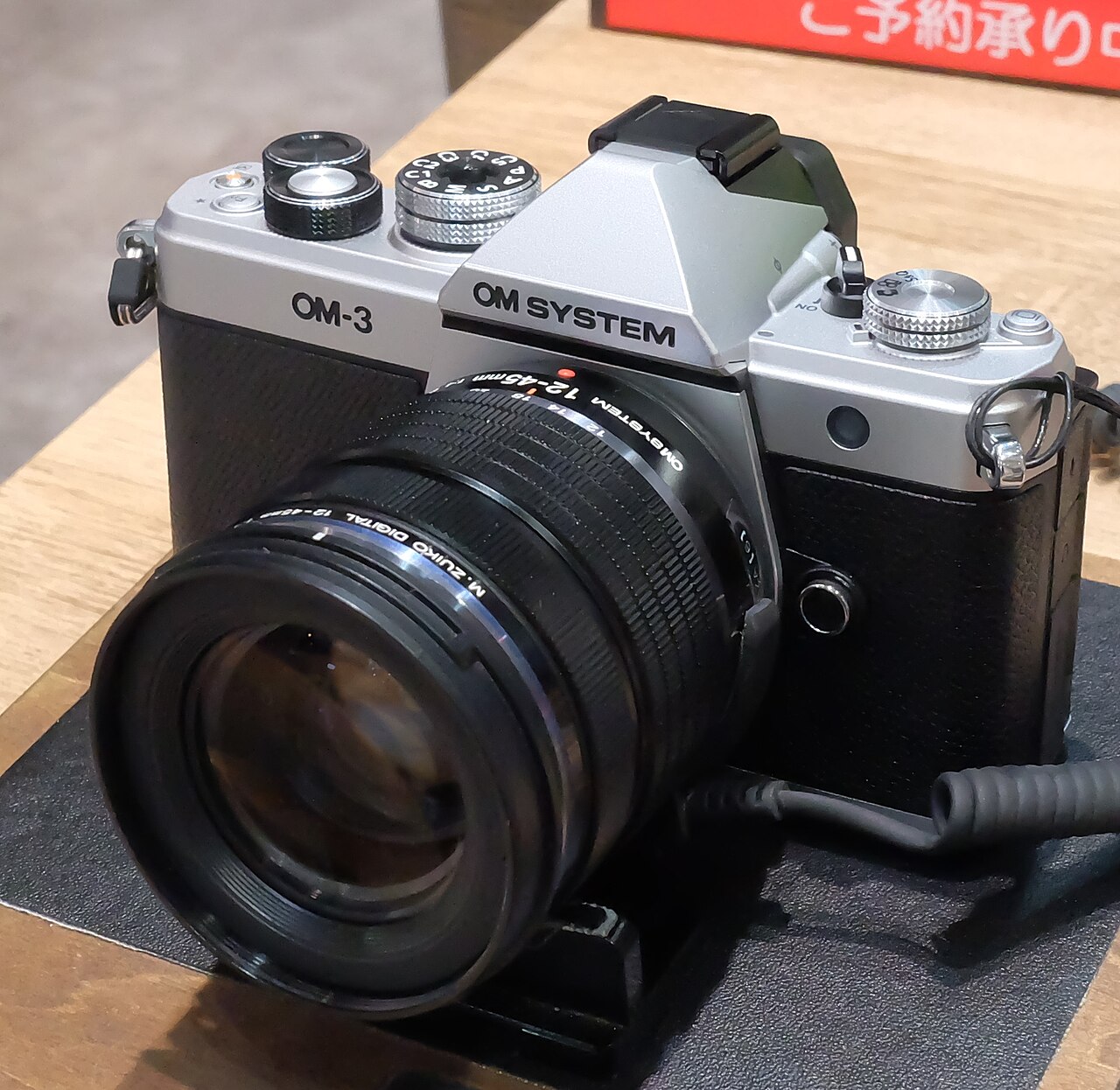
Image Quality
The 20.4MP stacked BSI sensor will not win a megapixel contest against 40MP-class APS-C or full-frame rivals, but it produces clean, well-controlled files across its native ISO 200–25,600 range, extending to ISO 102,400. The stacked architecture sharply reduces rolling shutter and read noise, so high-ISO shots stay usable and electronic-shutter action looks crisp. The Four Thirds 2x crop factor is a genuine asset for telephoto work — a 300mm lens delivers a 600mm full-frame-equivalent field of view. When you need more detail, High Res Shot composites multiple frames into an 80MP tripod image or a 50MP handheld shot, pushing resolution well beyond the sensor’s native output.
Autofocus & Speed
Autofocus is where the OM-3 most surprises at this size. The 1053-point cross-type phase-detection array, inherited directly from the OM-1 Mark II, covers the frame and locks on quickly. AI subject detection recognizes faces and eyes, animals, birds, and vehicles such as trains, planes, and automobiles. Burst rates reach 120 fps with single AF and a blackout-free 50 fps with continuous AF, while Pro Capture buffers frames while the shutter is half-pressed so you never miss the decisive moment. It is arguably overkill for street photography — and exactly right for wildlife and action.
Video
The OM-3 records DCI 4K/C4K and UHD 4K at up to 60p internally in both 8-bit and 10-bit 4:2:0, with OM-Log400, HLG, and FLAT profiles for grading, plus 24-bit/96kHz audio capture. The OM-Cinema art profiles bake film-look presets straight into the camera, and ProRes RAW output is available over HDMI to compatible Atomos recorders. The main trade-off versus the OM-1 Mark II is slow motion: there is no Full HD 240fps mode here — 1080p tops out at 60p.
Design & Handling
Design is the OM-3’s whole point. It borrows the flat top plate, metal dials, and minimalist grip of the original Olympus OM-1, and at roughly 496 g with battery and card it is genuinely light for an interchangeable-lens camera. The Creative Dial on the front gives one-touch access to color and monochrome profiles, while a dedicated Computational Photography button summons High Res, Live ND, and Focus Stacking without menu-diving. The 3-inch vari-angle touchscreen and 2.36M-dot OLED viewfinder are solid, though the EVF is a step below the 5.76M-dot unit on the OM-1 Mark II. The single UHS-II SD slot is the one meaningful compromise for working pros.
Full Specifications
| Specification | OM System OM-3 |
|---|---|
| Sensor | 20.4MP Stacked BSI Live MOS (Four Thirds, 17.3 × 13 mm) |
| Image processor | TruePic X |
| ISO range | 200–25,600 (standard), 102,400 (extended) |
| Image stabilization | 5-axis, 6.5 stops (body) / 7.5 stops (Sync IS) |
| Autofocus | 1053-point cross-type Quad Pixel phase-detection, AI subject detection |
| Continuous shooting | 10 fps mechanical, 50 fps (C-AF), 120 fps (S-AF) |
| Shutter speed | 1/8000 s–60 s (mechanical), up to 1/32000 s (electronic) |
| Video | DCI 4K/C4K & UHD 4K up to 60p (8-bit/10-bit 4:2:0), OM-Log400, HLG; ProRes RAW via HDMI |
| Viewfinder | 2.36M-dot OLED, 0.69×, 100% coverage |
| LCD | 3.0″ 1.62M-dot vari-angle touchscreen |
| Storage | 1× SD UHS-II |
| Connectivity | USB-C, Wi-Fi, Bluetooth, Micro HDMI, mic & headphone jacks |
| Weather sealing | IP53 (dust & splash resistant) |
| Battery | BLX-1, approx. 590 shots (CIPA) |
| Weight | Approx. 496 g (with battery & memory card) |
| Launch price | $1,999.99 (body only); $2,299.99 (kit with 12-45mm F4 PRO) |
How the OM-3 Compares
| Specification | OM System OM-3 | OM System OM-1 Mark II | Fujifilm X-T50 |
|---|---|---|---|
| Sensor | 20.4MP Stacked BSI MFT | 20.4MP Stacked BSI MFT | 40.2MP APS-C X-Trans 5 HR |
| Image stabilization | 6.5 stops (7.5 Sync IS) | 8.5 stops | 7.0 stops |
| Continuous shooting | 120 fps S-AF / 50 fps C-AF | 120 fps S-AF / 50 fps C-AF | 20 fps (e-shutter) |
| Video | 4K/C4K 60p (10-bit) | 4K/C4K 60p + FHD 240p | 6.2K/30p, 4K/60p, FHD 240p |
| Viewfinder | 2.36M-dot, 0.69× | 5.76M-dot, 1.48× | 2.36M-dot, 0.62× |
| Card slots | 1× UHS-II | 2× UHS-II | 1× UHS-II |
| Weather sealing | IP53 | IP53 | None |
| Weight | Approx. 496 g | Approx. 599 g | 438 g |
| Launch price (body) | $1,999.99 | ≈$2,199 | $1,399.95 |
Verdict
The OM-3 is a rare camera that hides flagship performance inside a travel-friendly retro body. It is ideal for street, travel, and everyday shooting, with enough speed and computational tricks to punch far above its size. The single card slot, modest EVF resolution, and missing 240fps slow motion are the main trade-offs versus the OM-1 Mark II — but for most shooters they are worth it for the smaller size and lower price. If you want a genuinely enjoyable camera that travels light without giving up serious capability, the OM-3 is one of the best Micro Four Thirds options of 2025.
What Amazon Buyers Say
Across 33 ratings on Amazon, the OM-3 holds a 4.6 out of 5 stars average, with 84% of buyers awarding five stars and just 4% scoring it one star.
| Rating | Share of reviews |
|---|---|
| ★★★★★ (5 stars) | 84% |
| ★★★★ (4 stars) | 6% |
| ★★★ (3 stars) | 6% |
| ★★ (2 stars) | 0% |
| ★ (1 star) | 4% |
Here is what verified buyers highlight in their own words (drawn from Amazon’s “Customers say” summary):
“Great camera, love it. I think the price is a little too high — but it’s a great camera.”
“It is great! Love it. I upgraded from the Lumix G7 and it’s a whole different world in terms of quality of the images.”
“It’s a very powerful and fun camera in a very small package. The stacked sensor provides impressive speed and the battery life is excellent.”
“It has all of the OM-1 features in an amazingly compact and well-designed body.”
Read the full set of customer reviews on Amazon’s OM-3 review page.
FAQ
Is the OM-3 weather sealed?
Yes. The OM-3 is rated IP53 for dust and splash resistance, matching the OM-1 series, so it holds up to light rain and dusty conditions with a sealed lens attached.
Does the OM-3 have a built-in flash?
No. Like the OM-1 Mark II, the OM-3 has no built-in flash. It relies on the hot shoe and external flashes, and it is compatible with Olympus/OM System and other Micro Four Thirds flash units.
How long does the battery last?
The BLX-1 battery is CIPA-rated for roughly 590 shots per charge and recharges over USB-C PD, which is a useful touch for travel and on-the-go shooting.
Related Posts
Nikon Z6 III Review (2026): The Video-First Full-Frame Powerhouse
Disclosure: This article contains affiliate links. If you buy through…
Best Cameras Under $500 in 2026: Top Picks for Photos, Video, and Adventure
You do not need to spend four figures to get…
Best Budget Lenses for Beginners: 7 Affordable Upgrades That Beat Your Kit Lens
Every beginner starts with the kit lens — and that's…