Disclosure: This article contains affiliate links. If you buy through them, we may earn a commission at no extra cost to you.
The Canon EOS R8 is one of those cameras that feels like it shouldn’t exist at its price. It takes the 24.2-megapixel full-frame sensor and DIGIC X processor from the EOS R6 Mark II — a camera that costs roughly twice as much — and squeezes them into a body that weighs just 461 grams. For photographers stepping up from APS-C or a smartphone, and for hybrid creators who want full-frame video without the bulk, the R8 remains one of the smartest buys you can make in 2026.
What Makes the EOS R8 Special
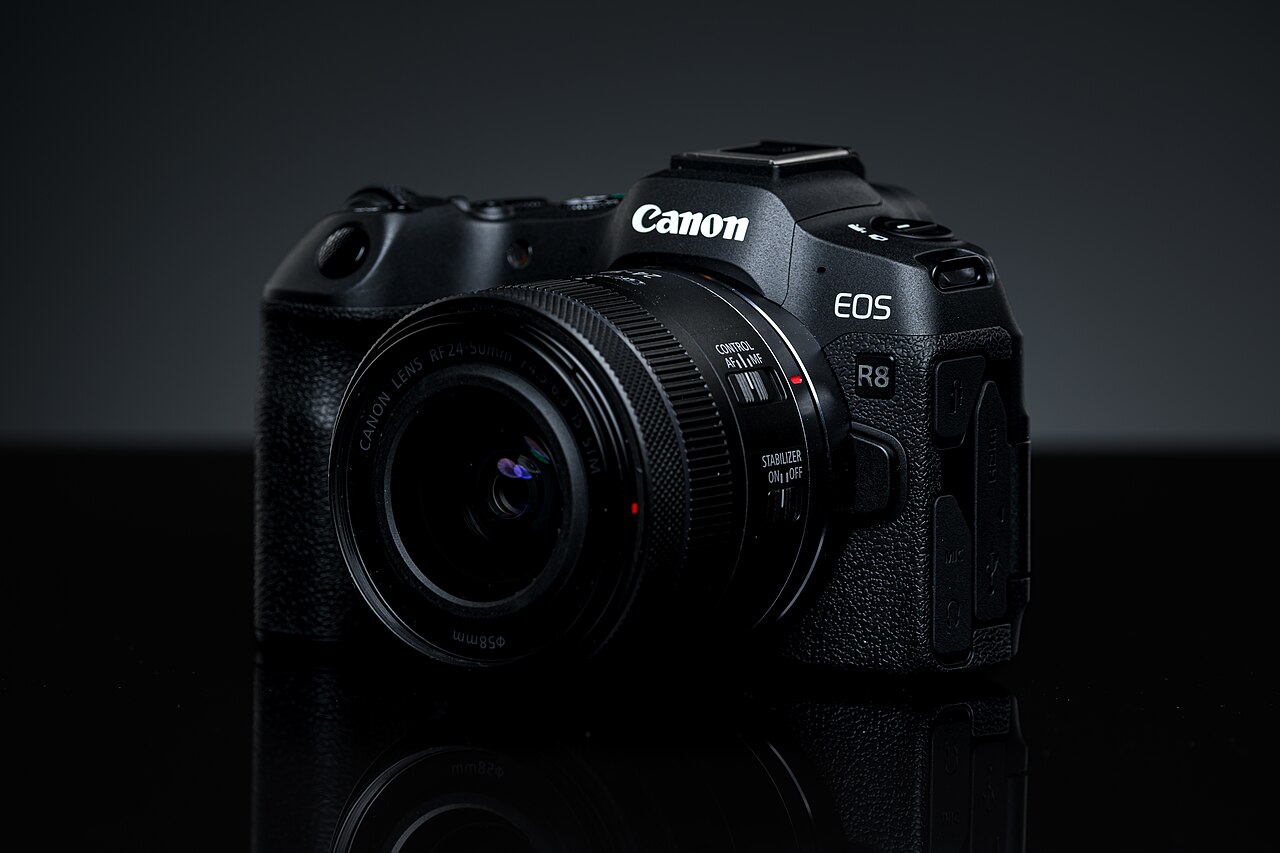
- 24.2MP full-frame CMOS sensor with the DIGIC X processor — the same imaging engine as the pricier R6 Mark II
- 40 fps continuous shooting with the electronic shutter (6 fps with electronic first-curtain)
- Dual Pixel CMOS AF II with deep-learning subject detection for people, animals, and vehicles
- 4K 60p video oversampled from 6K, plus 1080p at up to 180 fps
- Only 461 g (about 1.02 lb) — one of the lightest full-frame bodies ever made
- Canon Log 3, HDR PQ, and 10-bit 4:2:2 recording in-camera
Image Quality
The R8 inherits the exact same sensor as the R6 Mark II, and it shows. Full-frame gives you a wider dynamic range, cleaner high-ISO files, and that natural subject separation that’s hard to replicate on a crop sensor. The ISO range runs from 100 to 102,400 (expandable to 204,800), and real-world shots stay impressively clean well into five-figure territory. Colors straight out of the camera have Canon’s familiar pleasing warmth, and the sensor’s rolling shutter is noticeably better controlled than on older full-frame bodies. There’s no in-body stabilization here — that’s the one big spec you give up versus the R6 Mark II — so for slow-shutter handheld work you’ll want an RF lens with optical IS.
Autofocus & Speed
Dual Pixel CMOS AF II is genuinely excellent. It finds and tracks eyes on people and animals quickly, locks onto vehicles, and hangs on reliably even when your subject briefly leaves the frame. For action, the 40 fps electronic burst is fast enough for almost anything short of pro sports, and with a fast SD UHS-II card the buffer clears quickly. The trade-off: there’s no mechanical shutter, so under artificial light you may occasionally see banding at the highest electronic speeds — dialing down to the electronic first-curtain mode fixes it.
Video
This is where the R8 quietly over-delivers. It shoots 4K up to 60p oversampled from 6K, so footage is sharp and detailed with no crop penalty. You also get 1080p slow motion at up to 180 fps, 10-bit 4:2:2 color, Canon Log 3, and HDR PQ — a genuinely professional feature set in a sub-$1,500 body. The catch is heat and battery: the LP-E17 is small, and extended 4K/60p sessions will drain it fast (and can eventually trigger thermal limits). For short clips and vlogs it’s perfect; for long continuous interviews, plan for power and breaks.
Design & Handling
The R8 feels almost impossibly light, and that’s the whole point. The grip is shallower than on larger EOS bodies, but it’s comfortable for a day of casual shooting. You get a 3.0-inch vari-angle touchscreen, a 2.36M-dot OLED viewfinder, a single UHS-II SD slot, and mic/headphone ports. If you shoot events professionally, the single card slot and small battery are legitimate limitations — but for travel, everyday carry, and content creation, the compact footprint is the feature.
Full Specifications
| Specification | Canon EOS R8 |
|---|---|
| Sensor | 24.2MP full-frame CMOS |
| Processor | DIGIC X |
| Lens mount | Canon RF |
| Autofocus | Dual Pixel CMOS AF II (people/animal/vehicle detection) |
| Continuous shooting | 40 fps (electronic), 6 fps (electronic first-curtain) |
| ISO range | 100–102,400 (expanded 50–204,800) |
| Image stabilization | None (lens IS only) |
| Video | 4K/60p (6K oversampled), 1080p up to 180 fps, 10-bit 4:2:2, Canon Log 3 |
| Viewfinder | 0.39-in OLED, 2.36M dots |
| LCD | 3.0-in vari-angle touchscreen, 1.62M dots |
| Card slot | 1× SD UHS-II |
| Battery | LP-E17 |
| Weight | 461 g (body incl. battery & card) |
| Dimensions | 132.5 × 86.1 × 70 mm |
Canon EOS R8 vs EOS R6 Mark II vs Sony a7C II
| Feature | Canon EOS R8 | Canon EOS R6 Mark II | Sony a7C II |
|---|---|---|---|
| Price (body, approx.) | ~$1,300 | ~$2,299 | ~$2,198 |
| Sensor | 24.2MP full-frame | 24.2MP full-frame | 33MP full-frame |
| In-body stabilization | None | 5-axis (up to 8 stops) | 5-axis (up to 7 stops) |
| Continuous shooting | 40 fps | 40 fps | 10 fps |
| Video | 4K/60p (6K oversampled) | 4K/60p (6K oversampled) | 4K/60p (cropped) |
| Card slots | 1× SD UHS-II | 2× SD UHS-II | 1× SD UHS-II |
| Weight | 461 g | 670 g | 514 g |
| Battery | LP-E17 | LP-E6NH | NP-FZ100 |
Verdict
The EOS R8 is the value king of full-frame. You give up in-body stabilization, a second card slot, and a big battery — but you keep the R6 Mark II’s sensor, processor, and autofocus at roughly half the price and two-thirds the weight. For hobbyists moving up to full-frame, travel photographers, and vloggers who want serious 4K video on a budget, there is still nothing else in this price class that competes. If you can live without IBIS, this is an easy recommendation.
What Amazon Buyers Say
The EOS R8 holds a 4.8 out of 5 star average across 476 verified Amazon reviews — exceptional for any camera, let alone a full-frame body. Here’s what verified buyers consistently highlight.
| Rating summary | Value |
|---|---|
| Overall rating | 4.8 / 5 |
| Total ratings | 476 global ratings |
| Top praise | Image quality, autofocus, lightweight body |
“…The image quality is simply superb. The full-frame sensor delivers rich colors, excellent dynamic range, and incredible detail. Whether I’m shooting portraits, landscapes, or candid moments, the R8 consistently produces professional-grade results.”
“Perfect camera.”
Read all customer reviews on Amazon
FAQ
Does the Canon EOS R8 have image stabilization?
No. The R8 has no in-body image stabilization (IBIS). For handheld stabilization you’ll want to pair it with an RF lens that has optical IS, or use a stabilized adapter with EF glass.
Is the EOS R8 good for video?
Yes — it’s one of the best video values in full-frame. It records 4K up to 60p oversampled from 6K, 1080p up to 180 fps, and 10-bit 4:2:2 with Canon Log 3. Just note the small LP-E17 battery means you’ll want spares for long shoots.
What’s the difference between the EOS R8 and the R6 Mark II?
They share the same sensor, processor, and autofocus system. The R6 Mark II adds in-body stabilization, dual SD card slots, a larger battery, and a bigger grip — which is why it costs significantly more. The R8 is the lighter, cheaper version of the same core imaging tech.
Related Posts
Canon EOS R5 Mark II Review (2026): The 45MP Full-Frame Flagship
Disclosure: This article contains affiliate links. If you buy through…
Nikon Z8 Review (2026): Flagship Power in a Lighter Body
Disclosure: This article contains affiliate links. If you buy through…
Full-Frame vs Medium Format: Is It Worth Upgrading?
For years, full-frame was the summit every photographer aimed for.…