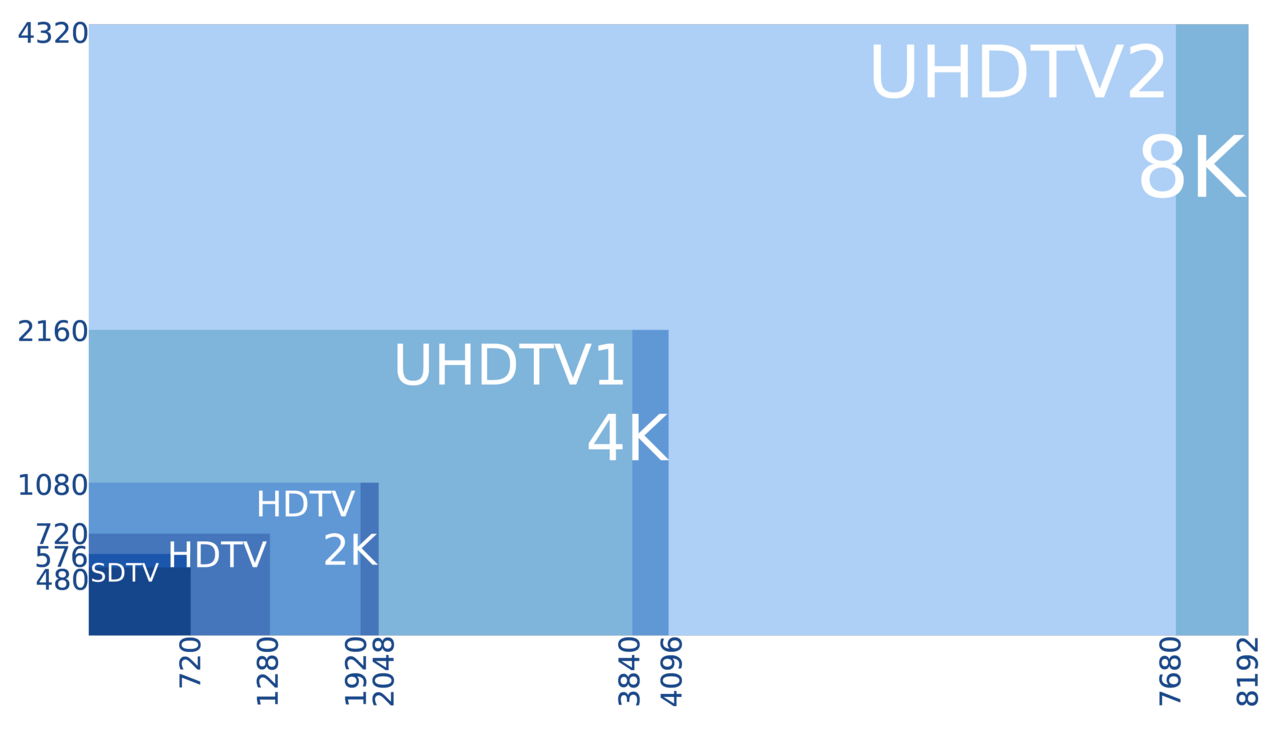
Eight years after the first 8K televisions reached store shelves, the format occupies a strange position in 2026: it is everywhere in camera spec sheets and almost nowhere in most living rooms. 8K means 7,680 × 4,320 pixels — roughly 33 million pixels per frame, four times the detail of 4K and sixteen times that of 1080p. The story of 8K adoption is really two stories running at different speeds: a capture side that has quietly matured, and a consumption side that is still waiting for content. Here is where 8K actually stands in 2026.
8K Capture Is Now a Solved Problem
On the camera side, 8K is no longer exotic. Nikon’s Z9 and Z8 pair 45.7-megapixel stacked sensors with internal 8K/60p recording in 12-bit N-RAW and ProRes RAW, and the Z9’s active-cooling design lets it record 8K continuously for well over two hours without overheating. Canon’s EOS R5 Mark II captures 8K/60p RAW from a 45-megapixel stacked sensor, while Sony’s A1 and A1 II offer 8K/30p — the A1 II pairing 61 megapixels with class-leading autofocus. The overheating limits that dogged the original Canon EOS R5 in 2020 have largely been engineered out through heat sinks and active cooling.
For many shooters, the point of 8K isn’t 8K. Capturing in 8K and delivering in 4K gives editors room to crop, reframe, and stabilize without losing detail, and every frame holds enough pixels to pull a 33-megapixel still. The trade-off is data: 12-bit N-RAW runs around 5 GB per minute, while ProRes RAW is closer to 19 GB per minute. Fast CFexpress cards and serious NVMe storage have become the format’s hidden cost.
The Display Side: A Slow Burn
8K televisions are real products, not vaporware. Samsung’s Neo QLED 8K line, LG’s 8K OLED panels, and Sony’s 8K BRAVIA sets are all shipping, and analysts value the 8K TV market at roughly $2.2 billion in 2025, with forecasts pointing to strong growth through 2034. But the installed base remains tiny next to 4K.
The reason most 8K sets sell is AI upscaling, not 8K content. Because native 8K video is scarce, 8K TVs spend almost all their time upscaling 4K and HD — a capability that visibly improves the picture even on a 4K screen. There is also an honest physics problem: at typical living-room seating distances, the extra pixels of 8K are nearly invisible below very large screen sizes, which is why many reviewers still recommend a premium 4K OLED over a mid-tier 8K panel.
Streaming: The Content Gap Is Still the Story
If capture is solved and displays are available, streaming is where 8K stalls. As of early 2026, no major subscription service — Netflix, Prime Video, Disney+, Apple TV+, or Max — streams native 8K. The practical ceiling for mainstream streaming remains 4K HDR.
YouTube is the de facto home of 8K video, serving creator uploads in AV1 and VP9, and Vimeo also hosts native 8K. Japan’s NHK continues to operate its BS8K satellite channel, the world’s most sustained experiment in 8K broadcasting. Bandwidth is no longer the main blocker: modern codecs deliver 8K at roughly 20–50 Mbps (AV1) or 40–100 Mbps (HEVC), comfortably within reach of fiber and fast cable. What holds major streamers back is the cost of producing 8K content and the small installed base of displays to watch it on.
Where 8K Stands in 2026
The short version: 8K has won on the capture side, is a slow burn on the display side, and is a waiting game on the delivery side. Filmmakers, wedding videographers, and YouTubers shoot 8K today because it future-proofs their work and pays off immediately in cleaner 4K deliverables. Consumers, by contrast, have little reason to upgrade yet — the content simply isn’t there, and upscaling closes most of the visible gap.
Conclusion
8K in 2026 is best understood as an upstream technology that matured before its audience arrived. That is not failure — 4K followed the same arc, with cameras and panels landing years before mainstream streaming. The most likely path forward is that AI upscaling quietly bridges the gap until streaming services commit, at which point the 8K capture pipeline is already in place. For now, 8K is the format professionals shoot in, and everyone else watches upscaled.
Frequently Asked Questions
Is 8K streaming available in 2026?
Native 8K is available on YouTube (via AV1 and VP9) and Vimeo, but no major subscription service streams 8K. Netflix, Disney+, Prime Video, Apple TV+, and Max all top out at 4K HDR.
Do I need an 8K TV?
For most viewers, no. At normal seating distances the extra resolution is hard to see below very large screens, and AI upscaling on a premium 4K set closes much of the gap.
Which cameras record 8K video?
Nikon’s Z9 and Z8 (8K/60p RAW), Canon’s EOS R5 and R5 Mark II, and Sony’s A1 and A1 II (8K/30p) are the main mirrorless options.
Featured image: Nikon Z9 by Peachyeung316, CC BY-SA 4.0, via Wikimedia Commons.
Related Posts
Sony LYT-901: The First 200MP Smartphone Sensor with Built-in AI
Sony has officially entered the 200-megapixel race. On November 27,…

Fujifilm GFX100RF Medium Format Launch: 102MP in a Compact Fixed-Lens Body
Fujifilm has just done something it has never attempted in…

The Rise of Global Shutter Sensors: Sony a9 III and the End of Rolling Shutter
For more than two decades, nearly every digital camera you…