Every landscape photographer hits the same wall: you want the flowers in the foreground and the mountain range on the horizon sharp in a single frame, but your lens can only hold so much in focus. Hyperfocal distance is the focusing technique that solves this — set your lens to the right distance, and everything from a few feet in front of you all the way to infinity comes out acceptably sharp. In this guide we’ll explain what hyperfocal distance is, how to calculate it, and how to apply it in the field.
What Is Hyperfocal Distance?
The hyperfocal distance is the closest focusing distance at which a lens still renders objects at infinity acceptably sharp. Focus your lens at exactly this distance and the depth of field stretches from half the hyperfocal distance all the way to infinity. That single number is why it’s so powerful for landscape and street photographers: one focus setting buys you maximum sharpness across an entire scene.
Mathematically, the hyperfocal distance H is:
H = f² ÷ (N × c)
- f = focal length (in millimetres)
- N = aperture (f-number)
- c = circle of confusion (a tolerance you choose, in millimetres)
What Is the Circle of Confusion?
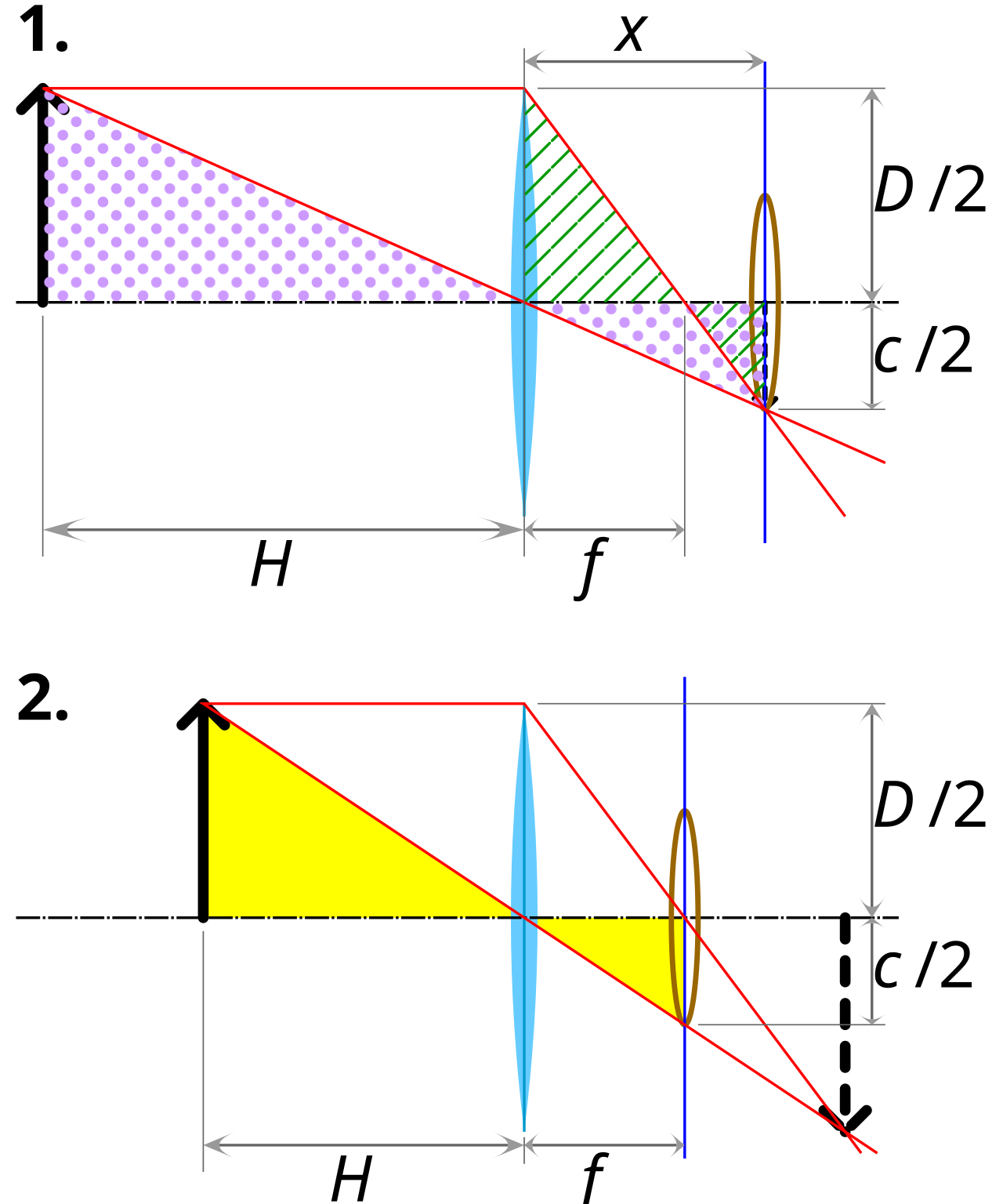
The circle of confusion (CoC) is the largest blur circle the eye still reads as a sharp point. It’s a tolerance, not a physical constant — it’s chosen based on sensor size and how big you’ll view or print the image. The commonly used values are about 0.03 mm for full-frame sensors and about 0.02 mm for APS-C. Because a smaller sensor must be magnified more to reach the same print size, it gets a tighter (smaller) CoC, which in turn changes the hyperfocal distance.
How to Calculate It (With a Real Example)
Let’s work through a common setup: a 24 mm lens at f/8 on a full-frame camera (Canon, Nikon, and Sony all use the ~0.03 mm standard).
H = 24² ÷ (8 × 0.03) = 576 ÷ 0.24 = 2,400 mm = 2.4 m.
So you focus at 2.4 m, and everything from about 1.2 m to infinity is in focus. Switch to a 16 mm lens at f/11 and the number drops dramatically: H = 256 ÷ (11 × 0.03) ≈ 0.78 m — focus at 0.78 m and everything from roughly 0.4 m to infinity is sharp.
The takeaway: wider lenses and smaller apertures shrink the hyperfocal distance, making it easier to get near-to-far sharpness. In practice, most people don’t do the arithmetic by hand — hyperfocal-distance charts, lens barrel scales, and smartphone apps all exist for this.
How to Use It in the Field
- Stop down first. Landscapes rarely need f/2.8; f/8 to f/11 is the sweet spot that extends depth of field without heavy diffraction.
- Use an app or chart to find H for your focal length and aperture, then switch to manual focus and set the lens to that distance using the distance scale or focus peaking.
- Focus magnifier helps. Zoom into a detail roughly one-third into the scene in live view, confirm it’s sharp, and you’re often close enough.
- Rule-of-thumb fallback: focusing about one-third of the way into the scene approximates the hyperfocal method when you can’t calculate precisely.
Hyperfocal Distance vs Focusing to Infinity
Many photographers simply focus on the horizon. That works when there’s nothing of interest nearby, but it wastes depth of field: with a 24 mm at f/8, focusing to infinity keeps everything from about 2.4 m to infinity sharp, while hyperfocal focusing pulls the near limit all the way back to 1.2 m. If you have a striking foreground, hyperfocal focusing is the difference between it being sharp and it being soft.
Limitations and Caveats
- The CoC is an assumption. It’s built around a standard viewing distance and print size. Pixel-peep a 45+ megapixel file and “acceptably sharp” gets stricter, effectively shortening your usable depth of field.
- Diffraction. Going beyond f/11–f/16 introduces softness from diffraction that can cancel the gains from added depth of field.
- Telephotos have huge hyperfocal distances. A 200 mm lens at f/8 has H ≈ 167 m — the technique is really a wide-angle tool.
Conclusion
Hyperfocal distance is one of the oldest tricks in photography and still one of the most useful for landscape and street work. Understand the three inputs — focal length, aperture, and the circle of confusion — and you’ll know exactly where to focus to keep a whole scene sharp from foreground to horizon. Next time you’re out with a wide-angle lens, dial in the hyperfocal distance instead of defaulting to the horizon, and watch your near-to-far sharpness improve.
FAQ
What aperture should I use for hyperfocal distance?
Between f/8 and f/11 is the usual sweet spot for full-frame landscape work. Smaller apertures (higher f-numbers) shrink the hyperfocal distance but eventually add diffraction softness.
Does hyperfocal distance work for portraits?
Rarely. Portraits usually want a shallow depth of field to blur the background, which is the opposite of what hyperfocal focusing achieves.
Can I use hyperfocal distance on a smartphone?
Most phones don’t expose a manual hyperfocal control, but their small sensors already give deep depth of field. Some third-party camera apps let you set focus manually for creative near-to-far shots.
Do I need to buy an app to use hyperfocal distance?
No. Printed charts and online calculators are free, and many lenses still carry a distance scale with aperture markings you can read directly.
Related Posts
Astrophotography: A Beginner’s Guide to Photographing the Milky Way
Pointing a camera at the night sky and capturing the…
Camera Filters Explained: ND, Polarizer, and UV — What They Do and When to Use Them
Walk into any camera store and you will find a…
How to Read a Histogram: A Beginner’s Guide to Perfect Exposure
Your camera's histogram is one of its most useful tools…