Every photographer hits the same wall sooner or later: you expose for a bright sky and the foreground turns to black, or you expose for your subject and the sky blows out to pure white. That wall has a name — dynamic range — and understanding it is one of the most useful pieces of sensor knowledge you can have.
What Is Dynamic Range?
Dynamic range is the span between the brightest and darkest tones a camera can record in a single frame, from the point where highlights clip to pure white down to where shadows sink into the sensor’s noise floor. It is measured in stops (also called EV), where each stop represents a doubling of light.
A camera with 14 stops of dynamic range can record a scene whose brightest area is roughly 16,000 times brighter than its darkest (2ⁿ for 14 stops is about 16,384). That sounds enormous, but it is a hard, finite ceiling — and real scenes routinely exceed it.

Where the Number Comes From
Dynamic range is a physics limit, not a software setting. It is set by two things: the full-well capacity of each photosite — how many photons it can collect before it saturates — and the sensor’s read noise, the tiny electronic signal present even with the lens cap on.
Dynamic range is essentially the ratio of the two: how much signal the pixel can hold, divided by how much noise is already there. The bigger the pixel or the cleaner its electronics, the wider the range. This is why sensor size matters.
Modern full-frame sensors sit around 14–15 stops at base ISO. Sony’s 61-megapixel a7R V measured 14.8 stops at ISO 100 in DxOMark testing, and Canon and Nikon full-frame bodies land within a fraction of a stop of one another — differences of 0.2–0.3 stops are real but rarely visible in practice. APS-C cameras typically manage 12–13 stops, and tiny phone sensors, with their physically small photosites, land lower still.
Why Highlights Clip and Shadows Crush
When a photosite fills to capacity, it simply stops counting. Any additional light produces no new data, so every highlight above that threshold renders as the same flat white — that’s clipping. At the other end, faint signals fall below the noise floor and become indistinguishable from sensor noise, so deep shadows turn to murky gray or blocky color — that’s crushing.
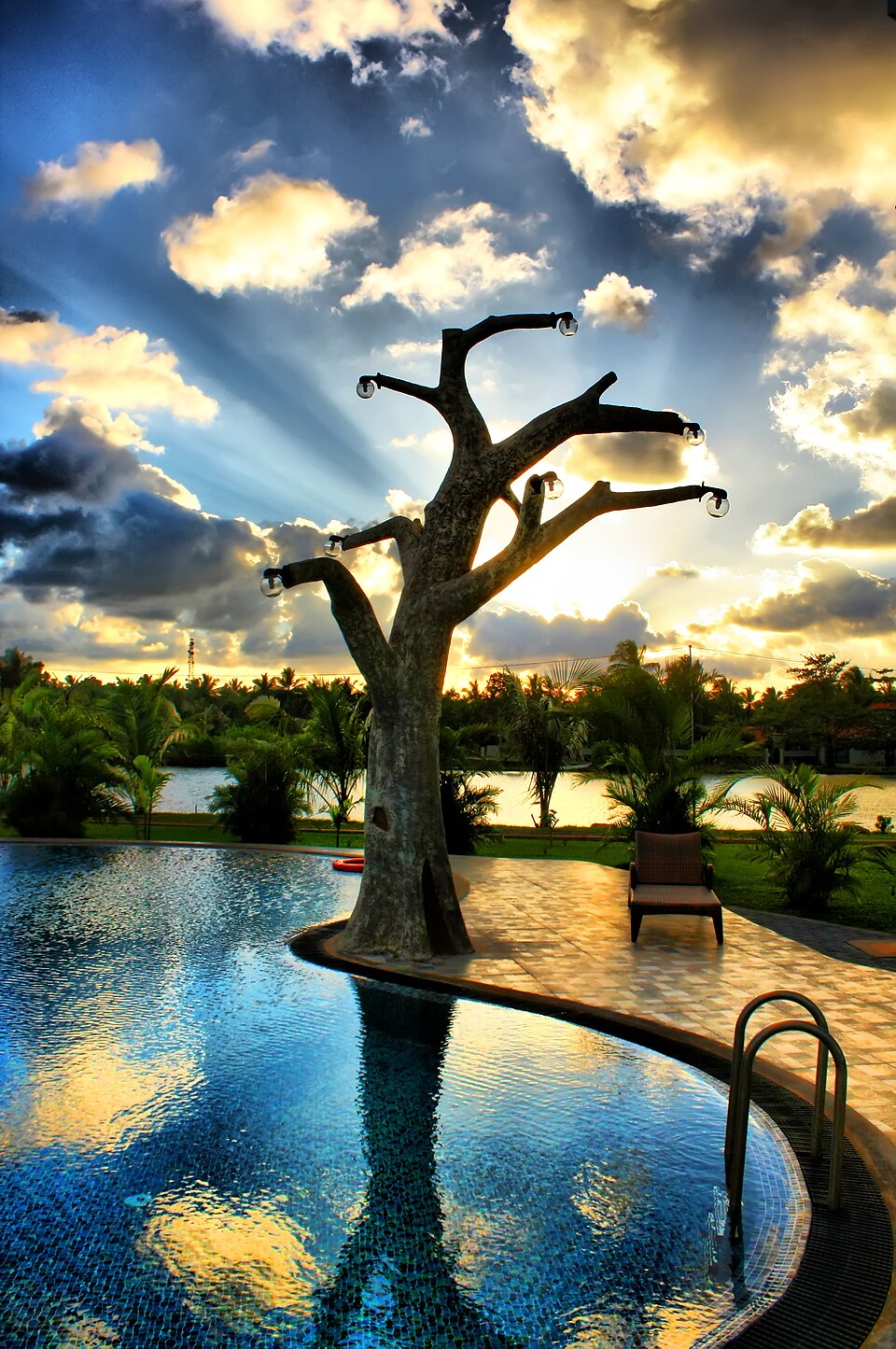
This is why a single exposure of a backlit scene is a compromise. A sunset over a landscape can span 15 or more stops; a 14-stop sensor cannot hold both the bright sky and the dark foreground in one frame without losing one of them. The camera isn’t broken — the scene is simply bigger than the sensor.
How ISO Changes the Picture
Raising ISO does not create more dynamic range — it does the opposite. Higher ISO amplifies the signal, but it amplifies the noise floor too, so the usable range between clipping and noise shrinks. A camera with 14.8 stops at ISO 100 may fall to around 12 stops at ISO 1600, and less at higher settings.
That’s why high-ISO photos look flatter and noisier: the sensor is working with a narrower band of clean tones. Whenever possible, keep ISO low to preserve maximum range.
Working Around the Limits
You can’t change your sensor’s dynamic range, but you can shoot within it. The most useful habits:
- Expose to the right (ETTR): push the histogram as far right as possible without clipping, then pull exposure back in editing. This captures the most shadow detail.
- Expose for the highlights: protect the sky, then lift shadows in post. Modern sensors are largely “ISO invariant,” so shadow recovery is cleaner than it used to be — especially from RAW.
- Bracket and merge: shoot two or three exposures (dark, mid, bright) and blend them into an HDR image that spans far more than a single frame.
- Use graduated ND filters: darken the bright sky optically so the whole scene fits into the sensor’s range at capture time.
- Shoot RAW: RAW files retain more tonal data than JPEG, giving you more room to recover both ends.
Conclusion
Dynamic range is the invisible spec that decides whether your sky is blue or white, and whether your shadows hold detail or fall to black. It is a fixed property of your sensor, set by physics — but once you know where the ceiling is, you can expose, filter, and bracket your way around it. Match your technique to your sensor’s range, and you’ll stop fighting blown highlights for good.
FAQ
How many stops can the human eye see?
The eye adapts dynamically — the pupil opens and closes and the retina chemically re-tunes — so it copes with a far wider total range than any single camera frame, roughly on the order of 20 stops. Its instantaneous, single-look range is much smaller, which is why we squint at bright scenes.
Is more dynamic range always better?
For most photography, yes — it means fewer clipped highlights and cleaner shadows. But it usually tracks with larger photosites and sensors, which come with their own cost and size tradeoffs.
Where can I find my camera’s measured dynamic range?
Manufacturers rarely list it. Independent labs such as DxOMark and PhotonsToPhotos publish measured dynamic-range figures for most current cameras.
Do I still need HDR if my camera has 14 stops?
Often yes. High-contrast scenes — sunrises, sunsets, interiors with windows — can exceed 15 stops, so bracketing and merging still recovers detail a single exposure can’t.
Related Posts
Camera Sensor Crop Factor Explained: Full Frame, APS-C and More
When you shop for a camera or lens, two phrases…
How Image Stabilization Works: OIS vs IBIS vs EIS Explained
Blurry handheld shots are one of the most common frustrations…
Stacked CMOS Sensors Explained: How They Work and Why They Matter
APS-C CMOS image sensor. Photo: Friedrich Haag, CC BY-SA 4.0,…