Disclosure: This article contains affiliate links. If you buy through them, we may earn a commission at no extra cost to you.
The Sigma 24-70mm f/2.8 DG DN II Art is the second-generation version of Sigma’s flagship standard zoom, and it’s a far more significant update than the “II” badge suggests. Rather than a mild refresh, Sigma rebuilt the lens from the ground up with a new optical formula, a faster HLA autofocus motor, and a body that’s roughly 10% lighter and 7% smaller than the original. For Sony E-mount (and L-mount) shooters who want professional-grade performance without paying the Sony GM II premium, it’s one of the most compelling lenses to arrive in 2024.
What Makes the Sigma 24-70mm F2.8 DG DN II Art Special
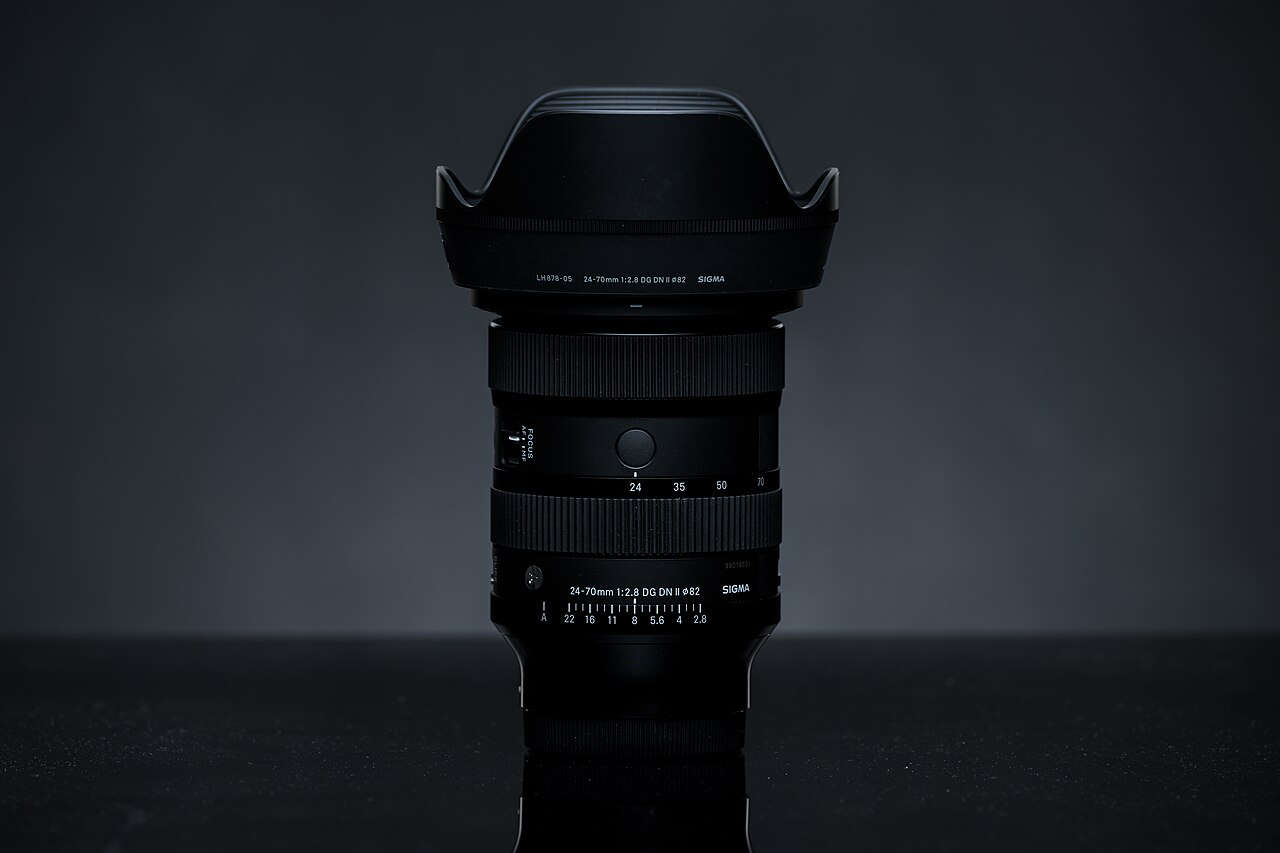
- Classic 24-70mm f/2.8 constant-aperture range — the workhorse for events, weddings, and everyday work
- New 19-element/15-group optical design with 6 FLD and 2 SLD low-dispersion elements for high resolving power
- HLA (High-response Linear Actuator) motor — Sigma claims up to 3× faster autofocus than the original
- Roughly 10% lighter and 7% smaller than the first-generation Art zoom
- De-clickable aperture ring, dual AFL buttons, and a zoom lock switch
- Dust- and splash-resistant build with water- and oil-repellent front coating
Image Quality
The optical formula packs 19 elements into 15 groups, including six FLD and two SLD low-dispersion elements plus five aspherical elements. The result is excellent sharpness that holds up across the frame wide open at f/2.8 and improves further when stopped down. Independent tests show clearly better resolving power than the first-generation Art lens, particularly on high-resolution bodies like the Sony a7R V. The 11 rounded aperture blades keep out-of-focus highlights nicely circular, and Sigma’s Nano Porous and Super Multi-layer coatings keep flare and ghosting well controlled in backlit scenes.
Autofocus & Speed
The switch to an HLA linear motor is the single biggest functional upgrade. Autofocus is fast, near-silent, and decisive, and it tracks moving subjects confidently. Sigma claims up to three times faster focusing than the original, and in practice the lens feels immediate — it pairs cleanly with Sony’s real-time Eye AF and subject tracking, snapping into focus without hunting.
Video
The near-silent HLA motor and minimal focus breathing make this a strong hybrid option for video. The de-clickable aperture ring lets you ride exposure smoothly mid-shot without the stepped “clicks” showing up in the footage, and the smooth, well-damped focus pulls suit run-and-gun shooting. There’s no optical stabilization on board — you’ll rely on your camera’s IBIS — but that’s standard for fast zooms in this class.
Design & Handling
At about 735 g for the Sony E version, the lens is roughly 85 g lighter than the original and only slightly heavier than Sony’s GM II. The barrel is metal and weather-sealed, with a rubber gasket at the mount. The addition of an aperture ring (with a lock and click on/off switch), two customizable AFL buttons, and a zoom lock switch brings the handling in line with premium first-party lenses — a welcome step up from the original, which had none of these.
Full Specifications
| Specification | Detail |
|---|---|
| Focal Length | 24–70mm |
| Maximum Aperture | f/2.8 (constant) |
| Minimum Aperture | f/22 |
| Optical Design | 19 elements in 15 groups (6 FLD, 2 SLD, 5 aspherical) |
| Aperture Blades | 11 (rounded) |
| Minimum Focus Distance | 0.17 m (24mm) / 0.34 m (70mm) |
| Maximum Magnification | 1:2.7 (at 24mm) |
| Autofocus | HLA (High-response Linear Actuator) |
| Image Stabilization | None (relies on camera IBIS) |
| Filter Size | 82mm |
| Dimensions | 87.8 × 122.2 mm (Sony E) |
| Weight | 735 g (Sony E) / 745 g (L-mount) |
| Mounts | Sony E, L-mount |
| Weather Sealing | Dust- & splash-resistant; water/oil-repellent coating |
| Coatings | Nano Porous Coating + Super Multi-layer Coating |
| Price | $1,219 (Amazon) / $1,319 list |
Sigma 24-70mm II Art vs. the Competition
| Feature | Sigma 24-70mm II Art | Sony FE 24-70mm GM II | Sigma 24-70mm Art (original) |
|---|---|---|---|
| Price | $1,219 | ~$2,298 | ~$1,099 |
| Weight | 735 g | 695 g | 830 g |
| Elements / Groups | 19 / 15 | 20 / 15 | 19 / 15 |
| AF Motor | HLA linear | 4× XD linear | Stepping motor |
| Aperture Ring | Yes (de-clickable) | Yes (de-clickable) | No |
| Aperture Blades | 11 | 11 | 11 |
| Filter Size | 82mm | 82mm | 82mm |
Verdict
At $1,219, the Sigma 24-70mm f/2.8 DG DN II Art delivers a large slice of the Sony FE 24-70mm f/2.8 GM II’s performance at roughly half the price. For event, wedding, portrait, and general-purpose shooters on Sony E-mount, it’s an easy recommendation: sharp, fast-focusing, and dramatically improved in handling over the original. The only real trade-offs are the absence of optical stabilization (standard in this class) and a little extra weight versus the GM II.
What Amazon Buyers Say
The lens holds a 4.5 out of 5 star average across 391 global ratings at the time of writing. Here’s how those ratings break down:
| Rating | Share of Reviews |
|---|---|
| 5 stars | 84% |
| 4 stars | 6% |
| 3 stars | 1% |
| 2 stars | 2% |
| 1 star | 7% |
“…excellent image quality… brings out the best of high-resolution Sony cameras… captures detailed images.”
“…fast autofocus… sharpness throughout the zoom range… good value for the price.”
“…suitability for weddings and portraits… opinions about its weight are mixed.”
Read the full set of buyer reviews on the Amazon reviews page.
FAQ
Does the Sigma 24-70mm f/2.8 DG DN II Art have image stabilization?
No. The lens has no optical stabilization and relies on the in-body image stabilization (IBIS) of your camera, which is standard practice for fast standard zooms.
Is it fully compatible with my Sony camera?
Yes. It’s a native Sony E-mount lens with full electronic communication, so continuous autofocus, Eye AF, and in-camera lens corrections all work on Sony E-mount bodies.
How does it compare to the Sony 24-70mm f/2.8 GM II?
It’s noticeably cheaper ($1,219 vs ~$2,298) and slightly heavier (735 g vs 695 g), while delivering very close image quality and excellent autofocus. The Sony still edges it out in outright corner sharpness and top-end AF speed, but the Sigma gets you most of the way for about half the money.
Related Posts
Full-Frame vs Medium Format: Is It Worth Upgrading?
For years, full-frame was the summit every photographer aimed for.…
Panasonic Lumix S5 II Review: The Full-Frame Hybrid That Finally Nailed Autofocus
Disclosure: This article contains affiliate links. If you buy through…
Prime vs Zoom Lenses: Which Should You Buy?
Every photographer eventually stands at the same fork in the…