When you shop for a camera or lens, two phrases keep coming up: crop factor and “35mm equivalent” focal length. They sound technical, but they are really just a translation tool — a way to describe how a lens will actually behave on the camera you are holding, compared to the classic 35mm film (full-frame) standard of 36 × 24 mm.
What Is Crop Factor?
Crop factor (also called focal length multiplier or format factor) is the ratio between a camera’s sensor size and the 35mm full-frame reference. It is usually calculated from the sensor diagonals: the full-frame diagonal of 43.3 mm divided by your sensor’s diagonal. A full-frame sensor has a crop factor of 1.0×; any smaller sensor gets a factor greater than 1.
The most important thing to remember is that a lens’s focal length is fixed by its optical design and never changes when you mount it on a different camera. Crop factor does not magically “zoom in.” Instead, the smaller sensor simply records a smaller central area of the image circle the lens projects — effectively cropping the edges of the frame.
How Crop Factor Changes Field of View
The best way to picture it is as a literal crop. A 50mm lens on a full-frame camera captures a certain angle of view. Put that same 50mm on a Canon APS-C body with a 1.6× crop factor and the field of view narrows to match an 80mm lens on full frame (50 × 1.6 = 80). The subject is not magnified more — you are simply using a smaller portion of the lens’s image circle.
This cuts both ways, which is why crop factor matters at both ends of the focal-length range:
- Wide angle: a 28mm wide-angle lens behaves like a roughly 45mm “normal” lens on a 1.6× body, so it loses much of its wide feel.
- Telephoto: a 300mm lens behaves like a 480mm lens on a 1.6× body, giving extra “reach” — a real advantage for wildlife and sports photography.
Common Sensor Formats and Their Crop Factors
Here are the crop factors you will meet most often in today’s cameras:
- Full frame (36 × 24 mm) — 1.0× (Canon EF, Nikon FX, Sony FE, Pentax K-1)
- APS-H — 1.3× (older Canon 1D-series bodies, Leica M8)
- APS-C — 1.5× (Nikon DX, Sony E, Fujifilm X, Pentax K, Samsung NX)
- Canon APS-C (22.2 × 14.8 mm) — 1.6×
- Micro Four Thirds / Four Thirds — 2.0× (Olympus/OM System, Panasonic)
- 1-inch type — 2.7× (Sony RX100 series, Nikon 1)
- Medium format — about 0.79× (Hasselblad, Phase One, Fujifilm GFX)
Notice that medium-format sensors are larger than full frame, so their crop factor is below 1. They behave as if your lens were wider, not longer.
Crop Factor, Depth of Field and Low Light
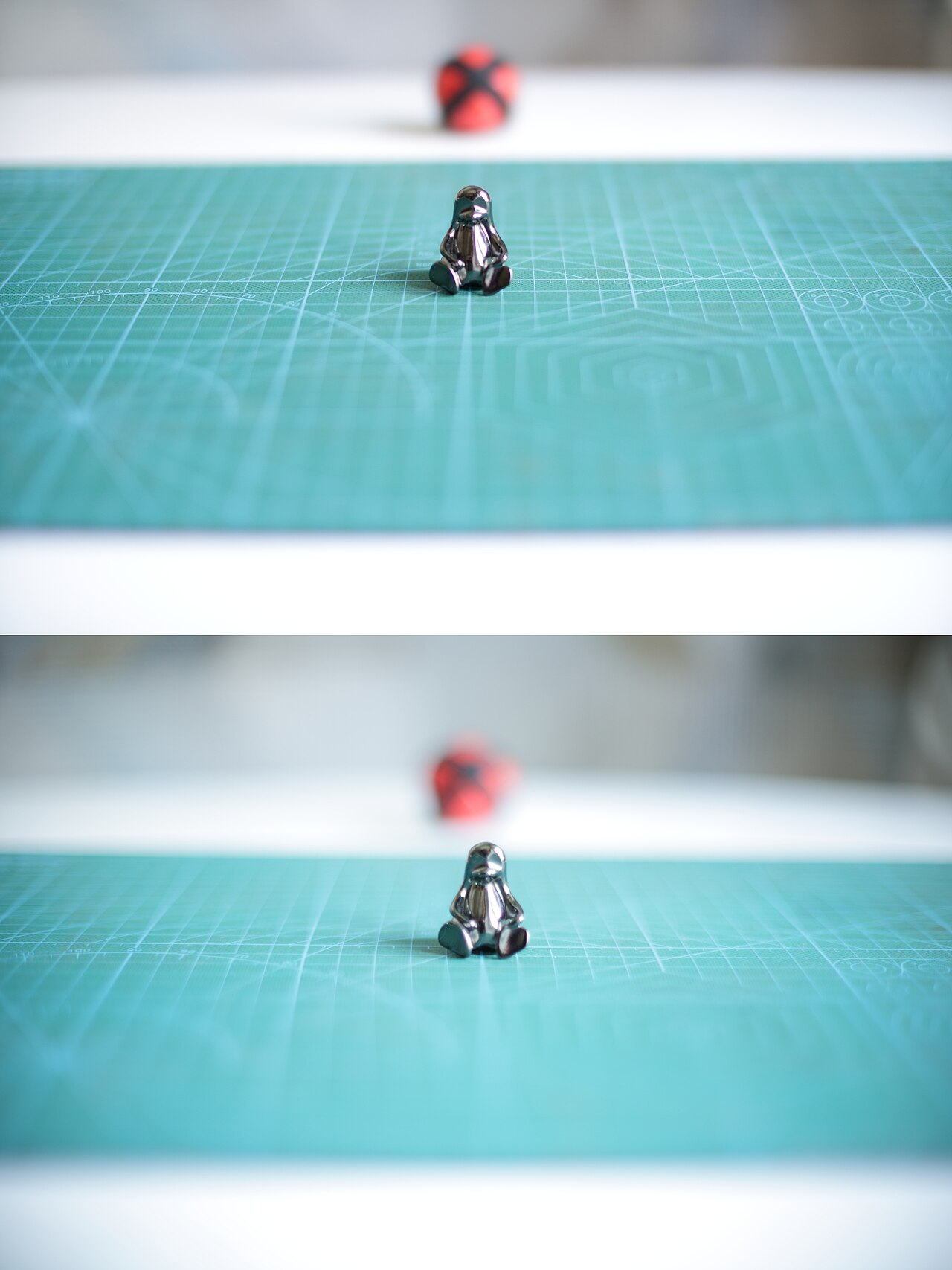
Sensor size affects more than framing. For a given exposure, a larger sensor captures more light and therefore tends to produce images with less noise and greater dynamic range than a smaller one — one reason full-frame cameras shine in low light.
Crop factor also influences depth of field. When you match the field of view and aperture, a smaller sensor produces a deeper depth of field, while a full-frame camera can more easily achieve the shallow, blurred-background look portrait photographers love. (The exact comparison depends on how you match the setup, which is why “crop factor math” for depth of field often applies the factor to the aperture as well as the focal length.)
One thing crop factor does not change is perspective. Perspective depends only on where you stand relative to your subject — not on focal length or sensor size. However, because a crop sensor narrows the field of view, photographers often step further back to reframe, and that changed position is what alters perspective.
How to Calculate 35mm-Equivalent Focal Length
The formula is simple: equivalent focal length = actual focal length × crop factor.
- 50mm × 1.5 = 75mm equivalent (Nikon DX, Sony E, Fujifilm X)
- 35mm × 1.6 = 56mm equivalent (Canon APS-C)
- 25mm × 2.0 = 50mm equivalent (Micro Four Thirds)
This is why compact cameras and smartphones always advertise a “35mm equivalent” figure — it lets you compare the field of view of a tiny phone sensor against a full-frame camera using one shared language.
Conclusion
Crop factor is best understood as a translator, not a spec to be feared. It converts a lens’s actual focal length into the full-frame equivalent you can compare across any camera. Once you know your camera’s crop factor — 1.5×, 1.6×, 2.0×, or less than 1 for medium format — you can predict exactly how wide or how long a given lens will feel before you ever press the shutter.
FAQ
Does crop factor change a lens’s aperture?
No. The physical f-number of the lens does not change. Photographers sometimes multiply the aperture by the crop factor to estimate equivalent depth of field and low-light performance, but that is a comparison tool — the lens itself is unaffected.
Is full frame always better than crop sensor?
Not always. Full frame generally wins on low-light noise, dynamic range, and shallow depth of field, but crop-sensor cameras are often smaller, lighter, and cheaper, and they give more telephoto reach for the same lens — a genuine advantage for wildlife and sports.
What is my smartphone’s crop factor?
Phone sensors are tiny. A typical 1/2.55-inch sensor has a crop factor around 6×, which is why a phone’s roughly 4–5mm lens is described as about 26mm “35mm-equivalent.”
Related Posts
Image Stabilization Explained: OIS, IBIS, and EIS
Blurry photos and shaky video share one root cause: camera…
Stacked CMOS Sensors Explained: How They Work and Why They Matter
APS-C CMOS image sensor. Photo: Friedrich Haag, CC BY-SA 4.0,…
Lens Mount Systems Compared: Canon RF vs Sony E vs Nikon Z vs Fujifilm X
When you buy an interchangeable-lens camera, you are not just…