Disclosure: This article contains affiliate links. If you buy through them, we may earn a commission at no extra cost to you.
The Nikon Z50 II is Nikon’s second-generation compact APS-C (DX-format) mirrorless camera, announced on November 7, 2024. Its headline trick is simple but significant: it pairs the same 20.9MP sensor as the original Z50 with the EXPEED 7 processor that powers Nikon’s flagship Z9 and Z8. That one change turns a small, affordable camera into a genuine autofocus and speed machine — and in 2026 it remains one of the best values in the APS-C segment. Here’s how it holds up.
What Makes the Nikon Z50 II Special
- EXPEED 7 processor — the first DX-format Nikon to get the flagship image engine, roughly 10× faster than the EXPEED 6 in the original Z50.
- 9-type subject-detection autofocus — people, dogs, cats, birds, cars, motorcycles, bicycles, trains, and airplanes, plus 3D-tracking.
- Up to 30 fps bursts and Pre-Release Capture — the camera buffers roughly one second of frames before you fully press the shutter.
- Serious video — 4K UHD 60p, full-width 4K 30p oversampled from 5.6K, Full HD 120p slow motion, and N-Log.
- Dedicated Picture Control button with 31 built-in color presets, plus downloadable recipes via Nikon Imaging Cloud.
- Product Review AF mode — a vlogger-friendly setting that shifts focus to an object held up in front of the camera.
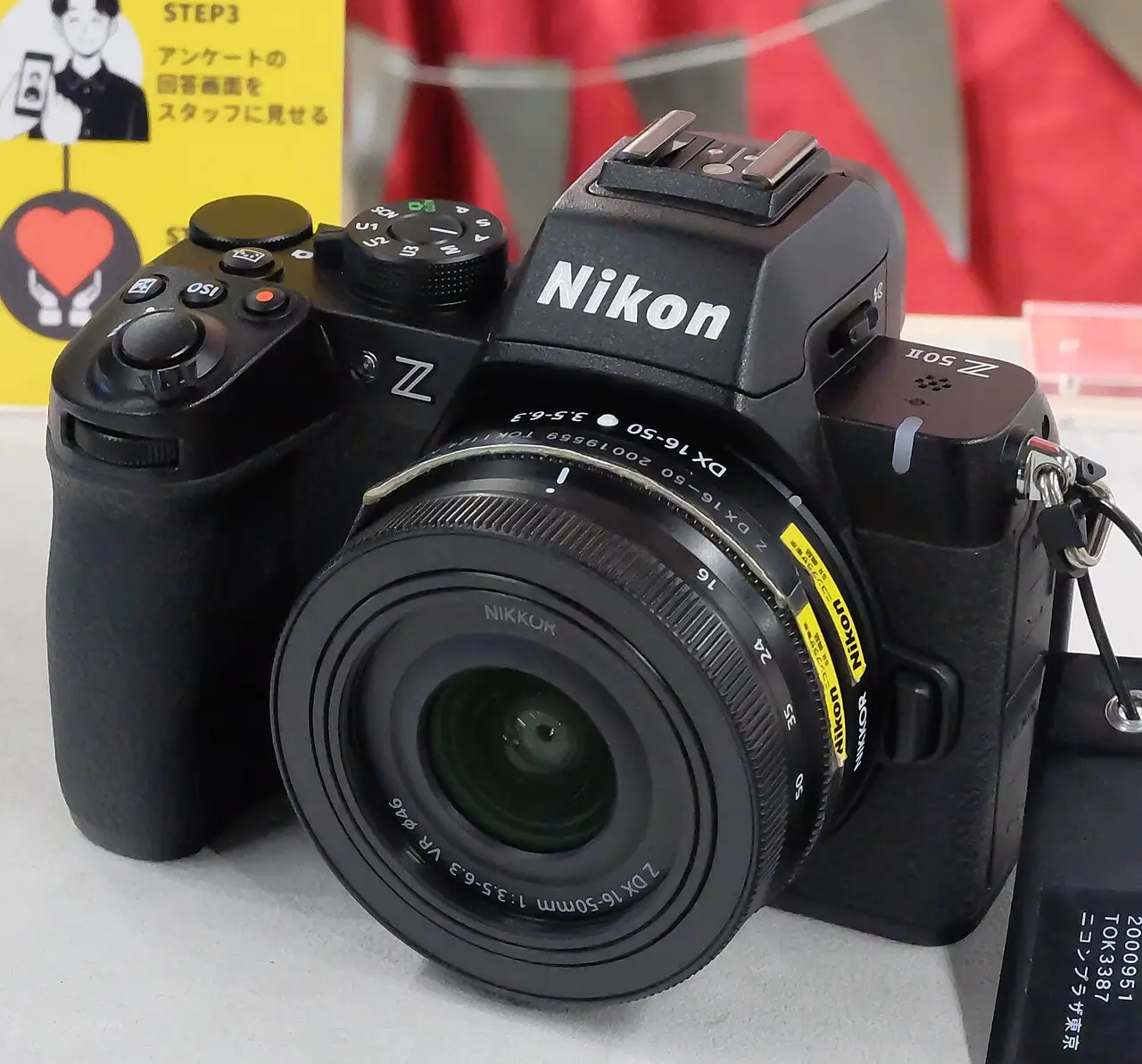
Image Quality
The Z50 II uses the same 20.9MP APS-C sensor as its predecessor, with no optical low-pass filter for maximum fine detail. What’s new is what happens after the light hits the sensor: the EXPEED 7 engine delivers measurably cleaner high-ISO files and better color than the original Z50 at the same settings. Native sensitivity runs ISO 100–51,200 (expandable to 204,800), and the camera has no in-body stabilization — you’ll lean on lens-based VR, which Nikon’s DX and FX Z lenses increasingly provide.
Autofocus & Speed
This is where the Z50 II punches far above its price. The 209-point hybrid phase/contrast AF system focuses down to −9 EV and recognizes nine subject types with eye detection for people and animals. 3D-tracking — borrowed from the Z9 — locks onto a moving subject and holds it across the frame. Mechanical bursts reach 11 fps, and the electronic C30/C15 modes hit up to 30 fps (JPEG). Pre-Release Capture means you’re far less likely to miss the moment a bird takes off.
Video
Nikon pitches the Z50 II as much at video shooters as stills photographers. It records 4K UHD 60p (from a 1.44× crop) and full-width 4K 30p oversampled from 5.6K, plus Full HD 120p slow motion. There’s 10-bit N-Log for graded footage and electronic VR for handheld stability. The vari-angle screen and Product Review AF mode make it a natural fit for vlogging and product demos.
Design & Handling
At roughly 495 g (body only) and 127 × 96.8 × 66.5 mm, the Z50 II slips into a small bag or large jacket pocket. You get a vari-angle 3.2-inch touchscreen, a 2.36M-dot OLED viewfinder that can hit 1000 nits, a single UHS-II SD slot, USB-C and HDMI (Type D) ports, 3.5mm mic and headphone jacks, and — a rarity in this class — a built-in pop-up flash. It’s powered by the EN-EL25a battery.
Full Specifications
| Specification | Nikon Z50 II |
|---|---|
| Sensor | 20.9MP APS-C (DX) CMOS, 23.5 × 15.7 mm |
| Image processor | EXPEED 7 |
| Lens mount | Nikon Z |
| ISO range | 100–51,200 (expandable to 204,800) |
| Autofocus | 209-point hybrid phase/contrast AF; 9-subject detection; 3D-tracking |
| AF sensitivity | −9 to +19 EV |
| Continuous shooting | Up to 11 fps (mechanical), 30 fps (electronic, JPEG) |
| Pre-Release Capture | Yes (up to ~1 second) |
| Video | 4K UHD 60p (crop), 4K 30p (full-width, oversampled), Full HD 120p; N-Log, 8/10-bit |
| Viewfinder | 0.39-inch 2.36M-dot OLED (up to 1000 nits) |
| LCD | 3.2-inch vari-angle touchscreen (~1.04M-dot) |
| Image stabilization | None in-body (lens VR) |
| Built-in flash | Yes (pop-up, guide number ~7) |
| Storage | 1× SD (UHS-II) |
| Connectivity | USB-C, HDMI Type D, 3.5mm mic + headphone, Wi-Fi, Bluetooth (SnapBridge) |
| Battery | EN-EL25a |
| Dimensions | ~127 × 96.8 × 66.5 mm |
| Weight | ~495 g (body only) |
| Body price | ~$1,000 MSRP ($1,006.95); often ~$800–900 |
Nikon Z50 II vs Sony a6700 vs Canon EOS R7
| Feature | Nikon Z50 II | Sony a6700 | Canon EOS R7 |
|---|---|---|---|
| Sensor | 20.9MP APS-C | 26MP APS-C | 32.5MP APS-C |
| Processor | EXPEED 7 | BIONZ XR | DIGIC X |
| In-body stabilization | No | Yes (5-axis) | Yes (5-axis) |
| Max burst | 11 fps (30 fps e-shutter) | 11 fps | 15 fps (30 fps e-shutter) |
| Video | 4K 60p (crop), 4K 30p | 4K 120p | 4K 60p |
| Weight | ~495 g | ~493 g | ~612 g |
| Body price | ~$1,000 | ~$1,398 | ~$1,399 |
The Z50 II is the budget option here. The a6700 and EOS R7 add in-body stabilization and (in the a6700’s case) 4K 120p, but they cost roughly $400 more. If you shoot mostly with stabilized lenses or on a tripod, the Z50 II delivers comparable autofocus speed for notably less money.
Verdict
The Nikon Z50 II is the rare camera that inherits flagship technology without a flagship price. EXPEED 7 brings class-leading subject detection, 30 fps bursts, and Pre-Release Capture to a body that costs around a thousand dollars and weighs under half a kilogram. Its main trade-offs — no in-body stabilization and a cropped 4K 60p mode — are easy to live with for most photographers and vloggers. If you want a compact, affordable APS-C camera with genuinely modern autofocus, it’s one of the best choices you can make in 2026.
What Amazon Buyers Say
The Z50 II holds a 4.7 out of 5 average from 41 global ratings on Amazon. Here’s how that breaks down:
| Rating | Share of reviews |
|---|---|
| 5 stars | 87% |
| 4 stars | 6% |
| 3 stars | 4% |
| 2 stars | 3% |
| 1 star | 0% |
The overwhelming majority of buyers rate it five stars, with only a small fraction scoring it below four. (Individual review text sits behind Amazon’s sign-in, so we’ve summarized the verified rating distribution rather than quote specific reviews.) Read all customer reviews on Amazon.
FAQ
Does the Nikon Z50 II have in-body image stabilization?
No. It relies on lens-based VR. If IBIS is a must-have in an APS-C body, the Sony a6700 or Canon EOS R7 are the alternatives to consider.
Is the Z50 II good for video and vlogging?
Yes. It shoots 4K 30p oversampled from 5.6K, 4K 60p, Full HD 120p, and 10-bit N-Log, with a vari-angle screen and a Product Review AF mode made for vloggers showing products to camera.
Which lens should I buy with it?
The NIKKOR Z DX 16–50mm f/3.5–6.3 VR kit lens is compact and stabilized, and a sensible first pairing. Add the DX 50–250mm for reach or a fast prime for low light.
Related Posts

Full-Frame vs APS-C: Which Camera Sensor Size Is Right for You?
Full-frame and APS-C are the two sensor sizes you'll see…
Best Cameras Under $500 in 2026: Top Picks for Photos, Video, and Adventure
You do not need to spend four figures to get…
Prime vs Zoom Lenses: Which Should You Buy?
Every photographer eventually stands at the same fork in the…