Nearly every digital camera you’ve ever used — from your phone to a flagship mirrorless body — reads its sensor with a rolling shutter. Most of the time you never notice. But pan quickly past a railing, film a spinning propeller, or photograph a fast golf swing, and straight lines start to lean, bend, and wobble. That distortion is rolling shutter in action — and it’s exactly the problem a global shutter solves. In late 2023, Sony’s Alpha 9 III became the world’s first full-frame camera to ship with a global shutter sensor, and it reset expectations for sports and wildlife shooters. Here’s how the two technologies work, what they cost, and whether you should care.
What a Rolling Shutter Actually Does
A rolling shutter exposes and reads the sensor row by row, usually from top to bottom. The top row starts its exposure a fraction of a second before the bottom row finishes. If nothing in the frame is moving, that’s fine — every row still records the same exposure duration, so the image looks normal. But if the subject or the camera moves faster than the readout sweep, each row captures a slightly different instant in time. The result is geometric distortion: vertical lines tilt, spinning propellers appear curved, and handheld video wobbles with the infamous “jelly” effect.

The severity depends on readout speed. A phone’s small sensor reads out fast enough that rolling shutter is subtle; a large full-frame sensor with a slow electronic shutter shows it far more. This is why many high-end cameras still rely on a physical mechanical shutter for stills, falling back to the electronic (rolling) shutter only for silent or very high-speed shooting.
How a Global Shutter Is Different
A global shutter exposes every pixel at the same instant and reads them all out together. There is no time gap between the top and bottom of the frame, so nothing can skew or wobble — every pixel records the exact same moment. This is how a mechanical leaf shutter has always behaved, and how the charge-coupled (CCD) sensors of early digital cameras worked before CMOS took over. The catch: to read all pixels simultaneously, each pixel needs a small memory node to hold its charge, which adds complexity and uses some of the pixel’s light-gathering area.
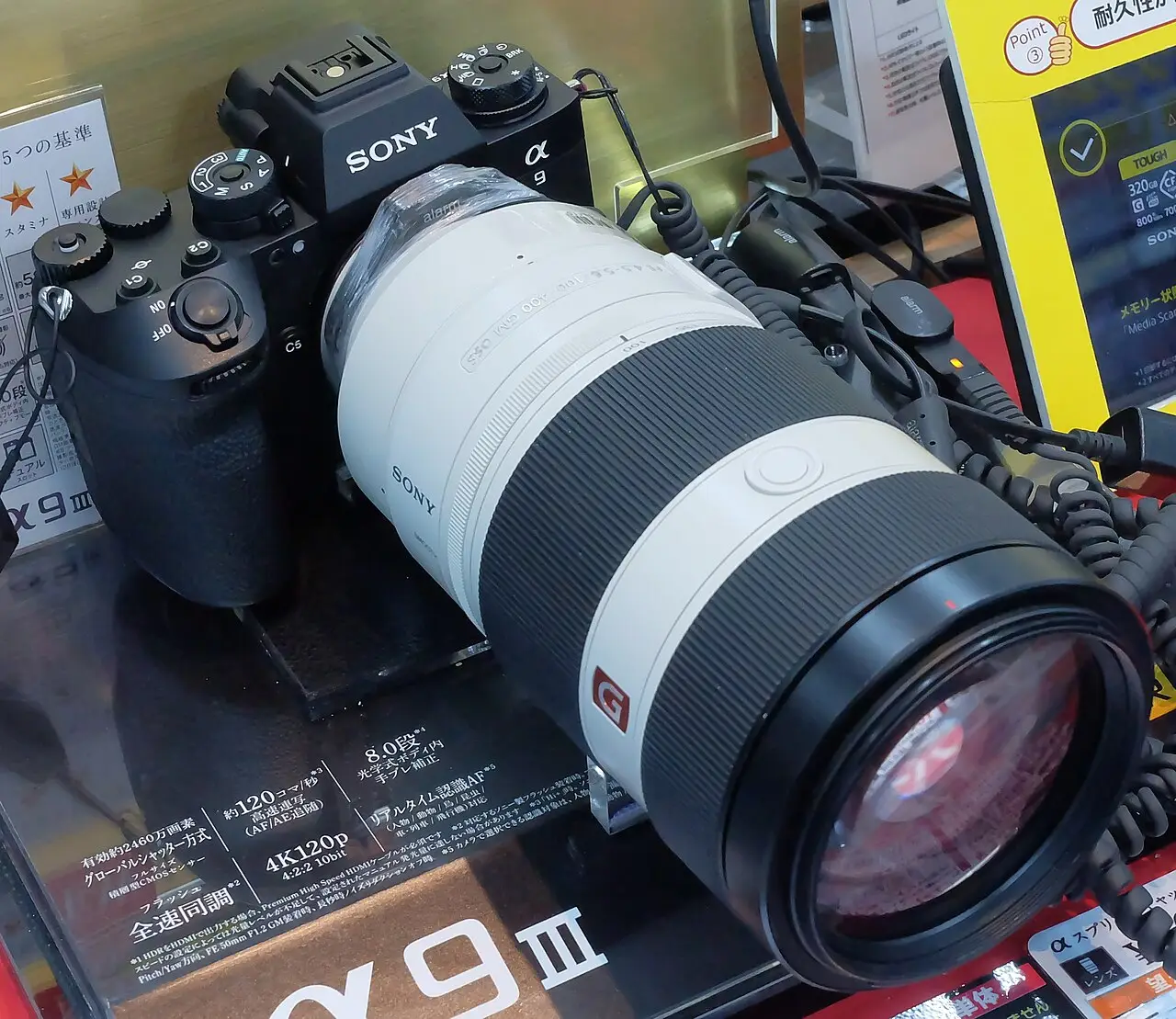
The Sony a9 III: Global Shutter Goes Full-Frame
Global shutters aren’t new — they’ve long been standard in industrial and machine-vision cameras. The hard part was building one on a large, high-resolution full-frame sensor while keeping readout fast and image quality high. Sony pulled it off in the a9 III, announced on 7 November 2023, using a stacked 24.6-megapixel full-frame Exmor RS CMOS sensor with built-in memory. The results read like a spec sheet from the future: blackout-free bursts of up to 120 frames per second with full autofocus and auto-exposure, a maximum shutter speed of 1/80,000 second, and — the headline feature — flash sync at any shutter speed, something no focal-plane shutter had ever allowed. An 8-stop, 5-axis stabilization system and an AI processing unit that recognizes humans, animals, birds, insects, cars, trains, and airplanes round out the package.
The Trade-Offs: Dynamic Range and Noise
Nothing is free. Giving every pixel a storage node sacrifices some of the photodiode’s light-capturing area. The practical result in the a9 III is a base ISO of 250 rather than the 100 of its predecessor, the a9 II, along with roughly a stop less dynamic range and a bit more noise at high ISOs — about the same gap you’d see between a full-frame and an APS-C camera, as DPReview’s studio tests found. For landscapes or low-light portraits, a Sony a7R V or Nikon Z9 will still beat it on pure image quality. The a9 III is a specialist: it trades a little dynamic range for the ability to freeze motion perfectly, with no distortion and no flash-sync limit.
Do You Actually Need a Global Shutter?
For most people, no — and that’s fine. If you shoot portraits, landscapes, or everyday family photos, you’ll never miss it, and today’s fast electronic shutters have shrunk rolling shutter to the point where it’s nearly invisible in casual use. A global shutter matters most when you photograph or film fast, unpredictable action: professional sports, birds in flight, motorsport, or any scene where you combine flash with high shutter speeds. If you’ve ever cursed a bent golf club or a wobbling drone shot, you already know the pain it removes.
Conclusion
The global shutter is that rare sensor technology that doesn’t just add megapixels — it changes what a camera can physically capture. Sony’s a9 III proved it’s possible on full-frame, and its influence is already spreading across the industry. The real question for most buyers isn’t whether global shutter is impressive, but whether their subjects move fast enough to need it.
FAQ
Is a global shutter better than a rolling shutter? Not universally. Global shutter eliminates motion distortion and allows flash at any shutter speed, but currently costs some dynamic range and low-light performance. Rolling shutter is perfectly adequate for most photography.
Which cameras have a global shutter? The Sony a9 III (ILCE-9M3) is the first full-frame camera with one. Global shutter sensors are also common in industrial and machine-vision cameras, where geometric accuracy is critical.
What causes the “jello” wobble in video? That’s rolling shutter. When you pan quickly, pixel rows record at slightly different times, bending straight lines. Slowing your pan, using a tripod, or shooting with a faster-readout or global-shutter camera all reduce it.
Related Posts
Log Video Profiles Explained: How S-Log3, C-Log3, and V-Log Capture More Dynamic Range
Point a camera with a log profile enabled at a…
Lens Aberrations Explained: Chromatic Aberration, Distortion, and Vignetting
Every lens is a compromise. Glass bends light, but it…
How Image Stabilization Works: OIS vs IBIS vs EIS Explained
Blurry handheld shots are one of the most common frustrations…