Mount a full-frame lens on an APS-C or Micro Four Thirds camera and the smaller sensor simply ignores the outer part of the image circle. Your 50mm lens suddenly “acts like” a 75mm — and you lose a good chunk of its wide field of view in the process. A focal reducer, better known by Metabones’ trademark name Speed Booster, is a lens adapter with glass inside that reverses that crop. It shrinks the image circle so a full-frame lens recovers most of its wide look, gains about a stop of light, and — with a well-made unit — often gets sharper in the corners. Here’s how it works and whether it’s worth the money.
What Is a Speed Booster (Focal Reducer)?
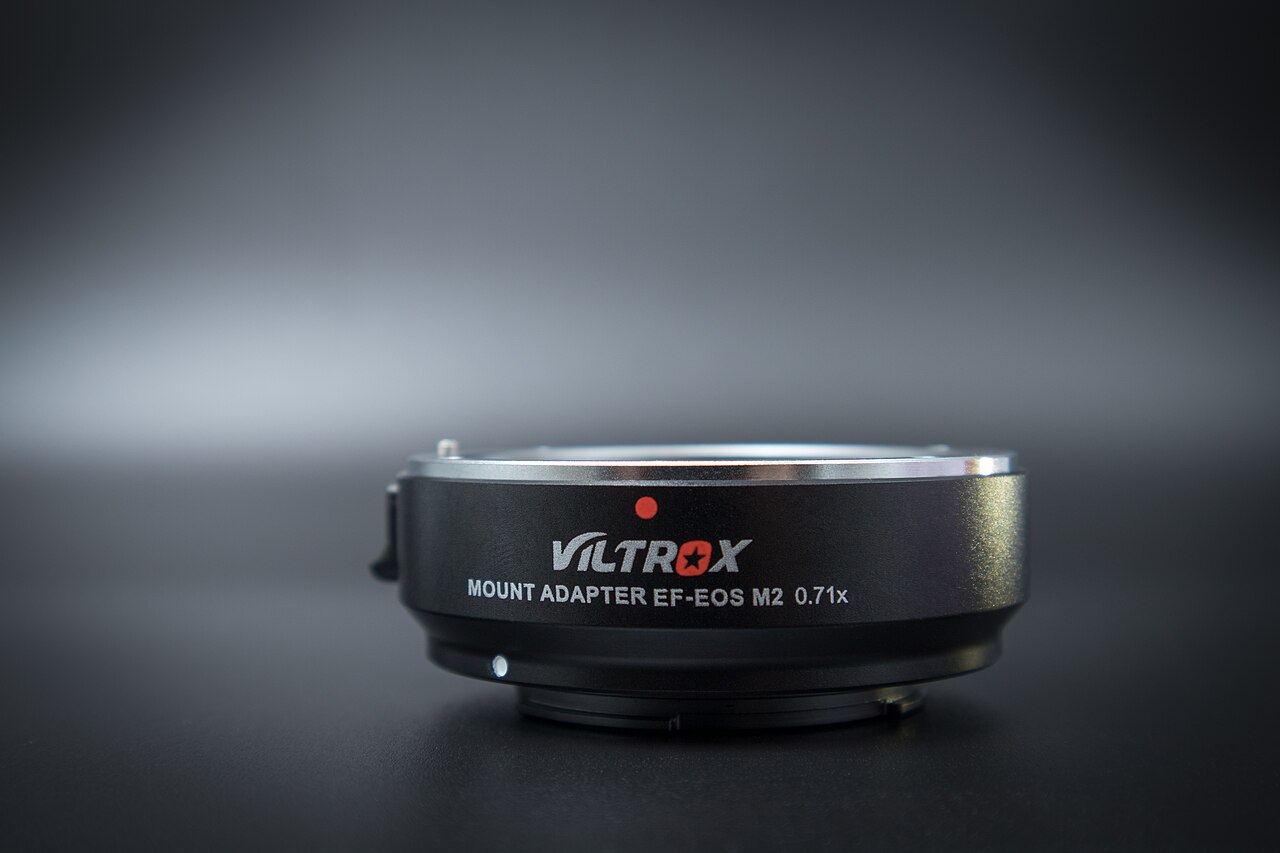
A speed booster is a lens-mount adapter containing a small positive lens group that sits between a lens designed for a larger sensor and a camera with a smaller one. A plain “dumb” adapter is just a spacer — it holds the lens at the correct flange distance but changes nothing optically. A focal reducer is different: it compresses the image the lens projects, so a wider slice of the full-frame image circle fits onto the smaller sensor.
“Speed Booster” is a Metabones trademark, but the category is generic. Viltrox, and others, sell equivalents under names like “focal reducer,” “turbo,” or “speed booster.” They exist only for mirrorless cameras — the short flange distance leaves room for the extra glass, where a DSLR’s moving mirror would physically get in the way.
How It Works: The 0.71x Math
A focal reducer is defined by its magnification, most commonly 0.71x (Metabones Ultra) or 0.64x (Metabones XL, for Micro Four Thirds). The math is refreshingly simple:
- Focal length: new = lens × magnification. A 50mm f/2 lens on a 0.71x reducer becomes a roughly 35.5mm f/1.4.
- Aperture: the f-number equals focal length divided by the entrance-pupil diameter. The focal length shrinks, but the entrance pupil (the actual opening light passes through) stays the same — so the f-number drops by the same factor. f/2.8 becomes f/2.0, exactly one stop brighter.
The “one stop” gain is not marketing rounding: 0.71 is approximately 1/√2 (about 0.707), and (1/0.71)² works out to roughly 2× — double the light, which is precisely what one stop means. A 0.64x reducer concentrates light by about 2.4×, worth roughly 1⅓ stops. At the extreme end, Metabones notes its Ultra can turn a 50mm f/1.2 into a 35.5mm f/0.9.
Undoing the Crop Factor
This is the feature people actually buy a speed booster for: getting the full-frame field of view back on a smaller body.
| Camera | Native crop | With 0.71x reducer | With 0.64x reducer |
|---|---|---|---|
| APS-C (Sony E, Fujifilm X) | 1.5x | ≈1.07x (near full-frame) | — |
| Micro Four Thirds | 2.0x | 1.42x | 1.28x (near Super 35) |
On a Sony E-mount or Fujifilm X APS-C body, a full-frame 50mm f/1.4 adapted through a 0.71x reducer behaves like a 35mm f/1.0 full-frame-equivalent — the classic “full-frame look” on a much cheaper, smaller camera.
What Actually Changes — and What Doesn’t
Depth of field is a non-issue. The focal length drops but so does the f-number, and the two cancel out in the depth-of-field equation. A 50mm f/2 on full frame has essentially the same depth of field as a 35mm f/1.4 at the same subject distance on the same sensor size. You gain light — not a shallower background blur.
Image quality can go up or down. A high-end reducer like the Metabones Ultra or XL (designed by Caldwell Photographic) can actually raise MTF — improving contrast and corner sharpness — because it re-imagines the lens’s already-large image circle onto a smaller area. Cheap reducers, in contrast, can soften edges, add chromatic aberration, and vignette. Any extra glass surface also adds a small flare risk.
Downsides and Caveats
- One-way only. The lens must be designed for a larger sensor than the camera. Full-frame lens → APS-C/MFT works; going the other way vignettes badly.
- Minimum aperture also drops. A 0.71x reducer turns f/22 into about f/16, so you lose the smallest apertures for deep landscape work.
- Autofocus trade-offs. Electronic reducers translate AF and aperture control, but speed can lag native glass. Cheap “dumb” reducers mean fully manual focus and aperture.
- Size and weight. It adds a chunk of glass and metal between lens and body, and it’s one more thing to keep clean.
Who Should Buy One
Videographers and hybrid shooters adapting legacy Canon EF or Nikon F glass to Sony E, Fujifilm X, or Micro Four Thirds get the most value — a full-frame 24–70mm f/2.8 zoom becomes a fast ~17–50mm f/2.0. Photographers with a shelf of full-frame lenses can reclaim the “full-frame look” on a smaller body without buying a new native kit. If you already shoot natively, or only own crop-sensor lenses, a speed booster buys you very little.
FAQ
Is a speed booster the same as a teleconverter?
It’s the opposite. A teleconverter multiplies focal length (1.4x/2x) and loses light; a focal reducer divides focal length (0.71x/0.64x) and gains light.
Does a speed booster hurt image quality?
A well-made unit usually maintains or slightly improves corner sharpness. A cheap one can soften the image and add aberrations. Extra glass always adds a small flare risk.
Can I use a speed booster on a full-frame camera?
Generally not for stills — the shrunken image circle won’t cover a full-frame sensor, so you get heavy vignetting. Some cine shooters use them deliberately in crop video modes.
What’s the difference between 0.71x and 0.64x?
0.71x gives +1 stop and a moderately wider view. 0.64x gives about +1⅓ stops and an even wider view; it’s aimed at Micro Four Thirds to approach Super-35 framing.
The Bottom Line
A focal reducer is one of the smartest budget accessories in modern photography: it turns a box of old full-frame lenses into fast, wide, near-native glass for a smaller mirrorless body. Just buy from a reputable maker with electronic contacts if you want autofocus, and skip it entirely if you already shoot native lenses. For the right kit, one small adapter delivers a stop of light and the wide field of view you thought your crop sensor had cost you.
Related Posts
Global Shutter vs Rolling Shutter: What’s the Difference and Why It Matters
Every digital camera turns light into an image using a…
Video-Optimized Sensors: 8K and High Frame Rates Explained
For years, the image sensor inside your camera was designed…
CMOS vs CCD Sensors: What’s the Difference?
Every digital camera you’ve ever held — from an early-2000s…