Pick up a photography lens and its aperture ring is marked in f-stops: f/2.8, f/4, f/5.6. Pick up a cinema lens and you will see T-stops instead: T2.8, T4, T5.6. Both look like aperture numbers, and for many lenses the values are nearly identical — but they measure two different things. Understanding the difference matters if you shoot video, swap lenses mid-project, or just want to know why your “f/1.4” lens does not always behave like one.
What Is an F-Stop? The Geometric Aperture Ratio
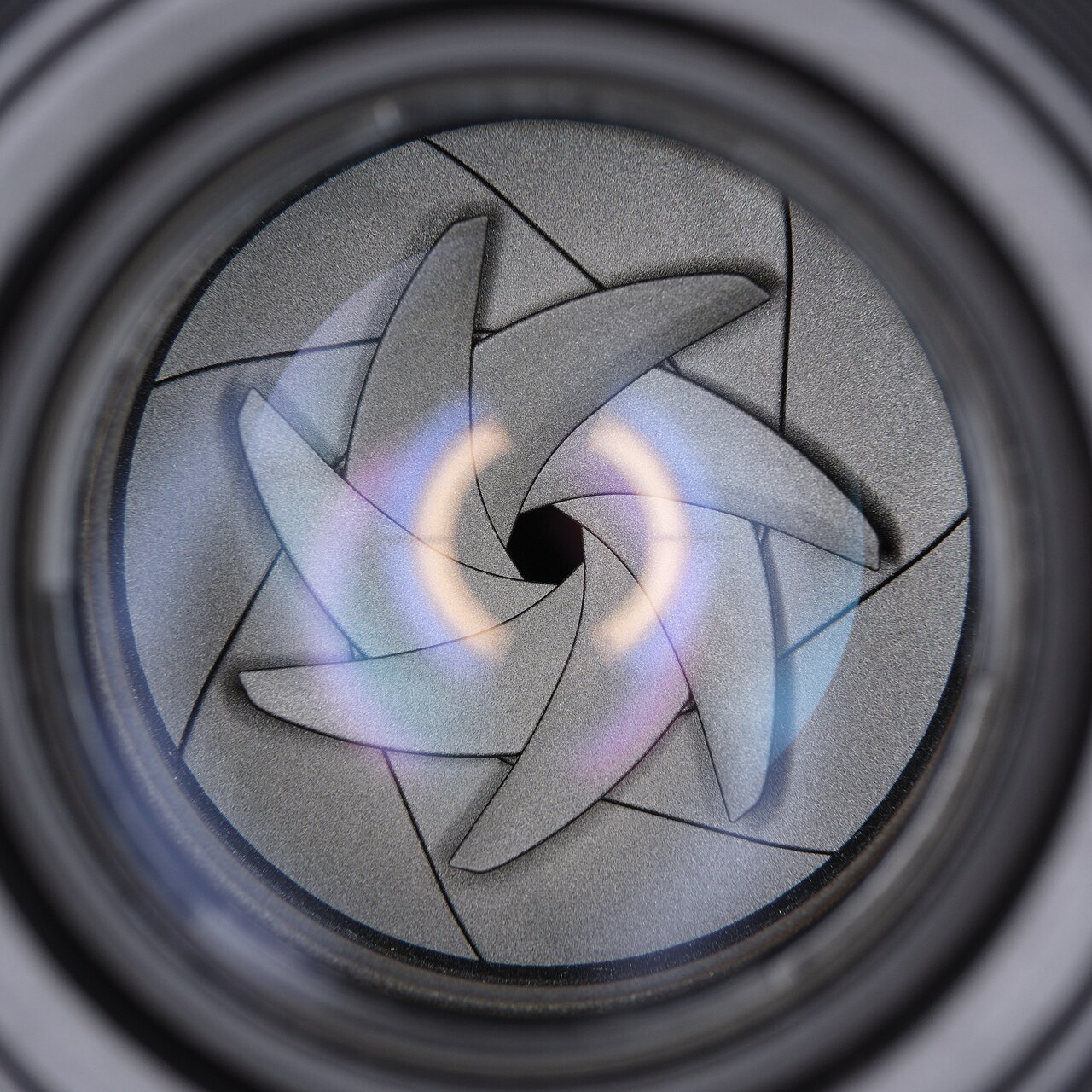
An f-stop (or f-number) is a purely geometric calculation. It is the lens’s focal length divided by the diameter of the entrance pupil — the aperture opening as seen through the front of the lens. Written as a formula, N = f / D, where N is the f-number, f is the focal length, and D is the entrance-pupil diameter. A 100 mm lens with a 50 mm entrance pupil is f/2. To reach f/2 on a 200 mm lens, the entrance pupil must be 100 mm wide.
The key point: the f-stop assumes a perfect, lossless lens. It describes the theoretical amount of light that should reach the sensor if every photon entering the front element made it to the back. In reality, it does not.
Why Lenses Lose Light
Real lenses are not transparent tubes. Every time light crosses a glass-to-air surface, a small fraction reflects away instead of passing through. The glass itself absorbs a tiny amount, and internal reflections scatter light that never reaches the sensor. Modern multi-coated lenses transmit most of their light — often 90 to 95 percent or more — but no lens reaches 100 percent. Lenses with many elements, especially zooms, lose more light than simple primes with just a handful of elements.
What Is a T-Stop? Measured, Not Calculated
A T-stop (the “T” stands for transmission) is an f-stop corrected for that real-world light loss. Instead of deriving the number from geometry, the manufacturer measures how much light actually passes through the finished lens and adjusts the aperture scale so the markings reflect true exposure. The relationship is roughly T-number = f-number ÷ √(transmittance). A lens transmitting 90 percent of light has √0.90 ≈ 0.95, so an f/1.4 lens becomes about T/1.5.
Cinema lenses are individually bench-tested, and the T-stop values are engraved on the barrel. Set two different lenses to the same T-stop and they deliver the same exposure — exactly what a cinematographer needs when cutting between shots taken with different lenses.
F-Stop vs T-Stop: The Key Differences
- F-stop is geometric and calculated; T-stop is measured.
- F-stop assumes 100 percent transmission; T-stop accounts for actual light loss.
- F-stop controls depth of field; T-stop controls exposure.
- Photography lenses are marked in f-stops; cinema lenses in T-stops.
- A T-stop is always equal to or “slower” (a higher number) than the matching f-stop, because every lens loses some light.
Why Cinematographers Need T-Stops (and Photographers Don’t)
On a film set, a scene may be shot over several days, with multiple cameras and lenses, then cut together in the edit. If one lens at f/2.8 transmits slightly more light than another lens at f/2.8, the exposure shifts between shots — a mismatch that is expensive to correct, especially when shooting film where you cannot just nudge a raw file in post. T-stops remove that variable: matching T-numbers mean matching exposure, lens to lens.
Photographers rarely notice the difference. Modern cameras meter through the lens (TTL), so the camera automatically compensates for whatever light the lens actually delivers. A transmission difference of a third of a stop or less is trivial to fix in a raw file, so lens makers skip the extra bench-testing and engrave f-stops instead.
Real-World Examples: When f/1.4 Isn’t T/1.4
The gap between the two scales is small but real. According to DxOMark’s transmission tests, the Zeiss Otus 55mm f/1.4 transmits at T/1.5, while the 85mm f/1.4 transmits at T/1.7. Cinema primes are often even closer — a Zeiss CP.2 marked T2.1 is f/2.0, a difference of less than a sixth of a stop. Fast stills primes such as a Canon 50mm f/1.2 often transmit closer to T/1.4 or T/1.5 in practice, and complex zooms like a 70-200mm f/2.8 can drop a third of a stop or more because of all the extra glass the light must pass through.
Conclusion
F-stop and T-stop both describe lens speed, but f-stop is a calculated geometric ratio while T-stop is measured transmission. For still photographers the difference is usually negligible because metering compensates automatically. For filmmakers who must match exposure across lenses and cameras, T-stops remove the guesswork. The next time you see “T2.8” on a cinema lens, you will know it is a promise about light — not just geometry.
FAQ
Is a T-stop always a higher number than the f-stop?
Yes. Because every lens loses some light, the T-number is always equal to or higher than the f-number of the same physical aperture opening.
Do I need to worry about T-stops for photography?
No. Through-the-lens metering compensates automatically, and the difference is usually a third of a stop or less — easy to correct in post-processing.
Which one controls depth of field?
The f-stop. Depth of field depends on the physical aperture size and focal length, not on measured light transmission.
Why do zoom lenses show bigger f/T differences?
Zooms contain more glass elements and air-to-glass surfaces, so they reflect and absorb more light than simple prime lenses.
Related Posts

Dynamic Range Explained: Why Your Camera Clips Highlights and Crushes Shadows
Every photographer hits the same wall sooner or later: you…

What Is a Tilt-Shift Lens? How Tilt and Shift Work (And the Miniature Effect)
What Is a Tilt-Shift Lens? A tilt-shift lens is a…
Sensor Cleaning and Camera Maintenance: The Complete Guide
Every photographer eventually notices them: faint dark spots that appear…