Almost every digital camera you have ever owned — your phone, your mirrorless, your DSLR — sees the world through a Bayer filter, a fine grid that lets each pixel record just one color and then guesses the other two. For two decades there was a genuine alternative. The Foveon X3 sensor, championed by Sigma, stacked three light-sensing layers on top of each other at every single pixel, so one location could capture red, green, and blue all at once. It never went mainstream, but it produced some of the most distinctive image quality in digital photography. Here is how it works, why its fans still love it, and why you have probably never shot with one.

How a Bayer Sensor Guesses Two-Thirds of Its Color
To understand what makes Foveon different, start with the conventional approach. A Bayer sensor places a single color filter over every photosite in a repeating two-by-two pattern: one red, one blue, and two green. A 24-megapixel sensor is therefore really about 12 million green photosites, 6 million red, and 6 million blue. To produce a full-color image, the camera runs a process called demosaicing, which interpolates the two missing color values for every pixel from its neighbors.
That estimation is astonishingly good, but it has consequences. Because adjacent pixels see different colors, fine repeating patterns — a distant fence, a fabric weave — can produce false color and moiré. Most Bayer cameras carry an anti-aliasing filter specifically to blur away those artifacts, trading a little sharpness for safety.
The Foveon Idea: Three Layers, One Pixel
Silicon does something convenient: it absorbs different wavelengths of light at different depths. Blue light is absorbed almost immediately at the surface, green penetrates a little further, and red travels deepest of all. The Foveon X3 exploits this by stacking three photodiodes vertically at each pixel location. The top layer registers blue, the middle layer green, and the bottom layer red — the entire stack is less than five micrometers thick, so depth adds no meaningful focus error.
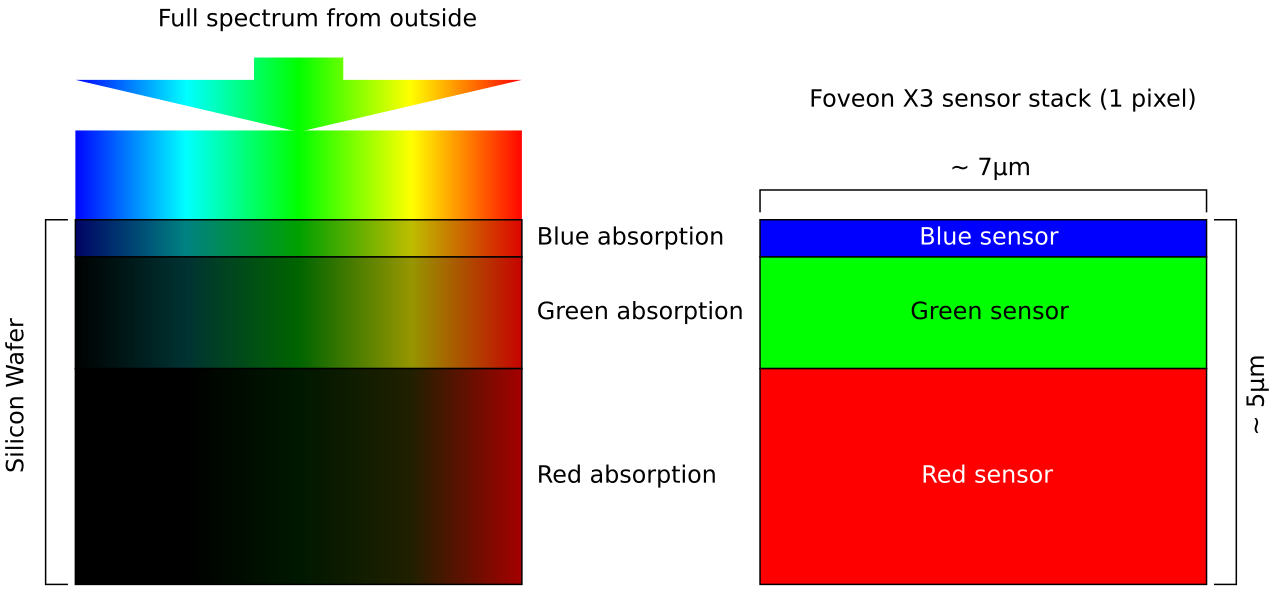

Because every pixel captures all three channels natively, there is nothing to interpolate. The sensor was designed by Foveon Inc. (founded in the late 1990s and acquired by Sigma in 2008) and manufactured by Dongbu Electronics. The core idea was not brand new — Kodak had patented a similar stacked-photodiode color sensor back in the late 1970s — but Foveon was the first to make it work in a shipping camera.
The Advantages: Sharpness Without the Guesswork
With no demosaicing step, the classic Bayer problems simply do not exist. There are no colored “jaggies” along fine edges, and color moiré essentially disappears, so no anti-aliasing filter is needed. That is why Foveon images earned a reputation for remarkable per-pixel sharpness: every output pixel is a complete, real RGB measurement rather than a partly invented one. In theory the design also wastes less light, since a Bayer filter absorbs the two colors each pixel is not allowed to see, while a Foveon stack uses them all.
The Trade-Offs That Kept It Niche
The elegant idea comes with hard engineering costs. Separating color by silicon depth is “leaky” — the three layers overlap in their spectral response, so turning their raw signals into clean red, green, and blue requires an aggressive mathematical matrix. That aggressive color correction tends to amplify noise, and Foveon sensors became known for weak high-ISO and low-light performance compared with contemporary CMOS.
There was also a marketing problem. Early Foveon cameras counted every layer, so the Sigma SD9 and SD10 were advertised as “10.2 megapixels” when their output was actually 2268 × 1512 spatial pixels (about 3.4 million) times three layers. Later models switched to quoting the spatial resolution to avoid the confusion.
The Quattro Compromise
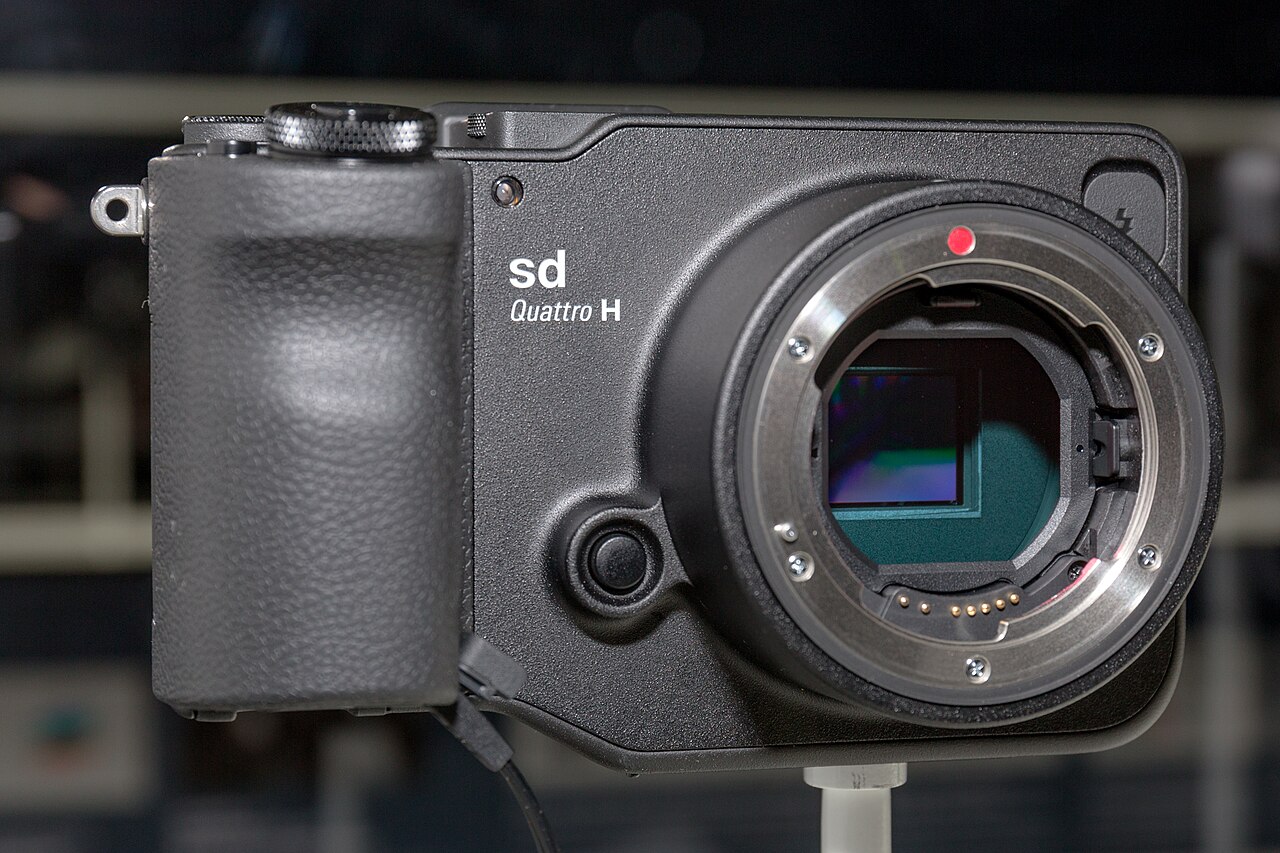
In 2014 Sigma re-thought the formula to chase higher resolution. The Foveon X3 Quattro sensor uses a 1:1:4 structure: a high-resolution top layer of 19.6 megapixels that captures blue plus most of the luminance, with two lower-resolution 4.9-megapixel layers beneath for green and red. Because the eye reads most of its detail from brightness rather than color, keeping the sharp top layer and letting the deeper layers fill in only the hue preserved much of the Foveon look while reducing data and improving noise. Sigma marketed the result as “39-megapixel equivalent,” and the later sd Quattro H pushed the top layer to 25.5 megapixels on an APS-H sensor for roughly 51-megapixel-equivalent output.
The Full-Frame Foveon That Never Quite Arrived
Sigma announced a full-frame Foveon mirrorless camera at Photokina in 2018 and planned a 2020 release, but in February 2020 the company restarted the project “with a clean slate” after prototype sensors kept surfacing technical problems. The effort is still alive: at CP+ 2026, CEO Kazuto Yamaki said issues had narrowed and the team might reach full-size sensor manufacturing within the year, while candidly admitting Sigma “had never designed a sensor by ourselves” before. The DP-series compacts were discontinued in 2022, and Sigma’s current cameras — including the recent Bf — use conventional BSI CMOS sensors. The full-frame Foveon remains photography’s most patient engineering promise.
Conclusion
The Foveon X3 is a beautiful idea executed against the grain: use silicon itself as the color filter and capture complete color at every pixel. It earned a devoted following and produced images with a character that Bayer shooters still envy, but the practical costs — low-light noise, slow readout, and tricky color math — kept it a niche. Its legacy lives on in how photographers think about “true” resolution, and its long-promised full-frame successor is still, as of 2026, a project rather than a product.
FAQ
What does the “X3” in Foveon X3 mean?
It refers to the three stacked photodiode layers — one each for red, green, and blue — at every pixel location.
Is a Foveon “10-megapixel” camera the same as a 10-megapixel Bayer camera?
Not quite. Early Foveon marketing counted all three layers, so a “10.2MP” SD10 actually captured about 3.4 million spatial pixels. Spatial resolution is the number that matters for comparing detail.
Why did Sigma stop making Foveon cameras?
The DP-series compacts were discontinued in 2022. Slow readout, weak high-ISO performance, and the cost of a niche sensor made them hard to sustain against mainstream CMOS competition.
Will Sigma ever release a full-frame Foveon camera?
Development is still ongoing as of 2026, but Sigma has not announced a release date. The company has repeatedly restarted the project as prototypes revealed new technical problems.
Related Posts
Log Video Profiles Explained: How S-Log3, C-Log3, and V-Log Capture More Dynamic Range
Point a camera with a log profile enabled at a…
Periscope Zoom Lenses Explained: How Phones Get Real Optical Zoom
Until recently, a smartphone with a true optical zoom was…
Stacked CMOS Sensors Explained: Why Flagship Cameras Got So Fast
Ten years ago, a flagship camera that shot 10 frames…