Disclosure: This article contains affiliate links. If you buy through them, we may earn a commission at no extra cost to you.
The Sony a9 III is the camera that rewrote the rulebook. Announced in November 2023, it became the world’s first full-frame mirrorless camera built around a global shutter sensor — meaning every one of its 24.6 million pixels is read at the same instant, with zero rolling-shutter distortion and a maximum shutter speed of 1/80,000 second. Even in 2026 it remains the single most interesting action camera you can buy. Here’s our full review.
What Makes the Sony a9 III Special
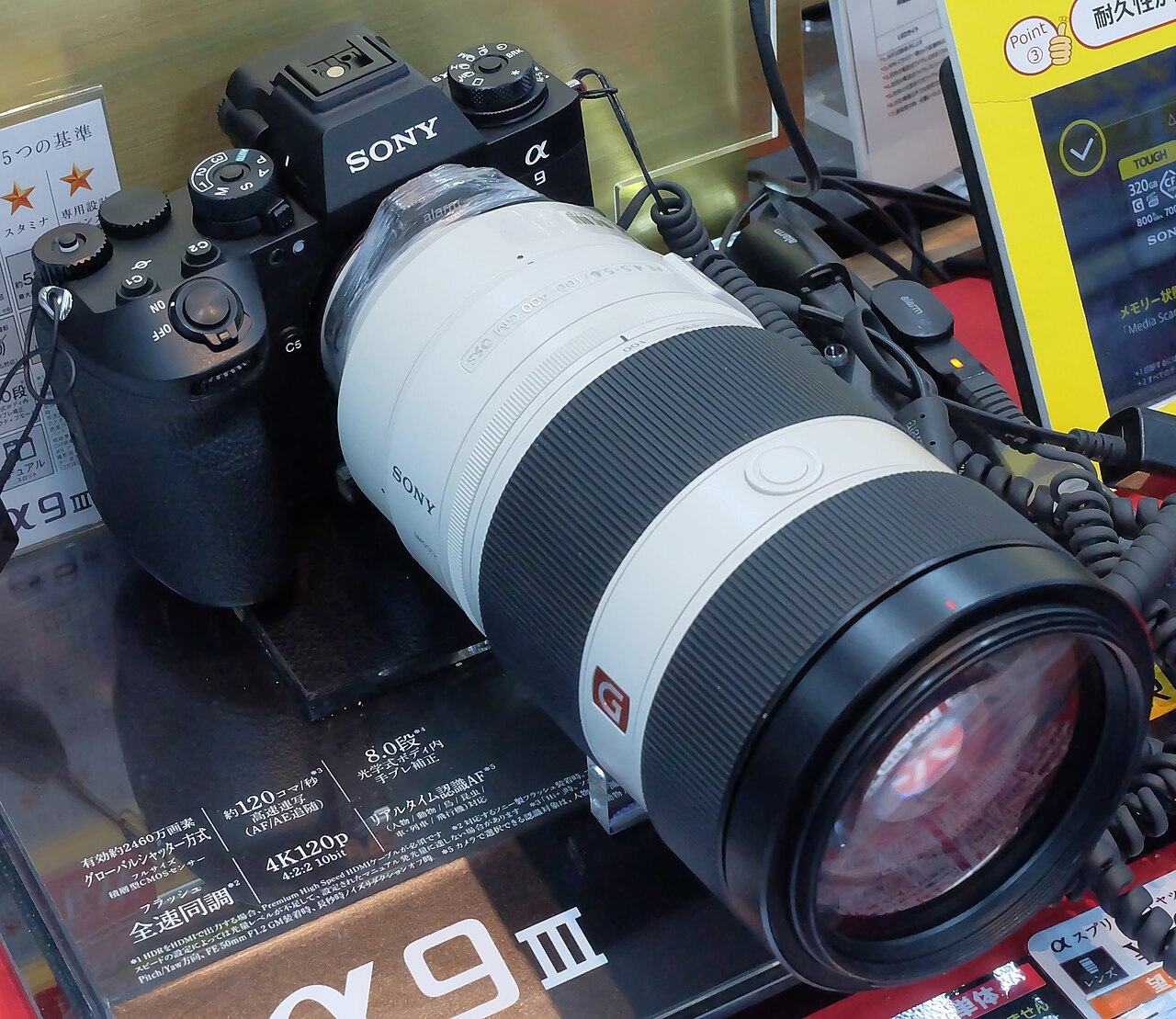
The a9 III isn’t just an incremental update — it’s a category-defining leap. The headline features:
- World’s first full-frame global shutter. All 24.6MP are read simultaneously, eliminating skew, banding, and “jello” distortion in one stroke.
- 120 fps blackout-free continuous shooting with full AF/AE tracking — a speed no mechanical shutter could ever reach.
- 1/80,000s maximum shutter speed, plus full-speed flash sync at every speed up to the maximum.
- 8.0-stop 5-axis image stabilization for sharp handheld shots even at long focal lengths.
- AI-powered subject recognition covering humans, animals, birds, insects, cars, trains, and airplanes.
- 4K 120p uncropped video with 10-bit 4:2:2, S-Log3, and S-Cinetone color.
Image Quality
The a9 III produces clean, natural files straight out of camera, with Sony’s signature color science and a BIONZ XR processor with roughly eight times the power of earlier generations. The honest trade-off is dynamic range: DPReview’s studio testing showed the global shutter costs roughly a stop of dynamic range and low-light headroom versus the best rolling-shutter sensors. For sports, wildlife, and photojournalism — where freezing motion matters more than a fraction of a stop of DR — that’s a trade most shooters will happily make. Native ISO spans 250–25,600, expandable to 125–51,200.
Autofocus & Speed
This is where the a9 III has no peer. The dedicated AI processing unit performs up to 120 AF/AE calculations per second, driving a 759-point phase-detection system with Real-time Recognition AF. It locks onto eyes with uncanny tenacity, and the new Animal/Bird combined mode means you no longer switch settings mid-burst. Pre-Capture buffers up to a full second of frames before you press the shutter, so a bird taking flight is already in the bag. Continuous Shooting Speed Boost lets you spike from a calm 30 fps to 120 fps the instant the action breaks.
Video
Despite its sports-stills billing, the a9 III is a serious cinema tool. It records 4K at up to 120p without cropping — a first for the Alpha line — so slow motion and normal-speed clips share the same angle of view. You get 10-bit 4:2:2 internally, S-Log3 and S-Cinetone profiles, and 16-bit RAW 4.6K output over HDMI. Global-shutter readout also means fast pans and whip moves are completely free of skew.
Design & Handling
The body is a magnesium-alloy shell with full weather sealing, a 9.44M-dot OLED viewfinder with a 240 fps refresh (effectively no lag or blackout), and a 3.2-inch 4-axis multi-angle touchscreen. Dual CFexpress Type A / SD slots sit side by side, and an RJ45 Ethernet port plus Wi-Fi and Bluetooth make it a natural fit for tethered pro workflows. At 617 g it’s compact for a flagship, and the NP-FZ100 battery is good for roughly 400 shots.
Full Specifications
| Specification | Details |
|---|---|
| Sensor | 24.6MP full-frame stacked CMOS with global shutter (Exmor RS) |
| Image processor | BIONZ XR + dedicated AI processing unit |
| Lens mount | Sony E |
| Native ISO | 250–25,600 (expanded 125–51,200) |
| Continuous shooting | Up to 120 fps with AF/AE, blackout-free |
| Max shutter speed | 1/80,000s (1/16,000s in continuous bursts) |
| Flash sync | Full-speed sync at all shutter speeds up to 1/80,000s |
| Image stabilization | 5-axis IBIS, up to 8.0 stops (CIPA) |
| Autofocus | 759-point phase-detection; Human, Animal/Bird, Insect, Car/Train, Airplane recognition |
| Video | 4K up to 120p (10-bit 4:2:2); 16-bit RAW 4.6K over HDMI; S-Log3, S-Cinetone |
| Viewfinder | 9.44M-dot OLED, 240 fps refresh, 0.9x magnification |
| LCD | 3.2″ 2.1M-dot 4-axis multi-angle touchscreen |
| Media slots | Dual CFexpress Type A / SD (UHS-II) |
| Connectivity | Wi-Fi, Bluetooth, Ethernet (RJ45), USB-C, HDMI |
| Battery | NP-FZ100 (approx. 400 shots, CIPA) |
| Dimensions | 136.1 × 96.9 × 82.9 mm |
| Weight | 617 g body only (702 g with battery & card) |
| Weather sealing | Yes — magnesium-alloy body |
Sony a9 III vs. the Competition
| Feature | Sony a9 III | Sony a1 II | Nikon Z9 |
|---|---|---|---|
| Sensor | 24.6MP global shutter | 50.1MP stacked CMOS | 45.7MP stacked CMOS |
| Max burst | 120 fps (AF/AE) | 30 fps (AF/AE) | 20 fps RAW (120 fps @ 11MP) |
| Max shutter | 1/80,000s | 1/32,000s | 1/32,000s |
| Video | 4K 120p (no crop) | 8K 30p / 4K 120p | 8K 60p / 4K 120p |
| IBIS | 8.0 stops | 8.5 stops | 6.0 stops |
| Price (body) | $6,798 | $6,498 | $5,496 |
The a9 III cedes resolution and video resolution to its rivals, but no camera — at any price — matches its 120 fps burst, 1/80,000s shutter, and unlimited flash sync speed. For action-first shooters, it’s simply in a class of one.
Verdict
The Sony a9 III is a purpose-built instrument: the closest thing to a “no missed moments” camera that has ever shipped. You give up a stop of dynamic range and a lot of resolution to get 120 fps with zero distortion and flash sync at any speed — and for sports, wildlife, and event photographers, that trade is almost always worth it. If you shoot action and want the absolute edge in speed, this is the one.
What Amazon Buyers Say
The a9 III holds a 4.6 out of 5 rating from Amazon customers. Here’s how the ratings break down:
| Rating | Share of reviews |
|---|---|
| 5 stars | 84% |
| 4 stars | 6% |
| 3 stars | 5% |
| 2 stars | 0% |
| 1 star | 5% |
“The single best camera I have owned/or used over the last 30+ years… The responsiveness of the global shutter sensor along with the cutting edge autofocus… has brought forth a camera that is as close to perfection as is possible.”
“Yes, you give up a stop in ISO performance, and you don’t have the resolution, but the tradeoff is pictures you could never successfully consistently capture before… global shutter, pre-capture, and burst speed are game changers.”
“I’m primarily using this camera for video… it’s absolutely incredible with video. 120fps with no crop, 10 bit 4:2:2, dynamic active stabilization, 16 bit raw through HDMI.”
“Global Shutter costs up to one stop in image quality in return for added performance… This shouldn’t be an issue for pro sports photographers, where prioritizing a high shutter speed is crucial.”
Read all customer reviews on Amazon
FAQ
Is the Sony a9 III good for sports and wildlife photography?
Yes — it’s arguably the best action camera ever made. The 120 fps burst, 1/80,000s shutter, and Pre-Capture let you freeze and anticipate moments that other cameras simply miss. Bird, animal, and human eye-tracking are among the best available.
Does the global shutter hurt image quality?
It costs roughly one stop of dynamic range and low-light performance compared with the best rolling-shutter sensors, and resolution tops out at 24.6MP. For action shooters this is a worthwhile trade, but landscape or high-resolution studio shooters may prefer a higher-megapixel body.
What lenses and flash units work with the a9 III?
Any Sony E-mount lens works, though hitting the full 120 fps requires compatible lenses and current firmware. For full-speed flash sync at 1/80,000s you’ll want a compatible Sony flash such as the HVL-F60RM2 or HVL-F46RM.
Related Posts
Tamron 28-75mm f/2.8 Di III VXD G2 Review: The Best Value Standard Zoom for Sony E-Mount
Disclosure: This article contains affiliate links. If you buy through…

Godox V1 Review: The Round-Head Flash That Changed On-Camera Lighting
Disclosure: This article contains affiliate links. If you buy through…
Best Budget Lenses for Beginners: 7 Affordable Upgrades That Beat Your Kit Lens
Every beginner starts with the kit lens — and that's…