Every lens is a compromise. Glass bends light, but it never bends every ray perfectly, and the small imperfections that result are called aberrations. You see them as purple fringing around backlit branches, warped lines at the edge of a wide-angle frame, soft corners, and darkened edges. The good news is that most aberrations are well understood, and nearly all of them can be reduced by good lens design, by stopping down, or by a simple software correction. Here is what each one is, why it happens, and how to deal with it.
What Is a Lens Aberration?
A theoretically perfect lens would take every ray of light leaving a single point in your scene and bring it back to a single point on the sensor. Real glass cannot do that. Opticians divide the classic defects into two families. The first is monochromatic aberrations — spherical aberration, coma, astigmatism, field curvature, and distortion — which occur even in a single color of light because the spherical surfaces that are easy to grind are simply not the shapes that focus perfectly. The second is chromatic aberration, which happens because glass bends blue light more than red. There are also stray-light defects — vignetting and flare — that lose or add light rather than mis-focusing it.
Chromatic Aberration (CA)
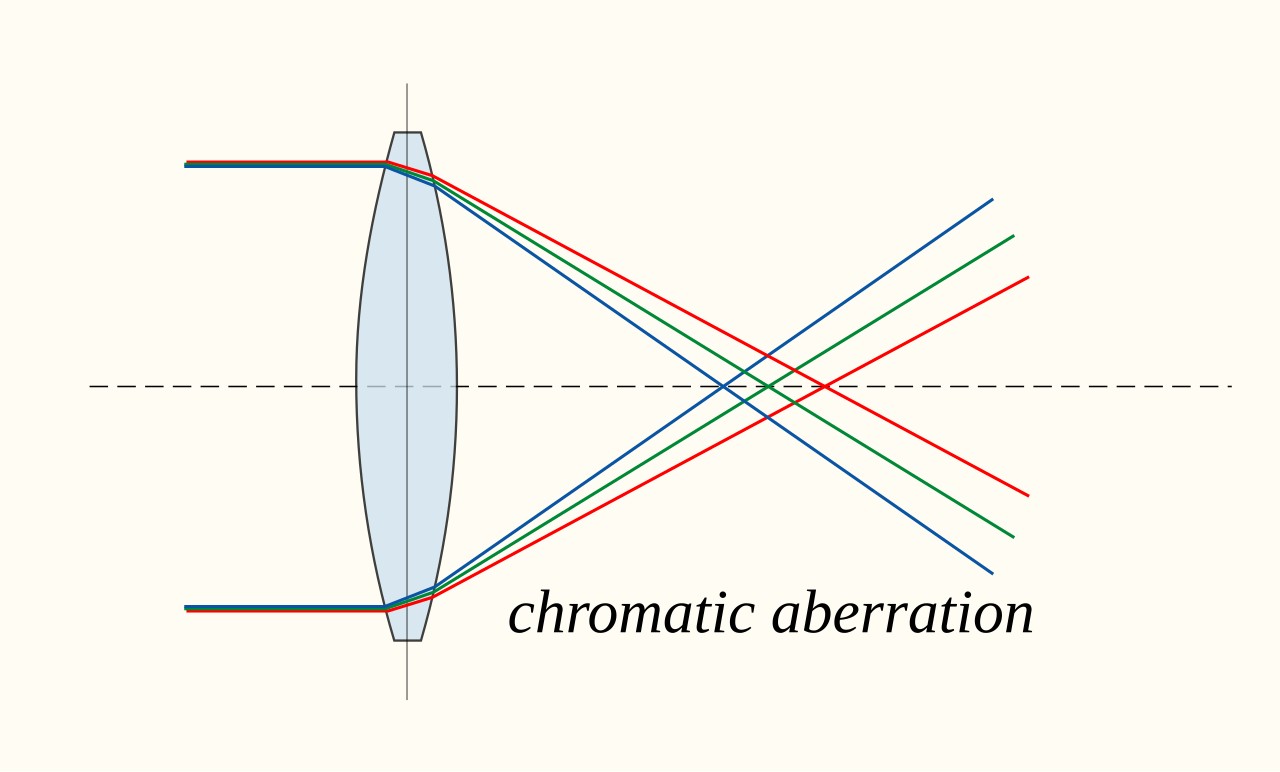
Glass is dispersive: its refractive index changes with wavelength, so a lens has a slightly shorter focal length for blue light than for red. The result is that colors do not share a single focus. Chromatic aberration comes in two flavors:
- Axial (longitudinal) CA — red, green, and blue focus at different depths along the optical axis. It appears as a green-to-magenta glow around high-contrast edges and as the classic purple fringing on backlit branches and chrome trim. It is worst at wide apertures.
- Lateral (transverse) CA — the colors are imaged at slightly different magnifications, so colored fringes grow toward the corners of the frame and disappear at the center.
The classic cure is the achromatic doublet: a low-dispersion crown glass element paired with a high-dispersion flint element so the color errors cancel at two wavelengths. Demanding designs go further with apochromatic (APO) lenses built from special low-dispersion glass — often called ED glass, or fluorite — found in pro lines like Canon’s L-series, Sony’s G Master, and Nikon’s ED lenses. Lateral CA is essentially a per-color magnification error, so software corrects it very well; axial CA, a genuine per-color blur, is harder to fix after the fact.
Distortion (Barrel and Pincushion)
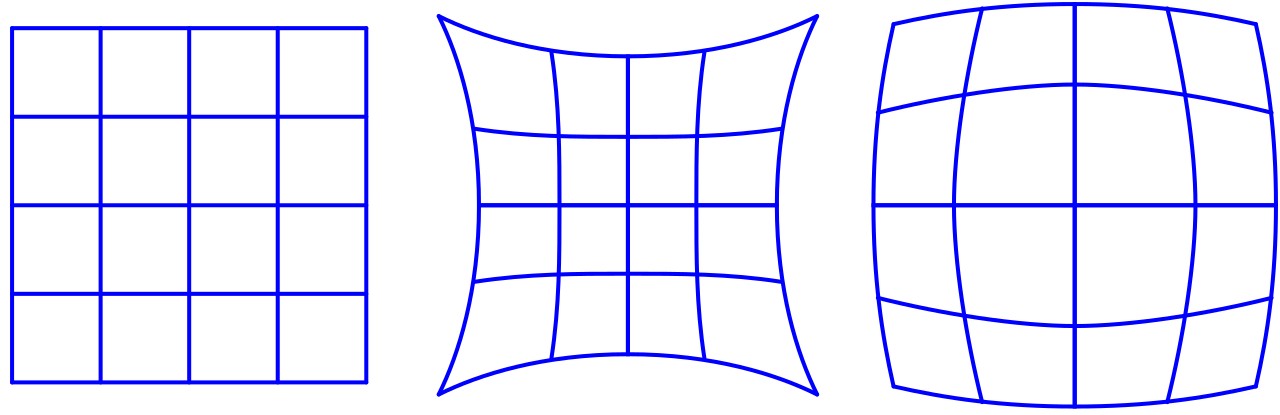
Distortion is the odd one out among aberrations because it does not blur anything — every point stays perfectly sharp, it just lands in the wrong place. The magnification varies with distance from the center of the frame. When magnification grows toward the edges, straight lines bow outward in barrel distortion, typical of wide-angle lenses. When it falls toward the edges, lines bow inward in pincushion distortion, typical of telephotos. Many zooms show both at different focal lengths.
Because distortion only relocates sharp points rather than spreading their light, it is the single most software-correctable defect in optics. Nearly every modern camera and phone applies a built-in lens profile that straightens the lines almost perfectly — which is also why a fisheye’s dramatic curve is treated as an intentional look rather than an error.
Spherical Aberration, Coma, Astigmatism, and Field Curvature
A few more aberrations round out the picture:
- Spherical aberration — the outer rays of a spherical lens are bent too strongly and focus short, producing a soft, low-contrast image with a glowing halo around highlights. It is worst wide open and is fixed with aspherical elements. (Some portrait lenses deliberately under-correct it for a dreamy soft-focus look.)
- Coma — the off-axis cousin of spherical aberration. Point sources away from the center smear into comet-shaped blobs, so stars at the corners of a frame grow little wings. It matters most to astrophotographers and improves on stopping down.
- Astigmatism — detail oriented radially and detail oriented tangentially come to focus at different depths, so you cannot get both fully sharp in the corners at once.
- Field curvature — the surface of sharp focus is a curved bowl (the Petzval surface) while the sensor is flat, giving center-sharp, corner-soft results that no single focus setting fixes. Dedicated flat-field lenses correct it.
Vignetting
Vignetting is the gradual darkening toward the corners of an image, and it has two causes. The first is natural falloff: light reaching the corner arrives at a steep angle and is dimmed — even a geometrically perfect lens shows this. The second is optical vignetting, where the lens barrel and elements partially block the light bundle heading off-axis. Both are worst wide open, and stopping down restores corner brightness. Optical vignetting also reshapes out-of-focus highlights near the edges into “cat’s-eye” shapes. A measured radial gain map in software lifts the corners back up, though it can add a little noise in the corners.
How Lenses Are Corrected
Modern lens design attacks aberrations with specific tools: aspherical elements for spherical aberration, low-dispersion ED or fluorite glass for chromatic aberration, multi-coating to suppress flare (about 4% of light reflects at each uncoated surface, and a lens can have a dozen of them), symmetric designs to cancel coma, and field-flattener elements near the sensor. On top of that, lens profiles correct lateral CA, distortion, and vignetting either in-camera or in editing software like Lightroom.
Conclusion
No lens is perfect — but that is fine. Once you know which aberrations matter for the way you shoot, you can buy the right glass and fix the rest in seconds. Chromatic aberration, distortion, and vignetting are the three you will notice most often, and all three are now largely a solved problem for anyone who knows where to look.
FAQ
What causes purple fringing in photos?
Purple fringing is mostly axial chromatic aberration, where blue and red light focus at different points. It is worst at wide apertures and on high-contrast backlit edges; stopping down reduces it.
Why do my wide-angle shots look warped at the edges?
That is barrel distortion — magnification increasing toward the corners of a wide-angle lens. It is easily fixed with a lens correction profile in your camera or editor.
Can I fix lens aberrations in editing software?
Distortion and lateral chromatic aberration correct almost perfectly in software; vignetting is also easy to lift. Axial CA and spherical aberration are harder because they are genuine blur, so they are best handled by good glass and stopping down.
Does stopping down the aperture reduce aberrations?
Yes. Most aberrations — spherical, coma, astigmatism, axial CA, and optical vignetting — improve when you close the aperture, because the offending outer rays are blocked. The trade-off is more diffraction at very small apertures.
Related Posts
Pixel Binning Explained: Why Your 200MP Phone Takes 12MP Photos
Open the camera app on a modern flagship phone and…
CMOS vs CCD Sensors: What’s the Difference?
Every digital camera you’ve ever held — from an early-2000s…
Weather Sealing in Cameras Explained: IP Ratings, Seals & Limits
"Weather sealing" is one of the most heavily marketed —…