Stop a lens down to f/16 or f/22 chasing maximum depth of field, and there’s a good chance the result comes back looking just a little soft — even with perfect focus on a sturdy tripod. That’s not a lens defect, and it’s not something you did wrong. It’s diffraction, a hard limit set by the physics of light itself. Here’s how it works, when it bites, and how to stay on the sharp side of it.
What Is Diffraction?
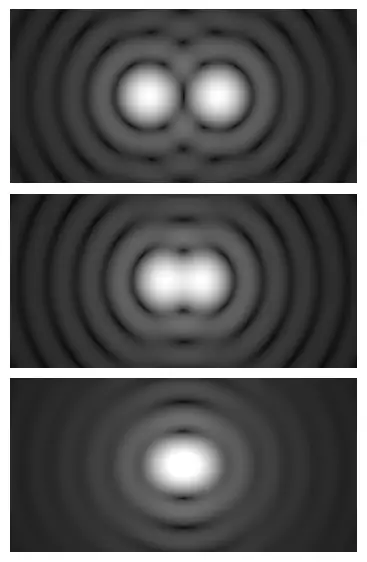
Light behaves like a wave. When those waves pass through a small opening — like your lens’s aperture blades — the edges of the opening bend the light, scattering it slightly. The waves interfere with one another, and instead of every point of light converging to a perfect dot, each point spreads into a small blurry disc surrounded by faint concentric rings. That disc is called the Airy disk, named after the 19th-century astronomer George Biddell Airy.
The size of the Airy disk is fixed by physics and depends on just two things: the wavelength of the light and the f-number of your lens. The classic formula is:
Airy disk diameter ≈ 2.44 × wavelength × f-number
For green light (about 550 nanometres), that works out to roughly 1.34 micrometres of blur per f-stop. A quick reference:
- f/2.8 ≈ 3.8 µm
- f/5.6 ≈ 7.5 µm
- f/8 ≈ 10.7 µm
- f/11 ≈ 14.8 µm
- f/16 ≈ 21.5 µm
Notice the pattern: the smaller the aperture, the larger the Airy disk. That single fact is the whole story in miniature.
Why Smaller Apertures Cause Softness
When the Airy disk is smaller than a single pixel on your sensor, the pixel can’t tell the difference — it records the light as one crisp dot, and the image looks sharp. But as you stop down, the Airy disk grows. Once it spills across two, three, or more pixels, that single point of light smears out, fine detail blurs together, and micro-contrast drops.
The first casualties are always the finest textures: the weave of fabric, distant foliage, eyelashes, brickwork at a distance. This is exactly why the old advice to “stop down to f/22 for maximum sharpness” backfires — past a certain point you’re trading depth of field for a genuinely softer image.
The Role of Pixel Size
Here’s a subtle but important point: the Airy disk’s size depends only on the f-number and the wavelength of light — not on the sensor. A 12 MP camera and a 61 MP camera produce the identical Airy disk at f/11. What changes is whether you can see it. Smaller pixels reveal diffraction sooner, because the blur covers more of them.
A rule of thumb: diffraction starts to soften fine detail once the Airy disk reaches roughly twice the width of a pixel. That’s why high-resolution sensors hit the wall at wider apertures than low-resolution ones:
- A 24 MP full-frame camera (about 5.9 µm pixels) generally stays sharp until around f/11.
- A 45 MP Canon EOS R5 (about 4.4 µm) begins to soften visibly around f/8–f/9.
- A 61 MP Sony a7R V (3.76 µm) shows the effect from roughly f/7–f/8.
- A 40 MP Fujifilm X-H2 (APS-C, about 3 µm) reaches the same limit around f/6.
- A 20 MP Micro Four Thirds sensor is limited from about f/5.6–f/6.
| Camera (sensor) | Pixel pitch | Diffraction softens from ~ |
|---|---|---|
| Sony a7R V (61 MP full-frame) | 3.76 µm | f/7–f/8 |
| Canon EOS R5 (45 MP full-frame) | ~4.4 µm | f/8–f/9 |
| Fujifilm X-H2 (40 MP APS-C) | ~3 µm | f/6 |
| 24 MP full-frame (e.g. Sony a7 III) | ~5.9 µm | f/11 |
| 20 MP Micro Four Thirds | ~3.3 µm | f/5.6–f/6 |
These are approximate onset points, not a hard cliff — diffraction is gradual, and small-scale contrast drops before outright blur appears.
How to Find Your Lens’s Sweet Spot
Most lenses aren’t sharpest wide open, because optical aberrations soften them there. Nor are they sharpest at the smallest aperture, because diffraction takes over. The sweet spot sits in the middle. For many full-frame lenses that’s f/5.6–f/8; on high-resolution sensors it’s often f/4–f/5.6.
A few practical rules to shoot by:
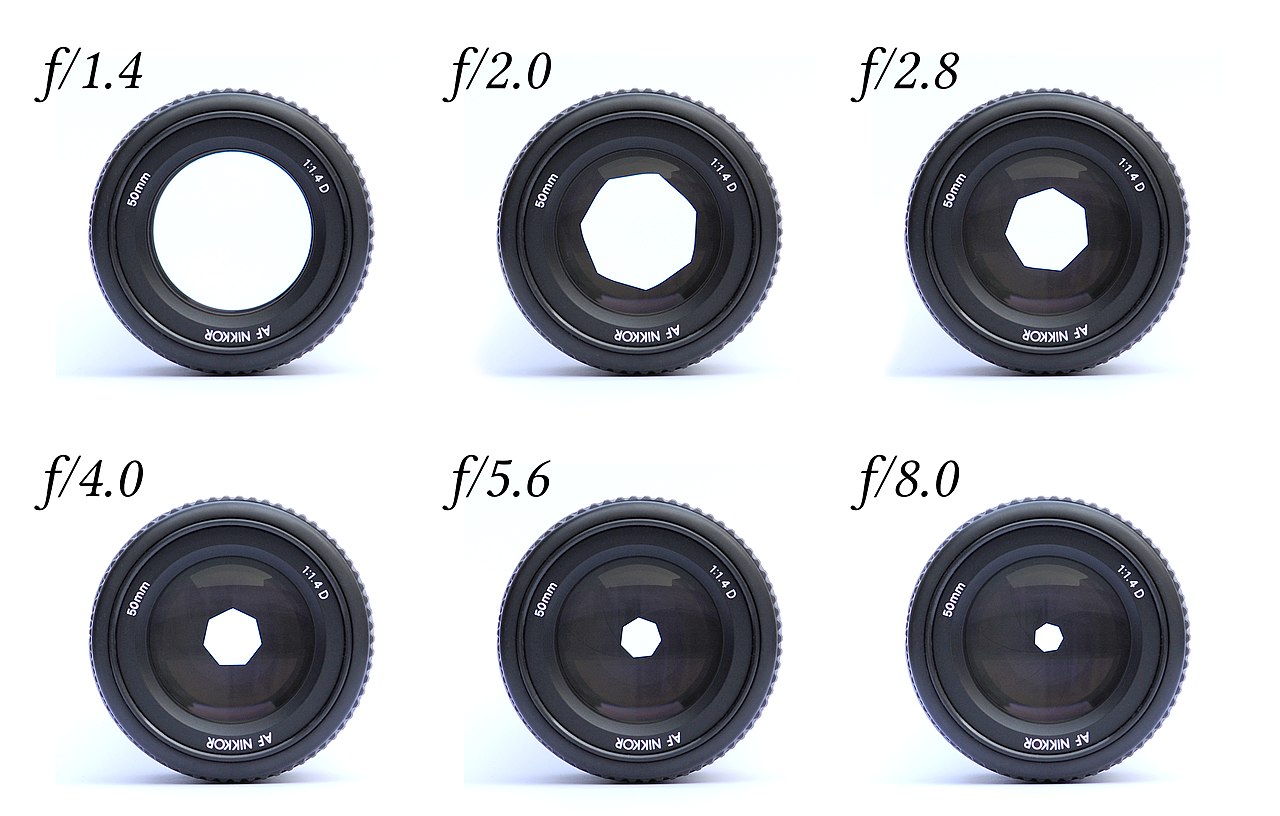
- On full-frame, treat f/11 as a sensible ceiling — go smaller only when you genuinely need the depth of field.
- On APS-C and Micro Four Thirds, consider f/8 your practical limit.
- If you need both deep depth of field and pixel-level sharpness, focus-stack instead of stopping down further.
Some cameras offer in-camera “diffraction compensation,” which applies sharpening tuned to the f-number. It can mask mild softening, but it can’t recover detail the sensor never resolved in the first place.
Conclusion
Diffraction isn’t something to fear — it’s something to respect. Know where your sensor hits its diffraction limit, and you’ll stop guessing when to stop down. The goal isn’t the smallest aperture or the widest; it’s the sharpest aperture for the shot you’re actually taking.
FAQ
At what aperture does diffraction become visible?
Roughly f/11 on a 24 MP full-frame camera, around f/8 on 45–61 MP full-frame, and f/5.6–f/6 on APS-C and Micro Four Thirds. It’s a gradual onset, not a sudden cutoff.
Does diffraction depend on the lens or the camera?
The Airy disk size depends only on the f-number and the wavelength of light, so it’s identical for any lens. Whether you can see it depends on your sensor’s pixel size — higher megapixels reveal it sooner.
Can I fix diffraction in post-processing?
Sharpening and AI tools can restore some apparent contrast, but they can’t recover detail the sensor never resolved. The real fix is choosing the right aperture before you press the shutter.
Related Posts

Expose to the Right (ETTR): How to Get Cleaner, Less Noisy Photos
Every photographer wants less noise and more detail in the…
The Exposure Triangle Explained: Aperture, Shutter Speed, and ISO
Photography comes down to one thing: light. Every photo you…

Hyperfocal Distance Explained: How to Get Everything Sharp in Landscape Photography
Every landscape photographer hits the same wall: you want the…